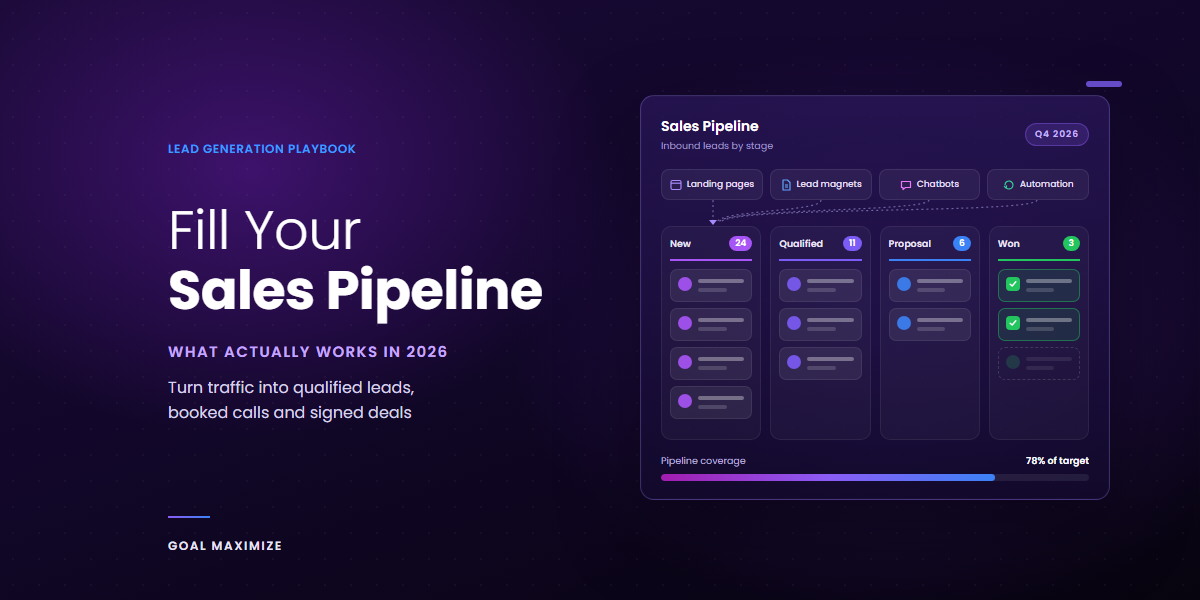
Most lead generation advice you read this year is recycled from 2019 with a chatbot bolted on. It talks about “top of funnel awareness plays” and “nurture cadences” as if the buyer has not fundamentally changed. The buyer has changed. Search behavior is different, ad costs are 3 times what they were, form fills are down across almost every category we track, and the average B2B deal now involves 11 stakeholders before a signature. If you are running the same lead gen motion you ran 2 years ago and wondering why the pipeline looks thin, this is why.
This playbook is the second pillar in our Lead Gen & Conversion cluster, and it exists because we kept getting the same question from clients in Q1 and Q2: what actually works right now? Not what worked in 2022. Not what a LinkedIn influencer says works. What we are seeing move real revenue for real companies across B2B lead generation and B2C lead generation, in industries from SaaS to home services to enterprise IT staffing.
I am going to be opinionated here. Some of these takes will annoy people who sell tools that do the opposite. That is fine. If you want a neutral, hedged, everyone-gets-a-trophy overview, plenty of other blogs will oblige. This is a working document based on what we run for our own clients through our sales lead generation service, and it links out to every deep dive in our cluster and the broader Digital Marketing Services pillar when you want to zoom out.
Let’s get into it.
What Lead Generation Actually Means in 2026
Lead generation is the process of turning a stranger who has never heard of you into someone who has raised a hand, given you a way to contact them, and signaled some level of intent to buy what you sell. That is the whole definition. Everything else, all the frameworks and stages and TOFU MOFU BOFU acronyms, is scaffolding built on top of that core act.
What changed is the cost and difficulty of each step. Getting the stranger’s attention now costs 4 to 6 times what it did a decade ago on paid channels. Getting them to raise a hand requires a much stronger offer because they have been burned by 200 whitepapers that were 3 pages of fluff. Getting them to signal real intent requires you to remove friction most companies have not touched since they built their site in 2018.
Good lead generation strategies in 2026 accept these constraints instead of pretending they do not exist. They spend more time on the offer and the page and less time on volume. They treat every form field as a tax. They assume the prospect has already looked you up on 3 review sites before they clicked. They build for a world where the buyer is skeptical, informed, distracted, and comparing you to 5 competitors in an open tab.
If your current motion assumes a patient, uninformed buyer who fills out a 12-field form because your logo looks nice, that motion is done. It just has not fallen over yet.
The Two Big Camps: B2B Lead Generation vs B2C Lead Generation
Before we get into tactics, the split matters because the same tactic run for the wrong audience produces garbage leads and wastes budget.
B2B lead generation is about identifying accounts, mapping stakeholders, and generating repeated touches with people who are researching a problem your product solves. Deal sizes are larger, sales cycles are longer, and the “lead” is really a signal that a buying committee inside a company is starting to look. Volume matters less than fit. One qualified lead from a 5000 person company evaluating a platform can be worth 2000 unqualified freebie downloads.
B2C lead generation is about capturing intent from individual consumers at the moment they are ready or close to ready. Deal sizes are smaller, cycles are shorter, and volume is often the whole game. The tactics that generate B2C leads well (short mobile-first forms, click-to-call, aggressive retargeting, discount-driven magnets, SMS follow-up) are often terrible for B2B, where the same aggressive follow-up burns your brand with a CFO.
The mistake I see most often is companies trying to run a B2C style motion for a B2B product because the metrics look better in the short term. You get more form fills, sure. They are just not from anyone who will ever buy. If you want a deeper breakdown of the B2B specifics, our post on account-based marketing versus inbound covers where each fits. For the consumer side, B2C lead capture on mobile has the field-by-field breakdown.
For the rest of this playbook, I will call out which side of the split each tactic favors so you do not have to guess.
Landing Pages That Convert (And Why Most Do Not)
Your landing page is where every other lead generation activity either pays off or dies. You can have the best ad, the best email, the best organic ranking, and still lose 90 percent of the visitors you send because the page they land on is confused.
Here is what a landing page that converts in 2026 looks like.
One offer. Not 3 offers. Not a “learn more” and a “book a demo” and a newsletter signup and a chat widget all fighting for attention. One thing you want the visitor to do, and every element on the page pushes them toward it. If you cannot delete an element without hurting conversion, keep it. If you can, delete it.
The headline names the specific outcome the specific person came for. Generic headlines like “Scale Your Business With Our Platform” are dead. Something like “Cut your SDR ramp time from 90 days to 21” makes the visitor feel like the page was written for them because it was. Segment your traffic and write different pages for different segments. A landing page targeting operations directors at logistics companies should not look identical to one targeting marketing VPs at fintechs, even if the underlying product is the same.
Social proof above the fold. Not a wall of logos with no context. 1 specific quote from 1 real person at 1 recognizable company, with a photo and a title. That single quote outperforms 30 grey logos in almost every test we run.
The form is as short as you can possibly make it and still qualify the lead. For most B2B offers, that is name, business email, and company. For most B2C offers, that is a phone number or an email. Every field you add beyond the minimum costs you conversions in a way that has been measured to death. Please stop asking for job title, company size, timeline, budget, and preferred contact method on your first touch form. You are not qualifying anyone. You are just repelling half your traffic.
Page speed still matters, and it matters more on mobile than most teams realize. If your page takes 4 seconds to load on a mid-range Android on a 4G connection, you have lost 40 percent of the people who clicked before they saw anything. Test on real devices, not just Lighthouse on your laptop.
For the deeper mechanics, we broke this down further in landing page structure that converts. If you are running paid traffic, also read our take on conversion rate optimization for paid landing pages in the CRO cluster.
Sales Funnels: Fewer Stages, Better Stages
The funnel diagram every consultant draws with 7 stages and a nurture loop and a scoring model is theater. Most companies do not need 7 stages. They need 3 or 4 stages that actually reflect how their buyer moves, and instrumentation that tells them where people drop out.
A working funnel in 2026 has these parts, and not much more.
Awareness. Someone learns you exist through a channel you can measure. That might be organic search, paid social, a podcast placement, a referral, or content shared by a colleague. If you cannot answer “how did this person first hear about us” you cannot optimize the top of the funnel. Our attribution basics post in the analytics cluster covers what to instrument.
Engagement. The person does something that indicates interest beyond a single page view. They read 3 pages, they subscribe, they follow you, they attend a webinar, they download something. This is where lead magnets and content offers earn their keep.
Conversion. The person raises a hand in a way that lets sales or your product take over. Form fill, demo request, trial signup, phone call, in-store visit. This is where the landing page and the offer do the work.
Close. The person becomes a customer. In B2B, this is where sales runs a real process. In B2C, this is often automated inside the product or checkout.
If your current funnel has stages like “MQL,” “SAL,” “SQL,” “opportunity,” “closed won,” you are not describing the buyer’s journey. You are describing your internal handoffs. That is fine for reporting, but do not confuse the internal Kanban with what the buyer is actually doing. Optimizing internal handoffs will not move revenue. Optimizing where buyers actually get stuck will.
The stages you obsess over should be the ones with the biggest drop-off. If 90 percent of trial signups never activate, that is your funnel problem. Not your MQL to SQL conversion rate. Look at where you lose the most people and fix that first. This sounds obvious. Almost nobody does it.
Conversion Rate Optimization: What Actually Moves the Needle
CRO has a reputation for being about button colors and headline tests. That reputation is 15 years old and still not accurate. Real CRO in 2026 is about 3 things.
Reducing friction on the actions you already want people to take. This means removing form fields, cutting page load time, killing distracting elements, and making the primary CTA impossible to miss on both desktop and mobile. Small mechanical improvements to friction produce most of the CRO gains we ever see. If you have not sat down with a stopwatch and tried to complete your own primary conversion action on a phone in the last 6 months, do that before you do anything else.
Matching intent at the page level. The person landing on your page came from somewhere with a specific expectation. If your ad promised “free SEO audit” and your page opens with “Welcome to our full service marketing agency,” you have broken the promise, and you will lose them. Every entry point to your site should land on a page that continues the conversation the entry point started. Our message match guide has the specifics.
Removing dead ends. Look at your site analytics for pages where sessions end without any conversion action. These are dead ends. Some of them are supposed to be dead ends (thank you pages, for example). Most are not. A blog post that gets 2000 visits a month and generates 0 leads is not a lead generation asset. It is a traffic asset that could be a lead generation asset with a relevant CTA, a content upgrade, or an exit intent offer that matches the topic. This is a place where SEO and lead gen have to talk to each other. See our SEO to lead gen bridge post in the SEO cluster for how we tie these together.
What does not move the needle in 2026: button color tests, hero image A/B tests on low-traffic pages, headline tests that take 8 weeks to reach significance and then get overwritten by the next redesign. If your traffic does not support statistical significance on a test in 2 weeks, you are not doing CRO. You are doing HiPPO with extra steps.
Lead Magnets That Are Actually Worth Downloading
The lead magnet as a category has been abused into uselessness. Every SaaS company has a “state of the industry” report that is 22 pages of stock photos and 2 useful charts. Nobody reads them. The download-to-actual-engagement rate is often below 5 percent. Sales calls the “leads” and gets ghosted because the person just wanted the chart and had no interest in your product.
A lead magnet worth trading your email for in 2026 does 1 of 3 things.
It solves a small, specific, immediate problem the person has right now. A calculator that tells a marketing director exactly how much their current MarTech stack is overspending. A template that lets an ops manager map their current process in 15 minutes. A checklist that helps a small business owner audit their Google Business Profile in an hour. Small, specific, immediate. Not “the ultimate guide to.” The ultimate guide to anything is a blog post now. Put it on the blog and rank for it.
It gives access to something exclusive that the person could not get anywhere else. A benchmark report using data you actually own, not scraped from public sources. A recorded workshop with a well-known practitioner. A private community with real activity, not a Slack that has 400 members and 3 messages a week.
It provides an interactive experience the person cannot self-serve. An assessment that scores their current situation against a benchmark and gives specific recommendations. A grader tool that runs an audit on their site and returns a real report. A 20-minute strategy call with someone senior enough to give them something they can use even if they never buy.
Notice what none of these are. None of them are a PDF that is a table of contents followed by 15 pages of AI-generated fluff. If you would not download it yourself and read it, do not ask your prospect to. Our lead magnet audit template walks through how we grade existing magnets before we help clients kill the ones that are not pulling their weight.
For B2C, the equivalent is often a discount code, a free sample, a shipping upgrade, or entry to a giveaway. These are still magnets. They are just calibrated to what a consumer values, which is money and time, not thought leadership.
Retargeting: Do Less of It, Better
Retargeting is where most companies waste the largest share of their paid budget. The default setup is: cookie everyone who visited any page, show them the same 3 banner ads for 30 days, wonder why the frequency capping is broken and 1 person saw the ad 47 times.
Retargeting that works in 2026 does 4 things differently.
It segments by intent. Someone who visited your pricing page twice is not the same person as someone who bounced off a blog post. Do not show them the same ad. Split your audiences by page category and time recency, and write different creative for each. Pricing page visitors get a demo request offer. Blog readers get a related content offer or a magnet. Cart abandoners get the specific product they left, with either a scarcity signal or a small incentive if margin allows.
It has a real frequency cap that is enforced across channels. If your Google, Meta, and LinkedIn retargeting are all running independently, your total frequency is way higher than any individual platform reports. Cap at 3 to 5 exposures per week across the total mix, not per channel.
It has an exit rule. Anyone who converts drops out of the retargeting pool immediately. Anyone who has been in the pool for 30 days without converting drops out. Do not keep chasing people who have made their decision.
It matches the creative to the funnel stage. Retargeting a cold blog reader with a “book a demo” ad is a waste. That person is 4 steps away from wanting a demo. Retarget them with something one step closer to the conversion you actually want, like a magnet or a case study. Retargeting is a sequence, not a single ad.
For the paid mechanics, we go deeper into retargeting sequences for B2B and, if you are running e-commerce, dynamic product retargeting done right.
Marketing Automation Without the Robotic Feel
Automation is a force multiplier when it is set up around real buyer behavior and a disaster when it is set up around your convenience. The number of “welcome sequences” I have received this year that greet me with a 6 email drip pitching products I never expressed interest in is embarrassing to the whole field.
The rules for automation in 2026, if you want it to actually help lead generation instead of hurting it.
Trigger on behavior, not on time alone. A 5-email nurture that fires on days 1, 3, 5, 7, and 10 no matter what the person does is a broadcast, not automation. Trigger the next email based on what the person opened, clicked, or viewed. If they went silent, slow down. If they visited pricing, speed up and change the content.
Segment aggressively. Different segments get different sequences. If your automation platform is sending the same welcome sequence to a solo consultant and to a VP of engineering at a Fortune 500, both of whom filled out the same form, you are wasting both of them. It is worth 2 weeks of setup to get this right once.
Write like a human, from a human, replying to a real person. The best-performing automated emails we ship for clients look like a hand-typed reply from a founder or account executive, 3 or 4 lines long, with a specific question at the end. Not a template with a header image and 4 CTAs. Response rates on the plain-text-looking automations are often 5 to 10 times higher.
Instrument the unsubscribes. If a specific email in a sequence causes a spike in unsubscribes, that email is doing damage. Fix it or cut it. Most teams never look at per-email unsubscribe rates. Look at yours this week.
Automation is also where lead gen touches CRM, and CRM is where deals go to die. Our CRM hygiene for lead gen post covers the minimum viable setup that prevents leads from disappearing into a black hole between marketing and sales.
Chatbots and Conversational Lead Generation
The chatbot conversation shifted meaningfully in 2025 and 2026. The old rules-based bots that made everyone hate chat widgets are being replaced by LLM-powered agents that can actually answer questions, qualify visitors, and hand off to a human when the question gets real. This is one of the few areas of lead gen where the technology genuinely moved forward in a way that matters.
The catch: most companies are deploying these badly and generating a new class of frustrated visitors.
What works. A conversational agent that has been trained on your actual documentation, pricing, and product details, that can answer 80 percent of top-of-funnel questions without a form, and that offers a human handoff for the other 20 percent. This kind of bot removes friction and captures intent from people who would have bounced rather than fill out a form.
What does not work. A bot that opens with “Hi! Can I help you today?” 3 seconds after you land, asks for your email before it tells you the price, and then routes you to a form when you finally ask a specific question. This is a form with extra steps and the visitor knows it. Kill this pattern.
What to instrument. Track which conversations lead to a qualified conversion and which lead to abandonment. Look at the transcripts of the abandonments. The bot is telling you exactly where your site is failing to answer questions, which is often more valuable than the leads themselves because you can fix the underlying pages.
For B2C, conversational commerce (chat to buy, chat to book, chat to schedule) is genuinely moving revenue in categories where the buying decision is small and fast. For B2B, the bot is usually a qualification and routing layer, not a closing tool. Do not try to close a 6-figure deal in a chat widget.
For a deeper look at what to deploy and what to avoid, conversational lead capture with LLM agents covers the current tooling. Also worth reading: chatbot handoff to sales if you are worried about the moment the bot passes the baton.
Putting It All Together: A 90 Day Rebuild
If you read all of this and are wondering where to start, here is what we actually do when a client hires us to fix a broken lead gen motion. This is compressed from what usually takes a full engagement, but the sequence is right.
Days 1 to 15. Instrument everything. If you cannot see where leads come from and where they die, do not touch anything else. Get analytics, form tracking, call tracking, and CRM stages talking to each other. Kill any dashboard that does not answer a specific question you actually ask.
Days 16 to 30. Audit and cut. Look at every landing page, magnet, ad, email, and automation. For each one, ask: does this drive qualified pipeline? If the answer is no or unclear, pause it. You will free up 30 to 50 percent of your team’s attention immediately.
Days 31 to 60. Rebuild the top 3 highest-traffic entry points. Rewrite the landing pages, tighten the forms, replace the magnets that are not pulling weight, fix the retargeting segments. Do not try to rebuild everything. The top 3 entry points usually account for 70 percent of your addressable pipeline.
Days 61 to 90. Layer in automation and conversational tooling where they clearly help. Set up behavior-triggered sequences on the rebuilt entry points. Deploy a chat agent on your 5 pages with the highest exit rates. Watch the transcripts for 2 weeks and fix what you learn.
Then rinse. Lead generation is not a project you finish. It is an operating system you maintain. The teams that fill their pipelines in 2026 are the ones that have made this maintenance a regular rhythm instead of a periodic panic.
If you want help running this, that is what we do. Our sales lead generation service is built around exactly this playbook, and we start with the instrumentation and audit steps before we sell you any tactics. If you want the broader context of how lead generation fits into a full-stack digital motion, the Digital Marketing Services pillar puts it in place next to SEO, content, and paid.
Frequently Asked Questions
What are the best lead generation strategies for a small business with a limited budget?
Start with the entry points you already have. Fix your top 2 or 3 landing pages, tighten your forms to the absolute minimum, and set up basic behavior-triggered retargeting on visitors who did not convert. Add 1 lead magnet that solves a small specific problem, not a generic ebook. This costs almost nothing and typically doubles the leads you get from your existing traffic before you spend a dollar on new acquisition.
How is B2B lead generation different from B2C lead generation?
B2B focuses on identifying accounts and generating repeated touches with a buying committee. Deals are larger, cycles are longer, and quality matters more than volume. B2C focuses on capturing individual consumer intent at or near the moment of decision, with shorter cycles and much higher volume. The tactics overlap in name (landing pages, ads, magnets) but the calibration is completely different.
Are chatbots actually worth deploying in 2026?
Yes, if they are LLM-powered agents trained on your real content and configured to hand off to a human at the right moment. No, if they are rule-based bots that pop up asking for an email before delivering any value. The difference between a good and bad chatbot deployment is now the difference between a meaningful conversion channel and a source of visitor frustration.
How long should a lead capture form be?
As short as you can make it and still route the lead correctly. For most B2B first-touch forms, that is name, business email, and company name. For most B2C forms, it is a phone number or email. Every additional field costs you conversions in a well-documented way. Qualify further in the follow-up conversation, not on the form.
What is the biggest mistake companies make with lead generation in 2026?
Running the 2019 playbook on 2026 traffic. Buyers are more skeptical, better informed, and more distracted than they were 5 years ago. Ad costs are higher, form fill rates are lower, and the friction that a buyer will tolerate has dropped sharply. Companies that keep the old motion running and blame the numbers instead of the motion fall further behind every quarter.
How do lead generation and SEO work together?
SEO brings the traffic. Lead generation converts it. Most companies treat these as separate functions that report to separate leaders, and the handoff between them is where most of the value leaks out. A blog post that ranks and gets 3000 visits a month but has no relevant CTA, no content upgrade, and no exit intent offer is not doing lead generation work. Every high-traffic page on your site should have a lead capture path tuned to the topic of that page.
Ready to build a pipeline that actually fills in 2026 instead of one that looks busy in a dashboard? Discuss Your SEO Scale Plan and we will walk through the instrumentation, audit, and rebuild steps for your specific setup.

**Shalini Thakur** is an SEO Specialist at Goal Maximize with 9+ years of experience in technical SEO, content strategy, and AI-powered search optimization. Specializes in data-driven SEO strategies, website optimization, content development, and adapting websites to the evolving AI-powered search landscape.