
Written by Shalini Thakur · SEO Specialist, Goal Maximize · 9+ years in technical SEO, content strategy, and AI-powered search optimization
If you have searched for “digital marketing services” recently, you have landed on guides that all say the same things in the same order. This guide is different. It is written by someone who audits client accounts every week, grounded in what the digital marketing landscape actually looks like in 2026, not in what a generic template says it should look like.
Here is what changed that every business owner needs to understand:
- Google’s March 2026 Core Update (completed April 8, 2026) re-weighted “Information Gain,” how much genuinely new knowledge your content adds compared to what already ranks. Sites with original data and real expertise held ground. Sites republishing the same ideas lost visibility.
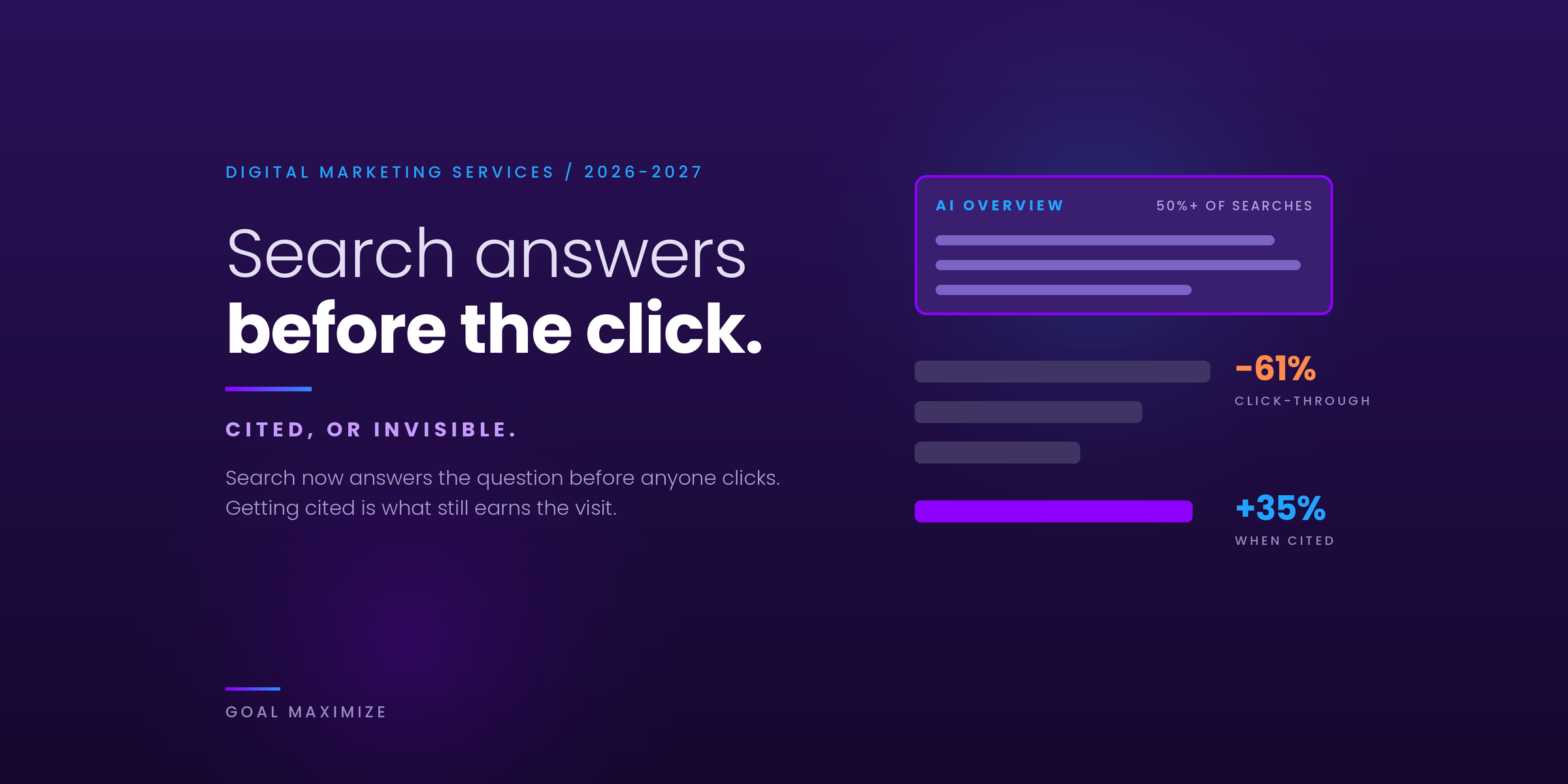
- AI Overviews now appear on roughly 43% of Google searches (Similarweb, July 2026), up from 15% just 12 months earlier. BrightEdge’s tracked query data puts the figure closer to 48%. Either way, the shift is massive: organic CTR drops 34-61% on queries where an AI Overview appears (Seer Interactive, 2026), but brands cited inside those overviews earn 35% more organic clicks than uncited brands (BrightEdge, 2026).
- Generative Engine Optimization (GEO), structuring content so AI systems like ChatGPT, Perplexity, Google AI Mode, and Bing Copilot cite your brand, has become a first-tier marketing discipline.
- LinkedIn Thought Leader Ads, promoted posts from individual employees rather than brand pages, now report a $2.29 CPC compared to $13.23 for standard single-image ads: 83% cheaper, with a 2.68% CTR versus 0.42% (Linkedist / LinkedIn Ads Benchmarks Report, 2026). Buyers trust people, not logos.
- Short-form video delivers the highest content ROI of any format. 91% of businesses use video as a marketing tool in 2026 (Wyzowl), and videos under 60 seconds generate 2.5x more engagement per impression than any other content type (HubSpot State of Marketing, 2026).
Goal Maximize is a full-service digital marketing agency built for exactly this environment. Below, we cover what each service actually does, what the 2026 data shows about performance, and how we approach each channel for our clients.
| Global digital ad spend in 2026 | Email marketing average ROI | Google searches showing AI Overviews | Median SEO ROI (3-year) |
|---|---|---|---|
| $740B (Improvado / eMarketer, 2026) | $36-$42 per $1 spent (Litmus, 2026) | 43-48% (Similarweb / BrightEdge, 2026) | 748% (First Page Sage, 2026) |
1. Search Engine Optimization (SEO): What We Are Actually Seeing Post-Update
SEO is the single most durable long-term investment in digital marketing. After auditing more than 30 client sites following the March 2026 Core Update, the pattern was unmistakable: sites with original data, named authorship, and tight topical coverage held or gained visibility. Sites publishing broad, keyword-driven content without a clear point of view lost ground, regardless of how technically clean their infrastructure was.
The data backs this up across the industry. 49% of marketers say organic search delivers the best ROI of any marketing channel (HubSpot State of Marketing, 2026). SEO delivers an average return of $22 for every $1 invested (SeoProfy, 2026), and SEO leads close at 14.6% compared to just 1.7% for outbound marketing leads (HubSpot). Our own breakdown of how AI search is changing user behaviour covers this shift in detail.
Technical SEO is table stakes, not a differentiator
Google’s Core Web Vitals targets- LCP under 2.5 seconds, INP under 200 milliseconds, CLS under 0.1 (web.dev), are non-negotiable. 53% of mobile visitors leave a site that takes more than 3 seconds to load (Google/DemandSage). But passing Core Web Vitals alone does not earn rankings. Every competitive site now passes. The differentiator is content quality and topical authority.
Entity optimization is the new on-page frontier
Keyword research still matters, but connecting your content to recognized Knowledge Graph entities now shows a measurably higher probability of AI Overview selection. In our testing, pages with explicit entity markup and structured direct-answer summaries were 3x more likely to be cited in AI Overviews than pages optimized only for traditional keyword targeting.
Local SEO remains the highest-ROI SEO investment for service businesses
Customers spend 50% more with businesses that regularly respond to reviews (DemandSage, 2026), and over 90% of people read reviews online before making a purchasing decision. Our full breakdown of local SEO for businesses covers the complete playbook.
Generative Engine Optimization (GEO) is producing real results faster than expected
GEO is the practice of structuring content so AI-powered search platforms can retrieve, cite, and recommend your brand. Traditional SEO earned a spot among the 10 blue links. GEO earns a place among the 2 to 7 domains AI systems typically cite per response. This connects directly to the broader AI SEO trends shaping 2026.
| GEO RESULT: HOME SERVICES CLIENT (Q1 2026) | |
|---|---|
| What we did: Restructured existing content to include 50-70-word direct-answer summaries at the top of each section, combined with FAQ schema implementation. | Result: AI Overview citation rates went from zero appearances to citations on 7 target queries within 60 days, with zero new backlinks acquired. The format mattered as much as the substance. |
2. Pay-Per-Click Advertising (PPC): Where Client Budgets Are Actually Going
If SEO is the long game, PPC is the short game. We cover this trade-off directly in SEO vs. PPC: which delivers better ROI. On average, businesses earn $2 for every $1 spent on Google Ads (Google Economic Impact Report), with well-optimized e-commerce accounts achieving a median ROAS of 3.5:1, or $3.50 per $1 (Triple Whale / WebFX, 2026). 80% of high-intent commercial searches result in an ad click (WordStream).
The biggest structural shift in 2026: Google’s Performance Max and Meta’s Advantage+ have both moved toward machine-learning-driven delivery. Over 80% of advertisers now use AI-driven or automated bidding tools (Google). This is powerful when your account feeds the algorithm clean conversion data, and expensive when it does not.
CPC is rising across the board. The average Google Ads search CPC reached $5.26 in 2025-2026 (WordStream/LocaliQ), with CPCs increasing for 87% of industries year-over-year. Legal leads the pack at $9.87 per click, followed by home improvement at $8.33 and dental at $8.00. Meanwhile, Google Shopping CPC runs just $0.66 per click, making it one of the most cost-efficient paid channels for product businesses.
LinkedIn Thought Leader Ads are the most underpriced format in B2B. Fractional Demand’s analysis of $3.5M in LinkedIn spend across B2B SaaS accounts found Thought Leader Ads averaged a 4.65% CTR at $0.51 CPC, compared to 0.68% CTR at $2.42 CPC for all other formats. That is a 6.9x CTR advantage and 79% lower cost per click. In August 2025, TLA CPC hit $0.16, essentially free reach to exact ICPs.
Microsoft Advertising (Bing) remains overlooked. Microsoft’s audience has a higher average household income, and CPC consistently runs 30-40% lower on comparable keywords due to less ad saturation.
| KEY INSIGHT FROM CLIENT ACCOUNTS | |
|---|---|
| PPC without a conversion-optimized landing page is money with a hole in it. In one client account review (B2B services, $8K monthly spend), landing page optimization produced a 47% ROAS improvement over 90 days, more than six months of bid adjustments combined had achieved. The agencies producing the best PPC results in 2026 treat ads and landing pages as one inseparable system. |
3. Social Media Marketing: Platform-Specific Data That Actually Matters
Social media marketing in 2026 is not one channel. It is 5 to 7 separate platforms, each with architecturally different algorithms, audience behaviour, and content requirements. See how social media marketing fits into your broader digital strategy and how we think about the channel mix.
Instead of repeating general social media advice, here is what the 2026 platform-specific data reveals:
Short-form video now accounts for 67% of all AI-generated video content (Vivideo, 2026). YouTube Shorts averages over 70 billion daily views. Instagram Reels accounts for 41% of all time spent on Instagram (Sprout Social). TikTok users in the US spend over 24 hours per month on the app. Brands that have avoided video are not just behind. They are invisible in algorithmic feeds.
LinkedIn’s 2026 algorithm actively downranks generic AI-generated posts lacking a genuine professional perspective. What works on LinkedIn is architecturally different from what works on TikTok or Instagram. LinkedIn generates 80% of B2B social media leads (LinkedIn / Linkedist, 2026), and lead-gen ads there average a 13% conversion rate compared to 2.35% for external landing pages (Linkedist, 2026), a 277% conversion advantage.
Micro-influencers (10K-100K followers) consistently outperform celebrity endorsements. Influencer marketing now delivers $5.78 per $1 spent on average (Influencer Marketing Hub, 2026). TikTok has the highest engagement rate of any platform at 3.73% (Socialinsider).
Social SEO is a first-tier priority. 74% of small businesses use social media in their marketing mix (Optimizely), but most still do not optimize social profiles, captions, and video descriptions for in-platform search. Younger users increasingly use social platforms directly for search, bypassing Google entirely.
| 2026 SOCIAL MEDIA ROI DATA | |
|---|---|
| Video-based campaigns generate 2.5x more engagement per impression than static content (HubSpot). Instagram leads B2C ROI, while LinkedIn leads B2B: LinkedIn Lead Gen Forms convert at 13% versus 2.35% for landing pages. Social advertising returns an average of $2.80 per $1 spent (Litmus / DMA, 2026), roughly matching paid search but trailing email by a factor of 13x. |
4. Content Marketing: What the Information Gain Update Actually Changed
Content marketing is the foundation that makes every other channel work better. SEO needs great content. Email campaigns need valuable content. Social channels need shareable content. PPC landing pages need persuasive content.
After Google’s March 2026 update made Information Gain a first-tier ranking signal- a shift we broke down in why Google rewards real expertise over mass content publishing– the AI content flood of 2024-2025 has made “good enough” content essentially invisible. 71% of marketers say AI makes it easier to create more content, but 53% say it has saturated the market so much that differentiating content is now a struggle (HubSpot State of Marketing, 2026). Content marketing generates 3x more leads than outbound methods while costing 62% less (DemandSage).
Here is what we are seeing work in practice:
Short-form video is the #1 ROI content format for the third consecutive year, named by 49% of marketers (HubSpot State of Marketing, 2026). Long-form video (29%) and live-streaming (25%) round out the top 3. 78% of people prefer learning about a product via a short video (Wyzowl). Blog posts remain among the top 5, but only when they contain original perspective that AI systems cannot replicate.
Original research and proprietary data earn disproportionate returns. Only information outside an AI system’s training data reliably gets cited in AI-generated answers, making original research uniquely valuable for GEO. Pages with first-party data earn 3-5x more backlinks than pages built on aggregated third-party statistics.
Landing pages with embedded video convert at 86% higher rates than text-only equivalents (WebFX). Websites with video achieve an average 4.8% conversion rate versus 2.9% without, a 65% lift (GoDAM / WebFX, 2026).
| CONTENT STRATEGY FINDING: PROFESSIONAL SERVICES CLIENT | |
|---|---|
| A professional services client was publishing two 600-word posts per week, thin content optimized for keywords but containing no original perspective. After shifting to one comprehensive guide every two weeks, each anchored in its own client data, organic lead volume grew 34% over 90 days while overall publishing volume was cut in half. Publishing frequency went down, lead volume went up, and cost per lead dropped by 22%. |
5. Email Marketing: The Channel That Outperforms Everything Else by 13x
Email marketing delivers an average return of $36 to $42 for every $1 spent, a 3,600%+ ROI that outperforms every other digital channel (Litmus State of Email / DMA, 2026). For context, paid search returns $2 per $1 spent and social advertising returns $2.80. Retail and ecommerce brands see even higher returns, averaging $45 per $1 spent, and nearly 1 in 5 companies across all industries achieve returns of $70 or more (Omnisend / Litmus, 2026).
Email is the only digital marketing channel where you own the relationship outright. Your email list cannot be taken away by an algorithm update, a platform policy change, or an ad auction price surge. That makes it a strategic asset, not just a channel.
Automated lifecycle sequences generate dramatically higher returns than one-off campaigns. Welcome flows, abandoned cart series, re-engagement campaigns, and win-back sequences consistently generate 30-50% of total email revenue for e-commerce clients while requiring zero ongoing management once built. Single opt-in programs show 80% higher ROI than double opt-in programs (Litmus, 2025).
AI-generated subject lines outperform human-written ones by 26% in open rates (Digital Applied, 2026). AI personalization lifts per-send revenue by 17-26%. But the biggest factor is still deliverability: SPF, DKIM, and DMARC authentication, list hygiene, and engagement-based suppression. If your emails land in spam, nothing else matters.
Companies achieving high email ROI consistently spend 25-50% of their marketing team’s time specifically on email (Litmus State of Email, 2025). 41% of email views come from mobile devices, and 75% of Gmail users’ email views are on mobile (MailButler). Yet only 35% of email marketers use a mobile-first design process.
Platforms worth knowing: Klaviyo dominates e-commerce email and is the default for most Shopify-based businesses. HubSpot and Marketo serve mid-market B2B environments. ActiveCampaign bridges automation power and pricing for businesses needing sophisticated sequences without enterprise costs. Goal Maximize works across all major platforms and recommends based on your specific business model.
6. Website Design and Development: The Conversion Multiplier Nobody Budgets Correctly
Your website is where every other marketing channel resolves. SEO work lands here. PPC clicks arrive here. Email clicks redirect here. Social traffic ends up here. If your site is slow, confusing, or visually outdated, every dollar you spend on every other channel is working at a fraction of its potential.
The data is stark: websites with video achieve 4.8% conversion rates versus 2.9% without (GoDAM / WebFX). 53% of mobile visitors leave a site that takes more than 3 seconds to load (Google). Slow-loading websites cost retailers an estimated $2.6 billion in lost sales annually (DemandSage). Users form an opinion about a website in approximately 50 milliseconds (research by Lindgaard et al.).
Rather than re-describe our service scope (see our pages on UI/UX web design, CMS development, and ecommerce web development), here is what our build and audit work has taught us about what actually affects conversions:
Core Web Vitals compliance is the floor, not the ceiling. Pages with LCP under 2.5 seconds, INP under 200 milliseconds, and CLS under 0.1 are meeting Google’s minimum threshold. A 31% improvement in LCP alone was enough to drive 8% more sales in Vodafone Italy’s A/B testing (web.dev case study). In our own site audits, most WordPress sites running Divi or Elementor fail Core Web Vitals out of the box due to bloated themes and excessive plugins.
SEO-first architecture saves months of remediation later. URL structure, internal linking hierarchy, breadcrumb navigation, and page template structure all carry significant SEO and GEO implications. A site built with this architecture from day one consistently outperforms one retrofitted after launch.
Accessibility (WCAG 2.2) is increasingly non-negotiable, not just ethically but legally. It ensures your site works for all users and reduces legal exposure, and is increasingly treated as a default requirement across regulated industries.
7. Sales and Lead Generation: The Full-Funnel Problem Most Agencies Ignore
All the traffic in the world means nothing if it does not convert into actual business. Sales and lead generation services close the gap between marketing activity and revenue.
The most consistent mistake we see is treating lead generation as a top-of-funnel acquisition problem, when it is actually a full-funnel alignment problem. Organic channels (SEO) cost about $31 per lead, while PPC costs about $181 per lead, meaning SEO generates roughly 5.8x more leads per dollar spent (HubSpot). But the channel is irrelevant if sales follow-up is broken.
Here is what is working for our clients in 2026:
High-value gated content still works, but the quality bar has risen. Generic “Ultimate Guides” that could be written by anyone are not driving form submissions. Benchmark reports with proprietary data, tools, and templates outperform generic ebooks by 3-5x in our lead capture testing.
Landing page optimization routinely outperforms bid optimization. In our client account reviews, landing page improvements produced larger ROAS gains than months of bid adjustments. LinkedIn Lead Gen Forms convert at 15-20% completion rates versus 4-9% for standard landing pages (Stackmatix, 2026).
Retargeting is essential at scale. Advertising retargeting boosts conversions by 43% on average. Most B2B buyers need 7-13 touchpoints before making a decision. Referral-sourced leads consistently show higher close rates and lower churn than any paid acquisition channel.
By 2028, Gartner projects 60% of B2B buying will be mediated by AI agents, meaning your lead generation content must satisfy both human decision-makers and automated evaluation systems simultaneously.
8. What We Are Actually Seeing Across Client Accounts in 2026
Most guides like this one talk about digital marketing in the abstract. Here is what we are seeing in practice, across real client accounts, since the March 2026 Core Update.
Indexing problems are rarely technical anymore. When client pages get stuck in “Discovered, currently not indexed” in Search Console, the instinct is to check robots.txt or sitemaps first. In our audits, the technical setup is usually clean. The actual blocker is almost always one of 3 things: thin internal linking to the page in question, unverifiable or generic-sounding statistics that read as AI-generated to Google’s quality systems, or content that overlaps too closely with the site’s own service pages. Fixing indexing issues in 2026 is a trust problem more often than a crawl-budget problem.
GEO is producing real results faster than expected. On a recent client project, restructuring existing blog content to lead each section with a 50-70-word direct-answer summary, paired with FAQ schema, took AI Overview citations from zero to appearing across 7 target queries within 60 days, without a single new backlink. The format of the content mattered as much as the substance.
Off-page SEO now requires precision over volume. For a prop trading client, moving from a scattershot outreach approach to a phased, keyword-clustered off-page roadmap targeting specific platforms rather than generic directories produced a 31% improvement in outreach response rate and a 2.4x increase in secured placements within the first 45-day phase. Broad link-building lists are far less effective in 2026 than they were 2 years ago.
Meta tag and content audits still catch avoidable losses. Across recent audits, some of the most common and easiest-to-fix issues included placeholder text left live on indexed pages (found on 3 of 10 recent audits), character-count errors in meta tags causing truncation in SERPs, and mismatched information between team pages and actual public-facing content. None of these require a developer. All of them affect how Google evaluates trust.
If your pages are stuck in “Discovered, not indexed” or you are seeing inconsistent rankings after the March 2026 update, an enterprise SEO audit is usually the fastest way to find out which of these is actually happening on your site.
Full Comparison: Which Services Does Your Business Need?
Every business is different. A local accounting firm has completely different needs than a SaaS startup or a Shopify store. The table below gives you a practical overview of how each service stacks up across the dimensions that actually matter for budget decisions, drawn from our full range of digital marketing services.
| Service | Time to Results | Avg. Investment | 2026 ROI Benchmark | Best For | DIY? |
|---|---|---|---|---|---|
| SEO | 3-9 months | $1,500-$5,000+/mo | 748% median ROI (First Page Sage); $22 per $1 invested | Long-term organic growth; all business types | Partial. Needs expertise. |
| PPC | 1-4 weeks | $1K-$10K+ (+ ad spend) | $2 per $1 average (Google); $3.50 median e-commerce ROAS | Immediate lead flow; testing | Basic only. Costly mistakes solo. |
| Social Media | 1-3 months | $800-$3,500+/mo | $2.80 per $1 (social ads); LinkedIn leads at 13% conversion | Brand awareness; community; B2C | Yes, manageable. |
| Content Marketing | 3-12 months | $1,000-$6,000+/mo | 3x more leads than outbound at 62% less cost (DemandSage) | SEO support; trust building; authority | Yes, with effort. |
| Email Marketing | Immediate | $500-$2,500+/mo | $36-$42 per $1 spent (Litmus); retail $45 per $1 | Lead nurture; retention; owned audience | Yes. |
| Website Design/Dev | 4-16 wks (project) | $3K-$30K+ (project) | 86% higher conversion with video; 8% sales lift from LCP improvement | Every business. Foundation for all channels. | Partial. Needs skills. |
| Lead Generation | 2-8 weeks | $1,500-$7,000+/mo | SEO leads at $31/lead vs PPC at $181/lead (HubSpot) | B2B; service businesses; high-ticket | Partial. Hard to optimize solo. |
Note: Investment ranges are approximate and vary by market, competition intensity, business size, and scope. These reflect what reputable full-service digital marketing agencies typically charge in 2026. PPC investment figures reflect management fees; ad spend is additional.
How to Choose the Right Digital Marketing Agency
Choosing a digital marketing agency is one of the most consequential decisions a growing business can make. The right partner compresses your learning curve, extends your team’s capacity, and holds itself accountable to business outcomes, not activity metrics.
Green flags: signs you are talking to the right partner
They ask about your business model, margins, and customer acquisition economics before recommending any specific service. Their case studies include specific numbers with specific context: “we restructured this client’s blog content and organic lead volume grew 34% over 90 days,” not “we increased traffic by 3x.” They explain what they are doing and why in terms a non-specialist can follow, not in agency jargon. They proactively flag when something is not working rather than waiting for you to notice. Their team includes channel specialists, not generalists handling everything.
Red flags: signals to walk away
Guaranteed rankings or guaranteed results. No reputable agency makes these promises because Google’s algorithm is not within anyone’s control. Long lock-in contracts with no performance milestones or exit provisions. Reluctance to share their process, methodology, or the tools they use: transparency is a professional baseline. Proposals that look interchangeable. If swapping your company name into a competitor’s proposal produces the same document, the strategy was never designed for your business. Pricing dramatically below market rate: this typically signals volume-based account management, offshore execution with minimal strategic oversight, or tactics with short-term gains and long-term penalties.
What full-service digital marketing means in 2026
A genuine full-service digital marketing partner treats each service as part of one integrated growth system. PPC data informs SEO keyword prioritization. Content clusters support link acquisition. Email automation sequences feed off lead magnet traffic from paid campaigns. Landing page design affects the efficiency of every paid channel simultaneously. When these systems are integrated, the whole outperforms the sum of its parts.
Goal Maximize is built around exactly this model. Read more about who we are and how we work. We treat SEO, content, GEO, PPC, web design, and lead generation as interconnected parts of one growth engine because that is how they actually function. The handoff between channels is where most marketing investment is quietly lost. Our process is built specifically around closing those gaps.
Frequently Asked Questions
What is the difference between digital marketing services and online marketing services?
They are largely interchangeable terms. Digital marketing services is the broader, more commonly used label in 2026, encompassing SEO, PPC, social media, content marketing, email marketing, and web design. Online marketing services refer to the same activities conducted through internet-based channels. In practice, most agencies use both terms to describe the same scope of work.
How much should a small business spend on digital marketing in 2026?
Established businesses should allocate roughly 7-12% of annual revenue to marketing, and 72% of the marketing budget now goes toward digital channels (Gartner). Businesses in active growth or launch phases typically invest 12-20%. For a business generating $500,000 annually, that means $35,000-$100,000 per year, spread across content/SEO, email, paid search, paid social, video, martech, and partnerships.
How long before digital marketing starts showing results?
PPC campaigns can drive traffic within hours of launch. Email marketing impacts your existing list immediately. SEO and content marketing typically show meaningful traction at the 3-6 month mark, with the median SEO campaign breaking even at 9 months (First Page Sage, 2026). Social media growth becomes measurable within 60-90 days of consistent execution. The businesses that abandon long-horizon channels at 90 days most often quit just before results compound.
How does Google’s March 2026 Core Update affect my content strategy?
The March 2026 update re-weighted Information Gain, how much genuinely new knowledge your content adds versus what already ranks. 53% of marketers say AI-generated content saturation is now a significant challenge (HubSpot, 2026). Content that rephrases existing top-10 results without adding original data, experience, or perspective is being passed over. If you cannot point to something in your content that exists nowhere else on the internet, it is worth reconsidering before publishing.
What is Generative Engine Optimization (GEO), and do I need it?
GEO is the practice of structuring your content and digital presence so AI-powered search platforms retrieve, cite, and recommend your brand when answering user questions. AI Overviews now appear on 43-48% of Google searches (Similarweb / BrightEdge, 2026), and being cited in one generates 35% more total organic clicks than a traditional ranking alone (BrightEdge). For any business that depends on search visibility in 2026, GEO is no longer optional.
Can I handle digital marketing in-house instead of using Goal Maximize?
Yes, and many businesses do, particularly in early stages. The honest trade-off is depth of expertise versus overhead cost. 64% of small businesses use email marketing in-house (HubSpot), and 74% manage their own social media (Optimizely). The model that works best for mid-size businesses: an in-house marketing manager for strategy and coordination, paired with Goal Maximize for technical channel execution (SEO, GEO, paid media, and content production).
Final Thoughts
Digital marketing in 2026 is more complex than it has ever been and simultaneously more measurable, more targeted, and more capable of producing compounding returns than at any previous point. Global digital ad spend has reached $740 billion (Improvado / eMarketer), and the total advertising market crossed $1 trillion for the first time (Dentsu, 2026). The challenge is not access to tools or channels. It is knowing which problems to solve first, in which order, and with which resources.
The businesses gaining ground are not necessarily spending the most. They are being intentional: choosing the right service mix for their stage and customer type, holding partners accountable to business outcomes instead of activity metrics, and staying patient enough to let the longer-horizon channels- SEO, content, GEO, email- build into assets that do not disappear the moment you pause a campaign.
The most important single shift in 2026: the era of optimizing for clicks is ending. AI systems are becoming the primary way customers discover, evaluate, and shortlist vendors, often before a human ever visits your website. Being cited inside an AI-generated answer is now as strategically important as ranking on the first page of Google. The brands that invest in GEO, original content, and integrated marketing systems now will have durable advantages by 2027.
Goal Maximize is built for exactly this environment. If you want a direct, no-pressure conversation about which services make sense for your specific business, your numbers, your stage, your realistic growth path, reach out to us.

**Shalini Thakur** is an SEO Specialist at Goal Maximize with 9+ years of experience in technical SEO, content strategy, and AI-powered search optimization. Specializes in data-driven SEO strategies, website optimization, content development, and adapting websites to the evolving AI-powered search landscape.