Ask 5 agencies what an app costs and you get 5 different numbers, with no way to tell why. This guide shows the arithmetic, so you can check it: hours multiplied by an hourly rate for each role, from discovery to testing.
It answers how much it costs to build a mobile app, and it is written for owners and managers who are weighing quotes. If you are still deciding whether to build at all, start with our mobile app development guide or the comparison of mobile app vs website vs PWA.
Quick answer: what a mobile app costs by complexity
Short answer: with a US-based agency team, a simple app costs about $30,000 to $50,000, a medium app $105,000 to $165,000 and a complex app $265,000 to $430,000 or more. Plan for 15% to 20% of the build cost every year after launch. Last reviewed: 3 November 2026.
| Simple | Medium | Complex | |
|---|---|---|---|
| What it looks like | 5 to 8 screens, email login, content or bookings, push notifications, 1 or 2 services | 15 to 25 screens, user roles, payments, chat or maps, admin dashboard, 3 to 5 integrations | 30+ screens, real-time features, marketplace or fintech logic, offline sync, strict security |
| Planning hours | 350 | 1,190 | 3,060 |
| Estimated cost, US-based team | $30,000 to $50,000 | $105,000 to $165,000 | $265,000 to $430,000 |
| Elapsed time | 2 to 3 months | 4 to 7 months | 8 to 12 months or more |
| Yearly upkeep (15% to 20%) | $5,600 to $7,400 | $19,300 to $25,700 | $49,800 to $66,400 |
These figures are not quotes from past projects. They come from a model you can reproduce: hours for each line item, multiplied by a blended hourly rate for the role. Every hour and rate is in the line-item table below, so you can swap in the numbers from your own quotes. The range runs from hours 20% lower to 30% higher, because unclear scope is the biggest unknown.
What a published survey says
Clutch says in its App Development Pricing Guide (page updated 21 September 2026, read on 3 November 2026) that the projects it reviewed typically cost $10,000 to $49,999, with an average of $90,780 and an average timeline of about 11 months. Clutch does not publish its sample size or a split by app complexity. The gap between the typical bracket and the average suggests that a few large projects pull the average up.
Use it as a sanity check. Our simple tier overlaps the top of Clutch’s typical bracket, and our medium and complex tiers sit in the $50,000 to $199,999 and $200,000 and up brackets it also lists.
What drives the price
Five things move a quote the most. Most are decisions you can still change.
Features and integrations
Every feature adds screens, back-end work and test cases. The ones that cost more than they look are payments, chat between users, maps and live location, video, offline sync and admin dashboards.
Integrations depend on the other system. A well-documented API is the cheap case, while a legacy system with no API can cost more than the feature it powers. Write features as must-have, should-have and could-have before you ask for quotes. Our app requirements document template shows how.
Platforms (iOS, Android, cross-platform)
Neither platform is meaningfully cheaper to build for. The cost difference comes from how you build, not which phone you target.
- Cross-platform (1 codebase): a framework such as React Native or Flutter runs on both. Our model assumes this.
- Native (2 codebases): separate iPhone and Android apps, which costs more but gives the deepest access to each phone.
Here is the arithmetic on our Medium app. Cross-platform front end is 380 hours. Two native builds add about 220 front-end hours (220 x $120 = $26,400) and 60 QA hours (60 x $75 = $4,500). That is $30,900 more, or 24% of the $128,400 base. The extra hours are our assumption, so ask each vendor for theirs.
Android needs testing across more device makers and screen sizes, while iOS has fewer devices to cover. Both stores review apps before release: Apple says every app is reviewed, and Google sends changes for review too. If you launch on 1 platform first, check the operating-system report in your analytics. See our iOS app development and Android app development pages, and our guide to choosing an app stack.
Design depth
A clean design built from standard components is faster than a fully custom one with animations, illustrations and a new design system. In our model, design runs from 50 hours for a simple app to 320 for a complex one. Cutting design rarely saves money for long, because unclear screens turn into rework during the build.
Backend and APIs
The part users never see is a large share of the bill. In our model the back end is 29% of the Medium cost and 34% of the Complex cost. It covers accounts, data storage, business rules, admin tools and connections to other systems. A backend-as-a-service can cut custom work on a simple app, but it adds a monthly fee that grows with usage.
Team model: in-house vs agency vs freelancer
| Option | How cost behaves | Works best when | Main risk |
|---|---|---|---|
| In-house team | Salaries, benefits and hiring time, whether or not you are building | The app is your core product and you will keep building for years | Slow to hire, and expensive if the work dries up |
| Agency | Higher hourly rate that includes project management and QA | You need a full team for a defined project | Scope gaps, so insist on an itemized estimate |
| Freelancer | Lowest rate for one skill | The scope is small and well defined | One person is a single point of failure, and you manage the work |
US-based or a lower-rate region? For mobile app development cost in the USA, we use the rate card in the line-item table below. A lower hourly rate is not the real risk. A lower number of hours is. The table applies an assumed $45 blended rate to the same hours as our US model, then adds 25% more hours for rework and communication.
| App | US-based team | $45/hr, same hours | $45/hr, 25% more hours | Saving after the allowance |
|---|---|---|---|---|
| Simple | $37,050 | $15,750 | $19,688 | $17,362 (47%) |
| Medium | $128,400 | $53,550 | $66,938 | $61,462 (48%) |
| Complex | $331,900 | $137,700 | $172,125 | $159,775 (48%) |
Even with the allowance, the lower-rate quote is about half the price on paper. It only loses if the work takes more than 2.4 times as many hours. The risk is elsewhere: vague scope, no independent QA, code you do not own and a team you cannot reach during your working day. A quote at a quarter of the others is more likely to reflect fewer hours than a lower rate. Ask for hours by role, repository access from day 1 and code ownership in the contract. Our guide to choosing an app development company and our questions to ask before choosing an agency help here. The second was written for marketing agencies, but most of the questions apply to app vendors too.
Line-item cost breakdown: hours times rate
The formula is simple: cost = hours x hourly rate, added up across every role. This table is the whole app development cost breakdown behind the quick answer.
| Line item | Simple | Medium | Complex |
|---|---|---|---|
| Discovery and scoping Business analyst, $100/hr |
20 h, $2,000 | 50 h, $5,000 | 120 h, $12,000 |
| UX and UI design Product designer, $95/hr |
50 h, $4,750 | 140 h, $13,300 | 320 h, $30,400 |
| Front end (the app itself) Mobile developer, $120/hr |
140 h, $16,800 | 380 h, $45,600 | 900 h, $108,000 |
| Back end and APIs Back-end developer, $125/hr |
40 h, $5,000 | 300 h, $37,500 | 900 h, $112,500 |
| QA and testing QA engineer, $75/hr |
60 h, $4,500 | 200 h, $15,000 | 520 h, $39,000 |
| Project management Project manager, $100/hr |
40 h, $4,000 | 120 h, $12,000 | 300 h, $30,000 |
| Total | 350 h, $37,050 | 1,190 h, $128,400 | 3,060 h, $331,900 |
- Discovery and scoping: workshops, user flows, technical choices and a ranked feature list. Skipping it is a common false saving.
- UX and UI design: wireframes, visual design and a clickable prototype you can test with real users.
- Front end: building the screens and connecting them to the back end.
- Back end and APIs: accounts, data, business rules, admin tools and integrations.
- QA and testing: functional testing, device and operating-system coverage, and regression checks before each release. Our app testing and quality assurance service covers what this involves.
- Project management: planning, demos, reviews and the release itself.
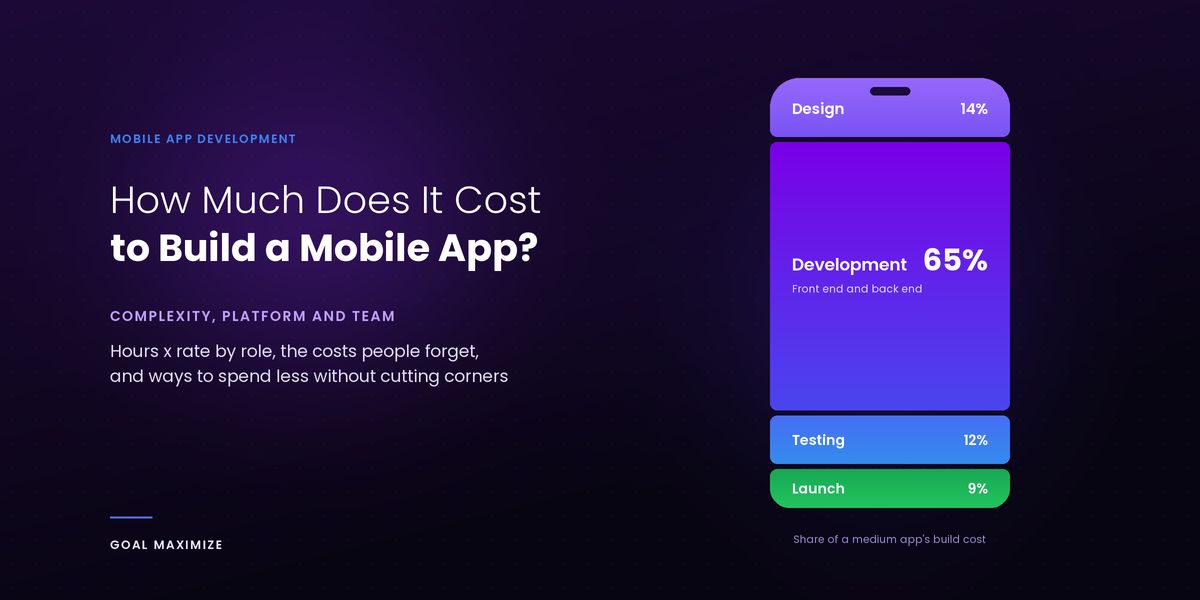
No single line dominates. In the Medium tier the front end is 36% of the cost, the back end 29%, QA 12%, design 10%, project management 9% and discovery 4%.
A simple mobile app cost calculator you can run yourself
- List your must-have features and group them into screens.
- Estimate hours for each of the 6 line items. Ask 2 or 3 vendors for theirs and compare.
- Multiply each line by the rate for that role.
- Add the lines. If scope is not yet written down, budget at the high end of our range, which is 30% above the base.
- Add the costs people forget, covered next, and yearly upkeep.
Costs people forget
Most quotes cover the build only. Check that each item below is either included or budgeted separately.
Store fees and accounts
- Apple: the Apple Developer Program costs $99 a year.
- Google: a Play Console account has a US$25 one-time registration fee. Google also requires personal accounts to complete app testing before an app can go live, which can add time before launch.
- Commission: if your app sells digital goods through Apple In-App Purchase, Apple takes a commission. The Small Business Program lowers it to 15% for developers who earned up to $1 million in proceeds in the prior calendar year.
We checked these pages on 3 November 2026, and fees change, so check them again before you budget. Register both accounts in your own business name, not the agency’s, so you own the app and its reviews.
Hosting, third-party services, compliance
- Hosting and database: a monthly cost that grows with users and data.
- Third-party services: push notifications, SMS, email, maps, analytics and crash reporting are often priced by usage. Payment processors take a fee on each transaction.
- Legal and compliance: a privacy policy and the data disclosures both stores ask for, which are Apple’s App Privacy details and Google’s Data safety form. Health data (HIPAA in the US), card payments (PCI DSS) or EU users’ data (GDPR) add security and legal work.
- Launch work: data migration, content, store listing assets and any paid promotion.
Maintenance after launch
How much does it cost to maintain an app each year? Budget about 15% to 20% of the build cost. That rule of thumb is repeated across agency guides, such as Cubix and Space-O, but neither cites a study for it, so treat it as a planning figure.
The arithmetic on our Medium example: $128,400 x 15% = $19,260 and x 20% = $25,680. That is roughly $1,600 to $2,100 a month.
- Covered: updates for new iOS and Android releases, bug fixes, security patches, library updates, hosting and monitoring.
- Not covered: new features, redesigns and support for new integrations. Those are new projects.
Skipping upkeep is not free. Both platforms ship major operating-system updates every year, and an app that is not updated can start to break on new versions.
How to lower the cost without lowering quality
Cut scope, not testing or discovery. The savings come from building less at first, not from building it badly.
- Ship an MVP. Pick 1 user type and 1 core journey. As an example, removing in-app chat from our Medium app (80 front-end, 60 back-end and 40 QA hours) saves $20,100, about 16% of the build. The hours are our assumption.
- Release in phases. Launch the core, watch what people use, then fund the next release from real data.
- Use standard components. Platform-native patterns are faster to build and familiar to users.
- Buy, do not build. Use proven services for sign-in, payments and push notifications.
- Write the requirements first. A clear app requirements document means vendors add less contingency to cover what they cannot see.
- Check you need an app. If the job is content, forms or bookings, a website or PWA may do it. .
Do not cut QA to hit a budget. Bugs found after launch are harder to fix quietly and can hurt your store ratings.
How to compare quotes
A good estimate lets you see the arithmetic. A quote that is 1 number on 1 line cannot be compared with anything.
| A good estimate lists | Why it matters | Red flag |
|---|---|---|
| Hours and rate for each role | You can compare like with like | A single lump sum |
| Scope and written exclusions | Shows what is not included | No exclusions listed |
| Platforms and the devices and OS versions tested | Drives QA hours | “All devices” with no list |
| Third-party services and who pays for them | Avoids surprise monthly bills | Not mentioned |
| Code, design and store-account ownership | Lets you change vendor later | Vendor keeps the repository |
| Bug-fix warranty and upkeep terms | Defines what happens after launch | No warranty period |
| Milestones and payment schedule | Ties payment to delivered work | Most of the fee paid upfront |
| Assumptions, such as rounds of design revision | Shows where cost can grow | No assumptions stated |
Send every vendor the same brief. Our app requirements document template is a good start, and choosing an app development company covers how to shortlist. When you are ready, our mobile app development services page explains how we work.
FAQs
How much does a simple app cost?
In our planning model, a simple app costs about $30,000 to $50,000 with a US-based team, built from about 350 hours. That covers around 5 to 8 screens, email login, push notifications and 1 or 2 third-party services, on 1 cross-platform codebase. A lower-rate team may quote less for the same scope. Clutch’s pricing guide says most projects it reviewed cost $10,000 to $49,999, which overlaps the top of this range.
How much does an app cost per year to maintain?
Plan for about 15% to 20% of the build cost each year. That is a rule of thumb repeated across agency guides, not measured data. On our Medium example, it comes to $19,300 to $25,700 a year. It covers operating-system updates, bug fixes, security patches, hosting, and monitoring. New features are extra.
Is Android cheaper than iOS?
Not by enough to decide on. A single-platform build costs about the same on either, because the screens, back end, and testing are similar work. Android usually needs testing across more device makers and screen sizes, while iOS has fewer devices to cover. Both stores review apps before release. The bigger saving comes from building both on 1 cross-platform codebase: in our Medium example, 2 separate native builds cost about $30,900 more.
How long does it take to build an app?
As a planning range, a simple app takes 2 to 3 months, a medium app 4 to 7 months and a complex app 8 to 12 months or more. Those are our own estimates, and unclear scope is the usual cause of delay. Clutch reports an average of about 11 months for the projects it reviewed.
Want an estimate that shows its arithmetic? Bring your feature list and book a free consultation. We will go through the hours by role with you.

**Shalini Thakur** is an SEO Specialist at Goal Maximize with 9+ years of experience in technical SEO, content strategy, and AI-powered search optimization. Specializes in data-driven SEO strategies, website optimization, content development, and adapting websites to the evolving AI-powered search landscape.