
A mid-sized ecommerce brand hired a marketing agency last year after a single Zoom call. The slides looked sharp. The founder spoke with conviction. Phrases like “proprietary growth framework” and “data-driven methodology” filled the proposal. Four months in, that founder had vanished from the picture. A junior coordinator was running campaigns solo, and the only measurable result was a pile of blog posts nobody read. That brand is far from alone. A 2026 study by Focus Digital found that delivery dissatisfaction is now the leading reason clients leave their agency, cited by 48% of departing clients.
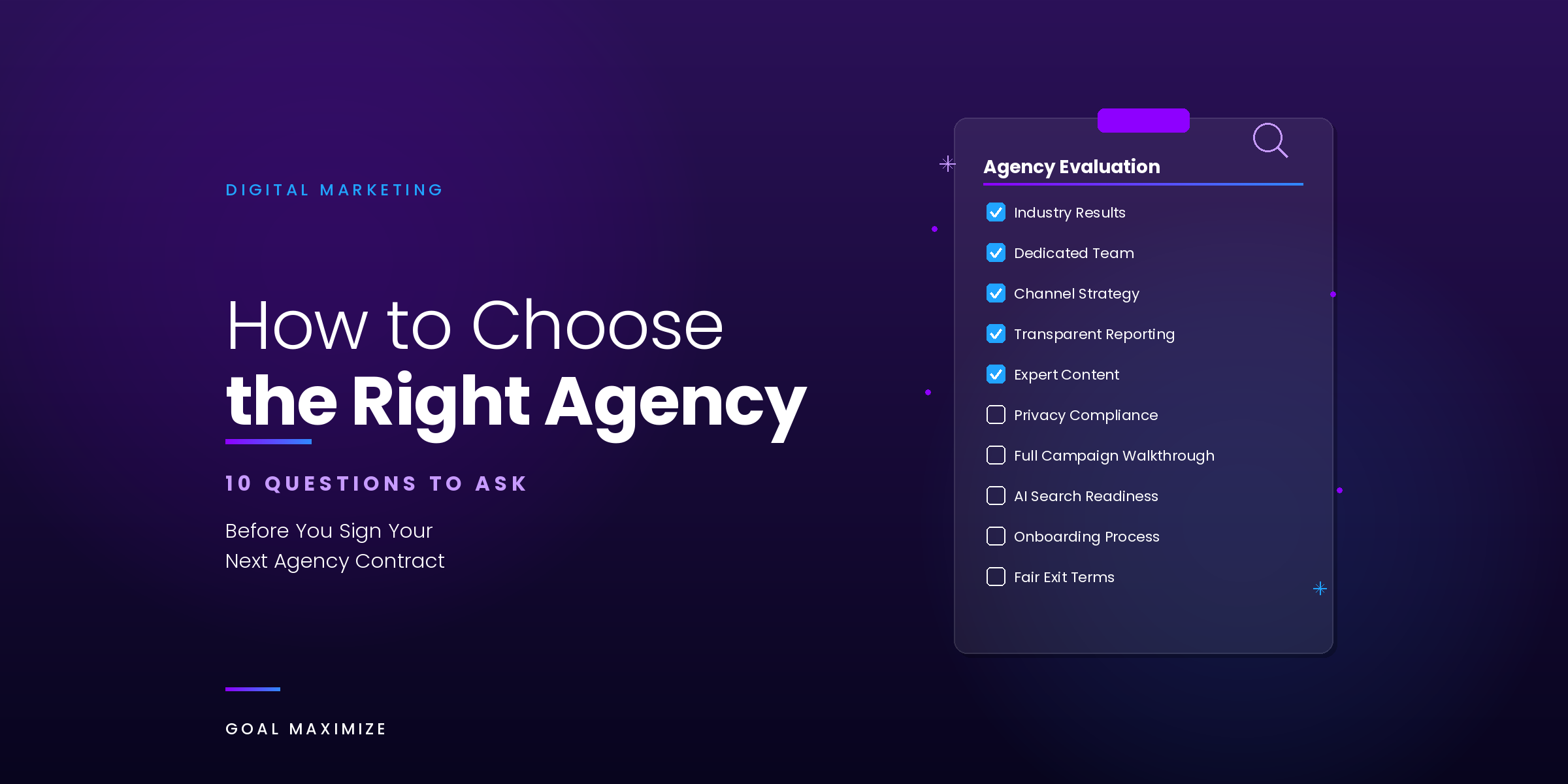
Stories like these play out across industries every quarter. And the frustrating part? They’re almost always preventable. The agency didn’t suddenly become incompetent. It was always going to operate that way. The warning signs were there before the contract was signed. Nobody asked the questions that would have surfaced them. Figuring out how to choose a digital marketing agency starts with knowing exactly what to ask, and what the answers should sound like. These 10 questions work as a practical checklist before any agency conversation.
1. What Measurable Outcomes Have You Produced for Companies Like Mine?
“We drive results” is the most meaningless sentence in agency sales. Every agency says it. What separates the serious ones is specificity. You want traffic growth percentages, lead volume changes, cost-per-acquisition numbers, and the timelines behind them. Not a polished case study on a PDF. A real conversation about what they did, what flopped, and how they adjusted.
Pay attention to whether the results align with your actual goals. Agencies that work across a broad range of digital marketing services sometimes spread too thin. A team that crushed Instagram campaigns for a DTC skincare brand might struggle with B2B software lead generation. Relevant experience beats impressive experience every time, because it shortens the learning curve and reduces wasted budget.
2. Introduce Me to the Team That Will Actually Run My Campaigns
The senior strategist in the pitch meeting is almost never the person logging into your ad manager at 9 a.m. on a Tuesday. That’s not necessarily a problem, as long as the people doing the daily work are experienced and not stretched across a dozen accounts. So ask directly: who writes the copy? Who manages paid media? Who’s handling the technical SEO? And how many other clients does each person serve?
Agencies with 8 to 10 accounts per strategist produce noticeably worse work than those capping it at 4 or 5. Getting that number upfront is critical. If the answer is vague or deflective (“we take a team-based approach”), that’s a signal. Vague accountability in the sales process predicts vague accountability in the work.
3. How Do Your SEO, Paid Media, and Content Teams Actually Coordinate?
This question separates real operations from a loose collection of freelancers sharing a brand name. In too many agencies, the person running Google Ads has never spoken to the person writing blog posts. The paid team bids on keywords the organic team is already ranking for. The content calendar lives in a spreadsheet nobody updates. The result is duplicated spend, conflicting messaging, and wasted opportunities.
What you want to hear is something concrete. A weekly cross-channel sync. PPC performance data feeding directly into organic keyword research. Shared conversion tracking across teams. Understanding the strategic tradeoffs between SEO and PPC is important context here, because an agency that treats each channel as a separate line item rather than pieces of one system will always cost more and deliver less.
4. Show Me an Actual Report You’ve Sent to a Client
Not a sample. Not a template. A real report, sent to a real client, redacted where necessary. Vendasta research found that roughly 43% of agency clients are unhappy with the reports they receive. On the flip side, agencies that shifted to data-backed, outcome-focused reporting saw client retention climb 51% over 2 years. That gap tells you everything about why this question deserves a direct answer.
When reviewing the report, look for business metrics, not just platform metrics. Clicks and impressions are activity indicators. Revenue influenced, pipeline created, and cost per acquisition are business outcomes. There’s a meaningful difference. Also ask how often you’ll review these numbers together with a live walkthrough. A monthly PDF landing in an inbox isn’t reporting. It’s a formality that builds no trust and drives no decisions.
5. Where Does Your Content Come From, and Who’s Creating It?
This is where a lot of agency relationships quietly fall apart. The proposal promises “premium content.” Three months later, the blog reads like a textbook written by someone who Googled the topic for 10 minutes. No original perspective. No depth. Nothing that would make a prospect stop scrolling and actually read.
Google has been clear about this: surface-level, mass-produced content gets buried. The bar is genuine expertise, real editorial standards, and writers who actually understand the industry they’re covering. Ask to see 3 published pieces. Read them carefully. Find out whether the agency uses trained specialists or outsources to the lowest bidder. Strong agencies treat content like a long-term content marketing investment with editorial oversight at every stage, not a volume play measured by word count alone.
6. How Do You Handle Tracking, Consent, and Data Privacy Compliance?
This question is a litmus test for operational maturity, and it makes more agency sales reps uncomfortable than you’d expect. Between GDPR, CCPA, and the expanding patchwork of state-level privacy regulations across the US, your marketing partner needs a clear answer for how they collect data, manage consent, and handle storage.
Ask about cookie consent implementation. Ask whether they’ve audited their tracking tools against current regulations. Ask what happens to customer data if the engagement ends. Data privacy in digital marketing is no longer a side topic buried in a compliance FAQ. It’s a core operational requirement. Agencies that take it seriously build privacy into campaign architecture from day one. The ones that treat it as an afterthought are a liability waiting to surface.
7. Walk Me Through One Campaign, Start to Finish, Including What Didn’t Work
That last part is the key. Any agency can show a highlight reel. The ones worth hiring will talk openly about a campaign that underperformed, explain what went wrong, and describe how they course-corrected. Willingness to discuss failure is one of the strongest signals that an agency has a repeatable process behind the wins, not just a collection of lucky outcomes.
When businesses hire a digital marketing company for the long haul, process visibility matters as much as results. Ask about the brief, the research phase, the internal review steps, and how mid-campaign adjustments were handled. Agencies that can narrate the full lifecycle of a campaign without getting vague or skipping over rough patches are the ones with real operational discipline.
8. What Has Changed in Your SEO Methodology in the Last 12 Months?
If the answer is “not much,” that tells you everything. Search has shifted more dramatically in the last 18 months than it did in the previous 5 years combined. AI overviews are compressing click-through rates on traditional results. Zero-click searches keep climbing. The old formula of “publish 4 blog posts a month and build some backlinks” doesn’t carry the weight it used to.
The best digital marketing agency for any business in 2026 is one that can point to specific, recent changes in their approach. Agencies paying attention to how AI is reshaping organic search are already adjusting content formats, rethinking snippet optimization, and restructuring how they measure visibility. Generalities like “we stay current with algorithm updates” are not a real answer. Push for specifics.
9. What Does the First 30 Days Look Like After Signing?
Onboarding is the most underrated predictor of whether an agency relationship will last. HubSpot’s 2025 Agency Retention Report found that 73% of clients who eventually left an agency pointed to poor communication as the primary reason. That breakdown almost always starts during onboarding: missed kickoff deadlines, repeated questions about goals that were already discussed, and stretches of silence during the first few weeks when momentum should be building.
Before signing, ask for the onboarding timeline in writing. When does the kickoff happen? When does the first strategy document land? What access and assets will they need, and by when? Clear milestones for 30, 60, and 90 days are a strong sign. Consider this your digital marketing agency checklist moment: how an agency starts a relationship reveals exactly how they’ll manage it.
10. If This Doesn’t Work Out, What Do I Walk Away With?
Nobody loves this question. But the answer reveals more about an agency’s confidence than any pitch deck ever could. Are ad accounts running under the agency’s profiles or yours? Do you retain ownership of content they produced? What’s the notice period, and is there a structured handoff plan for transitioning to a new team?
Agencies that rely on rigid 12-month contracts, punitive exit clauses, and data ownership restrictions are telling you something important: they don’t expect the work to keep you around. The agencies worth choosing earn retention through performance. They keep clients because leaving would mean walking away from real, measurable results, not because a contract makes leaving too expensive.
Red Flags vs. Green Flags at a Glance
| Red Flags | Green Flags |
|---|---|
| Promises page 1 rankings in under 30 days | Sets honest timelines (3-6 months for organic traction) |
| Dodges questions about who handles your account | Introduces the working team before you sign anything |
| Reports focus only on impressions and click counts | Reports connect activity to revenue and pipeline |
| Same cookie-cutter strategy regardless of industry | Builds a custom plan after thorough discovery |
| Rigid contracts, murky exit terms, they keep your data | Flexible terms, transparent offboarding, you own everything |
| Can’t name one SEO tactic they changed this year | Points to specific, recent shifts in their methodology |
The Right Agency Welcomes These Questions
That ecommerce brand from the opening? They’re on their third agency now. The current one answered every one of these questions during the sales process, most of them unprompted. That’s the difference. Knowing how to choose a digital marketing agency isn’t about chasing the flashiest proposal or the biggest roster. It’s about finding a team that doesn’t flinch when you dig into how they actually operate, day to day, behind the pitch.
At Goal Maximize, these conversations are built into how we engage from the start. Transparent teams, structured onboarding, outcome-focused reporting, and no lock-in contracts. If you’re weighing your options, start a conversation with us and bring every question on this list. We’ll answer all of them.

**Shalini Thakur** is an SEO Specialist at Goal Maximize with 9+ years of experience in technical SEO, content strategy, and AI-powered search optimization. Specializes in data-driven SEO strategies, website optimization, content development, and adapting websites to the evolving AI-powered search landscape.