
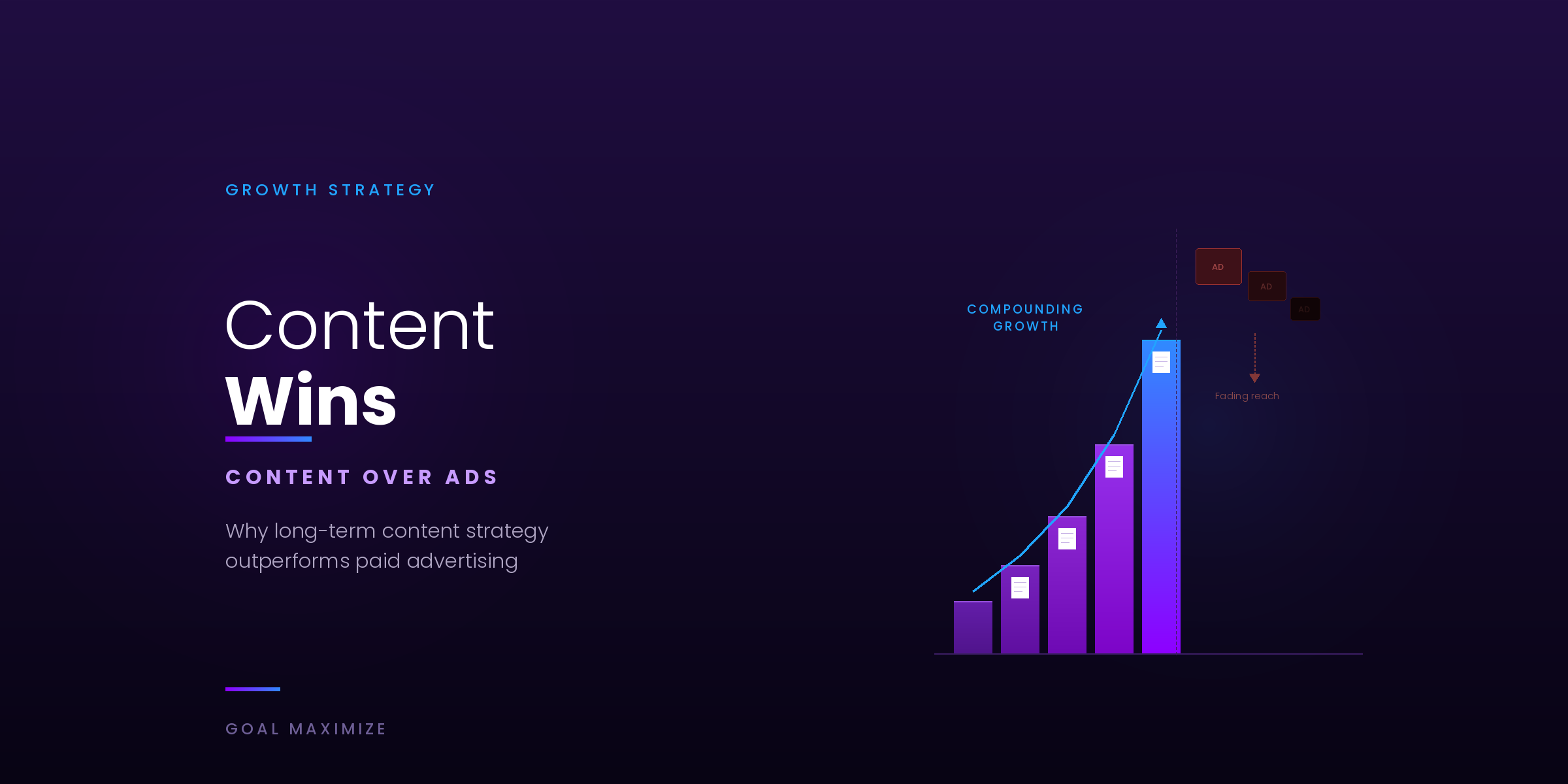
Ask any CMO where last quarter’s ad budget went and you will get a media plan, a reach report, and a lot of estimated impressions. Ask them what they own from that spend and the room goes quiet. Billboards come down. Paid campaigns expire. Sponsored posts vanish from feeds the day the budget runs dry. The attention was borrowed, and the receipt is all that remains.
That dynamic is exactly why the content marketing vs traditional advertising conversation keeps coming back. Not because content is trendy, but because the economics have tipped so far in one direction that ignoring the shift costs real money. Ad costs on major platforms have climbed 15-20% year over year, AI search is rewriting how people discover information, and audiences have gotten ruthlessly good at tuning out anything that feels like a pitch. If you are mapping out where your marketing dollars belong right now, our guide to digital marketing services breaks down how each channel fits together. This piece digs into why content keeps outperforming paid for long term growth.
Traditional Advertising Stops Working the Second You Stop Paying
A TV spot runs during prime time and hits a big audience. Once. A paid social campaign collects clicks for 4 weeks, and on week 5, nothing. Pull the budget and the results disappear overnight. There is no residual value, no compounding effect, no asset sitting on your balance sheet the next quarter. You rented somebody else’s audience for a fixed window and the lease is up.
Content flips that equation. One thoroughly researched article, published today, can show up in search results for the next 2 to 3 years without a single extra dollar of media spend. It picks up backlinks you never pitched for. People share it in group chats and Slack threads you will never see. And every piece that performs well makes the next piece easier to rank, because search engines start treating your site as an authority worth surfacing. This is the practical difference between inbound marketing vs outbound: one side accumulates, the other evaporates.
Search engines have doubled down on this distinction. Over the past 18 months, update after update has penalized thin, mass produced pages while pushing sites with genuine subject matter expertise higher in rankings. Brands that invested in depth over volume a year ago are reaping the rewards now, and their competitors cannot close that gap by simply outspending them.
Where the Numbers Actually Diverge
Too many marketers still compare these 2 approaches on surface metrics: impressions, clicks, engagement rates. Those numbers look similar in month 1. The gap only becomes obvious when you zoom out to 12 or 24 months and track what happened to your cost per lead and your brand equity over that stretch.
| Factor | Content Marketing | Traditional Advertising |
|---|---|---|
| Cost Trajectory Over 12 Months | Cost per lead drops as content library compounds | Cost per lead stays flat or rises with media inflation |
| Asset Lifespan | Months to years for evergreen pieces | Days to weeks, tied to campaign flight |
| Trust Signal | Builds credibility with every helpful piece | Audience recognizes it as paid promotion |
| Targeting | Pulls in high intent visitors via search queries | Pushes to broad demographic segments |
| Measurability | Granular: traffic, scroll depth, conversions, pipeline | Often estimated through reach models and surveys |
| After Budget Stops | Organic traffic continues on autopilot | Visibility drops to zero within hours |
Pay close attention to that final row. It separates a cost from an investment. Content Marketing Institute’s 2025 research found that 58% of B2B marketers credited content with directly increasing revenue, up from 42% the year before. Those are not brands tossing out a blog post every other week. They are running a structured digital content strategy with editorial calendars, topic clusters, and quarterly performance reviews baked into the workflow.
How Content Marketing ROI Compounds (and Why Paid Returns Cannot)
[Image: Content Marketing ROI vs Ad Spend curve comparison]
Content marketing ROI does not follow a straight line. For the first 3 to 6 months, progress feels painfully slow. You are building a foundation, earning your first backlinks, waiting for pages to get indexed and gain traction. Somewhere around months 6 through 9, the curve bends. Older articles climb. Newer articles rank faster because your domain has built credibility. Internal links pass authority across your own site like a network effect kicking in.
Now compare that to paid search, where your cost per click on competitive keywords can spike 10-25% in a single quarter the moment a new competitor enters the auction. Businesses that have tracked SEO and PPC side by side over a full year keep finding the same pattern: organic content delivers a lower cost per acquisition by months 9 through 12, even though paid search wins the first 60 days handily.
Every dollar you put into a paid campaign is gone the instant it is spent. Every dollar behind a well executed content piece keeps generating returns 18 months later. One is a depreciating expense, the other is an appreciating asset. The longer you invest, the wider that gap gets.
When Paid Advertising Still Earns Its Budget
None of this means you should scrap your ad spend tomorrow. Paid channels do things that content cannot do on its own, especially when speed matters.
Launching a product into a new market and need 10 million impressions in 3 weeks? Organic content will not deliver that kind of velocity. Running a seasonal sale or a grand opening with a hard deadline? Paid placements give you predictable timing that no blog post can guarantee. And for pure brand awareness at massive scale, a well placed sponsorship or broadcast spot still moves the needle in ways that take content months to match.
The sharpest marketers stopped treating this as an either/or choice a long time ago. They use paid for short term spikes and content for the long tail, then connect the 2 so each makes the other stronger. A high performing article becomes the landing page for a paid campaign. Ad performance data reveals which topics resonate, feeding the editorial calendar with proven angles. And layering social media marketing into the distribution mix extends the life of every content piece without doubling production costs.
What a Content Strategy Needs to Actually Hold Up Over Time
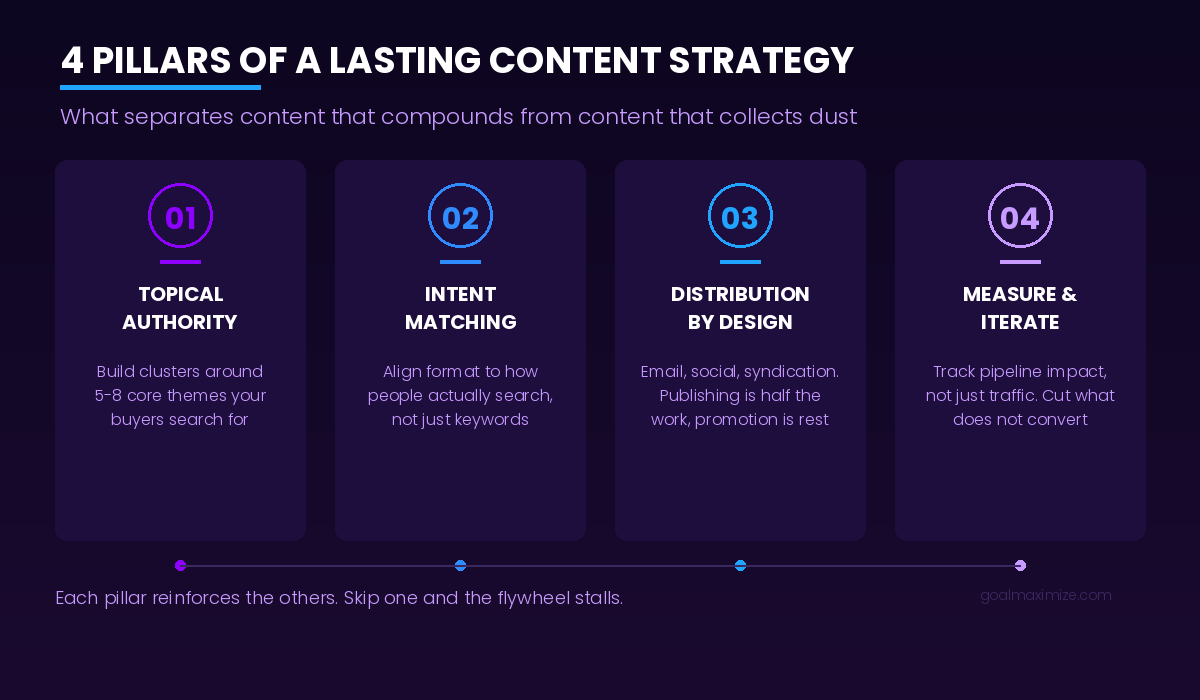
Publishing without a system behind it is just noise with a blog URL. The brands pulling real content marketing ROI treat their editorial operation with the same discipline they bring to product development. Four things have to work together.
Topical authority mapping. Forget scattering random articles across unrelated subjects. Build clusters of content around the 5 to 8 themes your buyers actually search for. Each cluster has a pillar page supported by deeper subtopics, creating a web of relevance that search engines reward with higher rankings across the entire group.
Intent matching. A 2,000 word guide is the wrong format for half the keywords on your list. Some queries need a comparison table, others need a calculator or a 90 second video. Aligning content format to what keyword research tells you about real search behaviour is the difference between page 1 and irrelevance.
Distribution by design. Even exceptional content will sit unread if you treat distribution as an afterthought. Email sequences, social promotion, syndication through industry outlets, and co marketing partnerships all play a role. Publishing is half the job. Getting it in front of the right people is the other half.
Measurement and iteration. Track which pieces generate pipeline, not just pageviews. A post bringing 500 visitors and zero qualified leads is a signal to pivot, not a success metric. Quarterly content audits are how you keep the flywheel efficient instead of accumulating dead weight.
Content Is the Growth Lever. Start Treating It Like One.
The content marketing vs traditional advertising question comes down to what kind of growth you are building. Fast and forgettable, or slow and compounding. Businesses investing in content today are not just filling a blog. They are building a library of expertise that gets harder for competitors to replicate with every piece published, no matter how big the other side’s media budget is.
At Goal Maximize, our content marketing services are built around this compounding model: strategy first, consistent execution, and results that keep growing quarter over quarter instead of resetting to zero. Ready to stop renting attention and start owning it? Our complete digital marketing services guide shows how content fits into a full growth stack.

**Shalini Thakur** is an SEO Specialist at Goal Maximize with 9+ years of experience in technical SEO, content strategy, and AI-powered search optimization. Specializes in data-driven SEO strategies, website optimization, content development, and adapting websites to the evolving AI-powered search landscape.