
Every marketing budget conversation eventually lands on the same question: do we invest in ranking organically, or do we pay for placement? The SEO vs PPC debate has been running for 20 years, and it is still argued badly, usually by agencies who only sell one of the two.
The honest answer is that neither channel wins outright. They win under different conditions. A 4-week product launch and a 5-year brand-building play have almost nothing in common, and the channel that suits one will quietly waste money on the other. Below, search engine optimization vs pay per click is broken down on the 4 things that actually decide the outcome: what each costs, how fast it moves, how long the gains last, and what you can prove afterwards. Use it to judge your own situation instead of taking someone else’s word for it.
The short answer up front
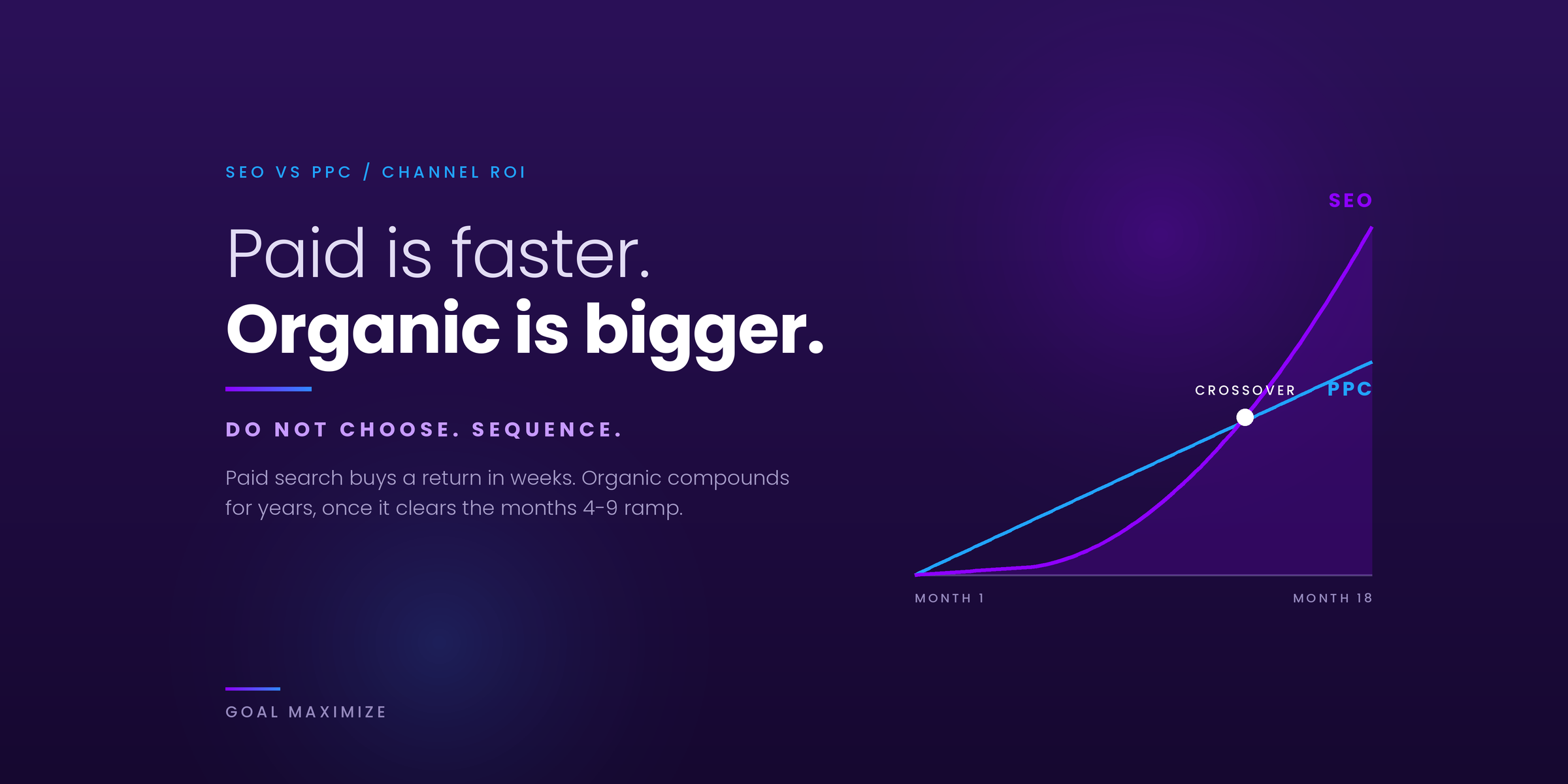
Paid search gets you to a return sooner. Organic search gets you to a bigger one, provided you can wait for it.
If your payback window is measured in weeks, paid search is almost always the right first move. If you are building an asset you intend to own for years, organic search compounds in a way paid media never does. The moment you stop funding ads, the traffic stops with it.
Most businesses that consistently win in search do not choose. They sequence.
What SEO actually is (and what it costs)
Nobody pays Google to appear in the organic listings. You have to be judged worth showing. Search engine optimization is the ongoing effort to make that judgement go your way. In practice it splits into 4 buckets: technical health (crawlability, site speed, indexation), on-page optimisation, content that answers real search demand, and off-page authority signals such as links and brand mentions.
The cost is not zero, just front-loaded and paid in labour rather than media spend. A typical mid-market SEO programme runs somewhere between $2,000 and $10,000 per month depending on competitiveness, with meaningful movement usually visible between months 4 and 9.
What makes SEO economically interesting is what happens after that ramp. A page that ranks well continues to generate traffic and leads long after the invoice for producing it has been paid. The effective cost per acquisition falls month after month, whereas paid CPA generally holds flat or rises as competition increases.
None of that work matters, though, if it is pointed at the wrong terms. Every hour of technical fixes and content production is a bet on a specific set of queries being worth showing up for, and getting that bet wrong is the most expensive mistake in the discipline. If you are starting from scratch, our guide to keyword research and optimization covers how to separate terms with real buying intent from those that only look good in a volume column.
What PPC actually is (and what it costs)
PPC skips the judgement entirely. You name a price for a keyword, Google runs an auction, and if you win it your ad sits above the organic listings, often before the end of the working day. The charge lands only when someone clicks, which is where the name comes from and why the budget drains in proportion to interest rather than exposure.
The cost model is transparent and brutal in equal measure. Average cost per click across industries sits roughly between $2 and $6, but competitive verticals distort that badly: legal, insurance and B2B software regularly clear $50 per click, and some terms run into three figures. Add management fees of 10-20% of spend, and the true cost of a paid programme is higher than the raw media number suggests.
PPC’s real advantage is control. You choose the keyword, the geography, the device, the time of day, the landing page and the budget ceiling, and you can change any of them before lunch. No other channel gives you that speed of iteration, which is why paid search is the fastest way to validate whether a market, an offer or a message works at all.
SEO vs PPC comparison: the data
| Factor | SEO | PPC |
|---|---|---|
| Time to first results | 3-6 months | 24-72 hours |
| Time to meaningful ROI | 6-12 months | 1-3 months |
| Typical monthly investment | $2,000-$10,000 (labour) | $3,000-$50,000+ (media + management) |
| Cost per click | $0 after ranking | $2-$6 average; $50+ in competitive verticals |
| Cost trajectory over time | Falls (earned rankings persist) | Flat or rising with competition |
| Traffic if you stop investing | Declines slowly over months | Stops within hours |
| Average click share of SERP | ~70-75% of clicks | ~25-30% of clicks |
| Trust perception | Higher (earned placement) | Lower (labelled as ad) |
| Targeting precision | Broad, keyword and intent-led | Granular: geo, device, audience, daypart |
| Testing speed | Slow (weeks per iteration) | Immediate (hours per iteration) |
| Attribution clarity | Harder, multi-touch | Clean, platform-reported |
| Best suited to | Long-term growth, high-LTV, content-rich markets | Launches, promotions, seasonal peaks, validation |
| Competitive moat | Strong (hard to replicate quickly) | Weak (competitors can outbid you tomorrow) |
Figures reflect typical industry ranges across US mid-market businesses. Your numbers will vary with vertical, geography and competition.
The single most important row in that table is the cost trajectory. Paid search is a tap: turn it on, traffic flows; turn it off, it stops. Organic search is closer to a well: expensive to dig, cheap to draw from afterwards.
Pros and cons of SEO
SEO pros
- Compounding returns; cost per acquisition falls as rankings mature
- Captures the large majority of search clicks
- Higher user trust than clearly labelled advertising
- Builds a durable asset that survives budget cuts
- Supports the entire funnel, from research queries to purchase intent
SEO cons
- Slow to show results; poor fit for urgent revenue targets
- Vulnerable to algorithm updates and shifting SERP layouts
- Harder to attribute cleanly in multi-touch journeys
- Requires sustained content and technical investment
- Results are influenced, not guaranteed
The volatility risk is real but frequently overstated. Look at who actually loses ground when a core update lands and a pattern emerges: it is rarely the site with 50 carefully researched pages and almost always the one that shipped 500 near-identical ones. Google has been increasingly explicit that it rewards demonstrable expertise over mass publishing, which means depth is now a defensive strategy as much as an offensive one.
Pros and cons of PPC
PPC pros
- Immediate visibility, often the same day
- Precise control over targeting, budget and messaging
- Clean, platform-level measurement and attribution
- Excellent for testing offers, messages and market demand
- Guarantees presence on keywords you cannot rank for organically
PPC cons
- Traffic ends the moment spending ends
- Costs escalate as competitors bid up the same terms
- Click fraud and irrelevant clicks erode budget
- Lower trust and click-through than top organic positions
- Requires ongoing management to avoid budget waste
Which is better, SEO or PPC? It depends on 4 things
Your time horizon. Revenue needed this quarter points to PPC. Growth planned over 2 to 3 years points to SEO.
Your margins. High-margin, high-lifetime-value products can absorb expensive clicks. Thin-margin businesses often find paid search maths simply does not work, and organic becomes the only sustainable route.
Your competition. If 3 well-funded competitors are bidding aggressively on your head terms, buying your way in may be prohibitively expensive. Long-tail organic content is frequently the cheaper flank.
Your existing assets. A site with technical debt, weak content and no authority will struggle to rank regardless of budget. If that is you, run paid for cash flow while fixing foundations. An enterprise SEO audit is the right first step before committing to a long organic programme.
The case for running both
The channels are not rivals so much as inputs to each other, and the businesses getting the best blended ROI treat them as one system.
Paid search data is the fastest keyword research you will ever get. Conversion data from ads tells you within days which terms actually produce revenue, information you can feed directly into your organic content roadmap instead of guessing for 6 months. Run the reverse test too: once a page ranks organically in position 1 or 2, pause the ad on that term and measure incremental lift. Sometimes you are paying for clicks you would have received for free.
There is also the dominance effect. Appearing in both the ad block and the top organic results increases total click share beyond what either position delivers alone, and it crowds competitors off the visible portion of the page.
A sequence that works for most mid-market businesses: launch paid to generate cash flow and demand data, invest that data into an organic programme, then gradually shift budget toward SEO on terms where you have earned rankings, while keeping paid for launches, seasonal peaks and terms you will never rank for. This is the approach we build into our SEO services and PPC management engagements, because measuring them in isolation almost always produces the wrong conclusion.
How AI search changes the calculation
One thing has genuinely shifted in the last 2 years. AI-generated answers now sit above both organic and paid results for a growing share of informational queries, absorbing clicks that used to reach websites at all.
The practical consequence is a widening gap between informational and commercial queries. Informational organic traffic is under pressure. Commercial and transactional queries, where someone is close to buying, remain valuable and, if anything, more contested. That makes bottom-of-funnel content and well-structured product pages more important than ever, and it makes broad top-of-funnel content a weaker bet than it was in 2021. Google’s own Search Essentials documentation remains the baseline for what qualifies for inclusion, and it is worth reading rather than relying on secondhand summaries.
Measuring ROI properly
Compare like with like or the whole exercise is theatre.
For PPC: ROI = (revenue from paid conversions – total ad spend – management fees) ÷ total cost. Straightforward, provided you are tracking conversion value rather than conversion count.
For SEO: value the traffic you earned at what it would have cost to buy. Take organic sessions per keyword, multiply by that keyword’s CPC, and you have a defensible cost-equivalent figure. Then measure against cumulative programme cost, not monthly cost, since the returns accrue over years.
Assess both over a minimum of 12 months. Judging SEO at month 3 will always make it look like a failure, and judging PPC at month 3 will always make it look like a triumph. Neither reading is accurate.
The verdict
If you need revenue quickly, have healthy margins and want tight control, start with PPC. If you are building a durable acquisition engine and can wait 2 to 3 quarters for compounding returns, prioritise SEO. If you can fund both, run paid for immediate demand and organic for long-term cost efficiency. That combination consistently outperforms either channel alone.
The mistake worth avoiding is treating this as a permanent decision. The right mix at $50k of annual revenue is not the right mix at $5m, and it should be revisited every couple of quarters as your margins, competition and search landscape change.
If you want help modelling which split makes sense for your numbers, get in touch, or read our complete guide to digital marketing services for how search fits alongside content, email and social in a full-funnel strategy.
FAQ
Is SEO cheaper than PPC?
Over a long enough horizon, almost always. SEO front-loads cost into labour, then delivers traffic at near-zero marginal cost. PPC has a low entry cost but never stops charging per click.
How long does SEO take to show ROI?
Typically 3 to 6 months for early movement and 6 to 12 for meaningful return, depending on domain authority, competition and content velocity.
Can I do PPC without SEO?
Yes, but landing page quality (speed, relevance, structure) directly affects Quality Score and therefore cost per click. Basic SEO work makes paid campaigns cheaper.
Which drives more clicks, SEO or PPC?
Organic results capture roughly 70-75% of clicks on a typical results page, though the split narrows sharply on high-commercial-intent queries where ads dominate the visible area.
What is the right budget split?
There is no universal answer. A common starting point for a business with immediate revenue targets is 70% paid to 30% organic, shifting toward organic over 12-24 months as rankings mature.

**Shalini Thakur** is an SEO Specialist at Goal Maximize with 9+ years of experience in technical SEO, content strategy, and AI-powered search optimization. Specializes in data-driven SEO strategies, website optimization, content development, and adapting websites to the evolving AI-powered search landscape.