
Ask ten business owners how social media is going and you’ll hear some version of the same answer: we post, we’re just not sure it does anything. The posts happen, maybe an ad runs here and there, and none of it feels connected to the SEO, the emails, or the pages where people actually spend money. Over time it turns into a chore nobody can quite justify keeping.
Usually the posting isn’t the problem. The problem is that social is running in its own lane, cut off from everything else. This piece is about fixing that. We’ll get into how a social media marketing strategy fits with the rest of what you’re doing online, and how to build one that earns its keep. Treat it as a working SMM strategy guide rather than another list of platform hacks you’ll forget by Friday.
What a social media marketing strategy really means
Underneath the jargon, it’s not complicated. A social media marketing strategy is your plan for using social to reach a goal you genuinely care about: more people knowing you exist, more traffic, more leads, more customers who come back. A decent one answers four questions. Who are you for? Where will you post? What will you say? And how will you know if any of it worked?
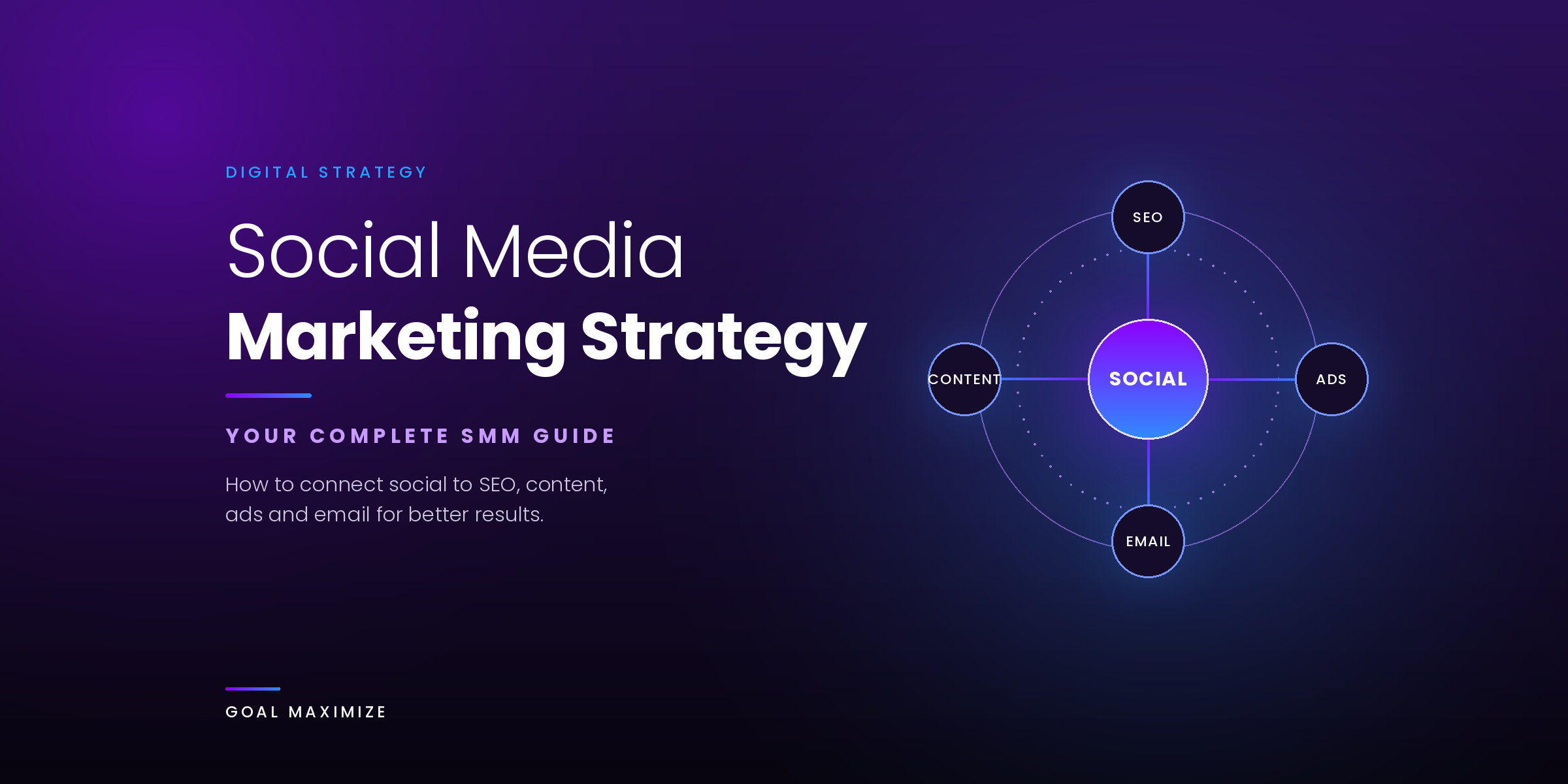
Skip that and you get social media digital marketing by feel, which is a lot of posting with no read on what’s paying off. The bigger realisation, though, has nothing to do with any single tactic. Social doesn’t stand alone. It borrows from your search, content, ads, and email, and it feeds all of them right back. Before you fine-tune the social piece, it’s worth seeing the whole board, and our complete guide to digital marketing services lays out how the parts fit together.
Where social media actually shows up in the journey
Worth saying plainly: social almost never closes the sale on its own. Its real job is everything happening around the sale. A stranger spots you in their feed. They see you again while comparing options. A retargeting ad nudges them back. Then, once they’ve bought, your posts are half the reason they stick around. Every one of those moments passes the baton to a different part of your marketing.
| Stage | What social is doing here | Who it hands off to |
|---|---|---|
| Discovery | Getting you in front of the right new people | Content, paid ads |
| Research | Earning trust with proof, reviews, and useful posts | SEO, email |
| Decision | Pulling warm people back and earning the click | PPC, landing pages |
| After the sale | Keeping customers close so they buy again | Email, community |
Look at how much of that leans on paid media and you’ll see why the money question comes up so fast: how much should go to organic posting versus paid ads? There’s no one right answer, but if that’s the knot you’re stuck on, our comparison of SEO vs PPC and which delivers better ROI is worth a read before you commit the budget.
How to weave social into the rest of your plan
Here’s where it gets practical. A handful of moves will help you integrate social media marketing into your strategy instead of letting it scrap for whatever attention is left over.
Aim social at the goals you already have. If the business runs on qualified leads, your social scoreboard should show leads, not follower counts. Followers feel nice. They rarely turn up on a revenue report. Choose numbers that connect to something real.
Go where your people already are. Pick platforms around your actual customers, not this month’s trend. Run a commercial cleaning company selling to office managers? LinkedIn will probably do more for you than TikTok ever will. A neighbourhood bakery is the reverse. It’s better to be good on two platforms than forgettable on six.
Get more mileage out of the content you own. You’re likely sitting on weeks of social material without realising it. A single 900-word blog post can stretch into 8 or 10 pieces: a carousel, a short video, a couple of quote graphics, a thread. That’s the whole point of a content engine, and it’s what our content marketing services keep running so you’re not staring at a blank calendar every Monday.
Give every post somewhere to go. Anything meant to drive traffic needs a real next step: a landing page, a form, a signup. Social sparks the interest; something else has to catch it. A brilliant post that links nowhere is just a nice thing that happened.
Measure what social is really doing. Last-click reports make social look weaker than it is, because it usually assists the sale rather than closing it. Tag your links with UTMs so you can spot the post that started a journey which finished a week later through email or a branded search.
Doing all of that well, across two or three platforms, week after week, is a genuine job. Most owners we talk to hit a wall somewhere between building the content calendar and making sense of the reporting. That’s usually the point where handing it off starts to make sense, and our social media marketing team runs exactly this kind of connected program every day.
The habits that separate good social from noise
None of these cost much. They mostly ask for consistency, which is where a lot of accounts quietly fall apart.
Show up on a rhythm you can actually keep. Three or four thoughtful posts a week will do far more than a burst of twenty followed by silence. Lean useful before you lean promotional, roughly 80 percent value to 20 percent selling, so people don’t tune you out. And talk back. Comments and DMs are where trust gets built, so don’t run your account like a billboard nobody can reply to.
Beyond that, match the format to the place (a LinkedIn document and an Instagram Reel are not the same idea in different outfits), and let the numbers settle your arguments about what to make next. Platforms shift constantly, so it helps to check current benchmarks rather than repeat last year’s playbook. HubSpot’s social media research is a reliable place to see what’s landing right now.
One shift you shouldn’t ignore: search and social keep bleeding into each other. More people are finding brands through AI answers and by searching inside the platforms themselves, so a good post is now something people discover, not just scroll past. Our take on how AI search is changing user behaviour gets into why that changes the value of the content you’re already making.
Where social strategies usually go wrong
Most of them don’t collapse in one dramatic moment. They drift, a small habit at a time. The usual culprits:
- Keeping social walled off from your SEO and content, which throws away the whole benefit of running things together.
- Getting hooked on vanity metrics. Likes with no clicks, leads, or sales behind them are just noise dressed up as progress.
- Posting into a void, where the traffic lands somewhere useless or nowhere at all.
- Ghosting your own audience. Slow replies, or none, wear down trust faster than most people expect.
- Trying to be on every platform at once and ending up thin everywhere.
Questions people actually ask us
How is a strategy different from just posting?
Posting is an activity. A strategy is the thinking behind it: goals, audience, platforms, an approach to content, and a way to tell if it’s working. Without one, you’re guessing. With one, the same effort starts producing results you can point at.
How do I connect social with my SEO?
Use social to distribute the content you’ve already optimised for search, earn the engagement and brand searches that signal to Google you’re worth trusting, and route visits back to your key pages. Content sits in the middle of both, which is why they lift each other when you plan them side by side instead of separately.
How much should I spend on social?
Honestly, it depends on your goals and how heavily you rely on paid reach. A lot of small and mid-market businesses set aside a fixed slice of their digital budget for social, then adjust as the results come in. Revisit that organic-to-paid split every quarter instead of deciding once and walking away.
Which platforms should I be on?
Wherever your customers already spend time, not wherever the noise is loudest. Start with 1 or 2 that suit your audience and your strengths, prove they earn their place, then expand from there.
Bringing it together
Social does its best work plugged into everything else you’re running, from SEO and content through to ads and email. Left on its own, it’s a scattered pile of posts. Connected, it makes every other channel pull harder. If you want the full picture of how those channels fit, it’s worth heading back to our digital marketing services guide and keeping it as your reference point.
And when you’d rather stop guessing and put a real plan into motion, that’s where we come in. Goal Maximize builds social media marketing programs wired into your SEO, content, and paid campaigns from the start, not bolted on afterward. Curious what that could look like for your business? Have a chat with the Goal Maximize team and we’ll map out a strategy that actually connects.

**Shalini Thakur** is an SEO Specialist at Goal Maximize with 9+ years of experience in technical SEO, content strategy, and AI-powered search optimization. Specializes in data-driven SEO strategies, website optimization, content development, and adapting websites to the evolving AI-powered search landscape.