
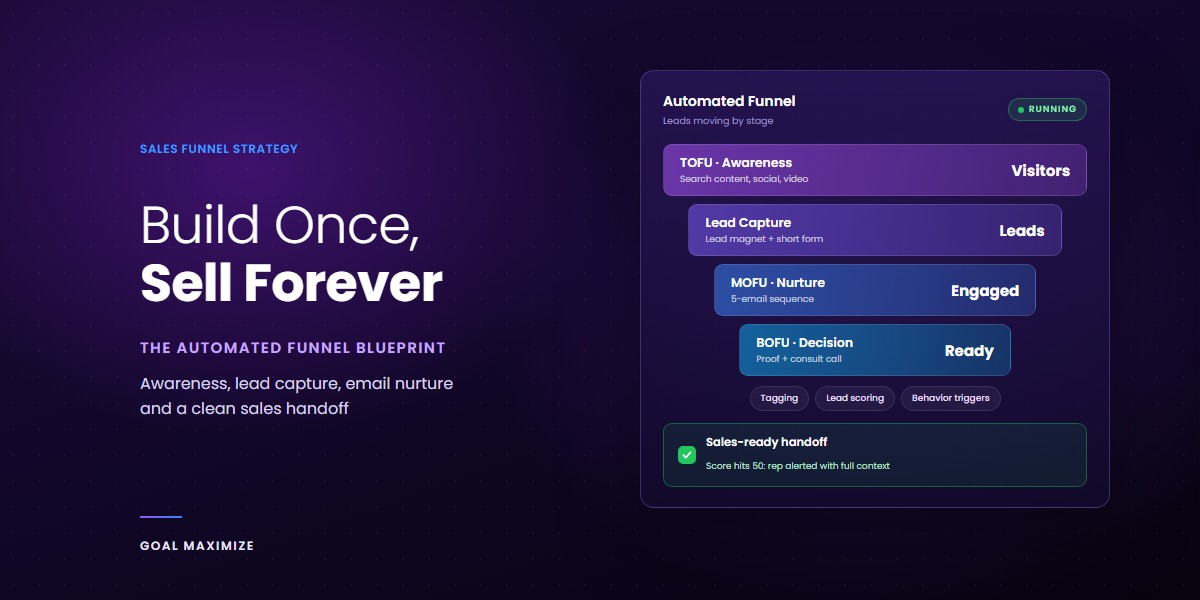
Most businesses don’t have a lead problem. They have a leak problem. Traffic comes in, a handful of people fill out a form, someone on the team sends a follow-up 3 days later, and everyone else quietly disappears. More traffic won’t fix that. A sales funnel strategy that catches people at each stage and moves them forward without someone babysitting every lead will.
So what is a sales funnel strategy? It’s the plan for how a stranger becomes a customer: what they see first, what makes them hand over an email, what they read next, and the exact moment a salesperson steps in. Automate the middle of that journey and you get an automated sales funnel. You build it once and tune it, instead of rebuilding it every quarter.
This guide walks through the full build the way we set it up for clients: the framework, the 4 stages, a 5-email sequence you can copy, a simple lead scoring model and the numbers worth watching. It’s part of our larger lead generation playbook, so start there if you want the wider view of channels and tactics.
To keep things concrete, we’ll follow 1 example the whole way through: a 15-person IT managed services company that sells monthly support contracts to businesses with 20 to 200 employees. Every deal is worth chasing, but the sales team is 2 people who can’t call everyone.
AIDA vs TOFU, MOFU and BOFU: The Same Funnel With Different Labels
AIDA stands for Attention, Interest, Desire and Action. It’s the older model and it was built for writing ads. TOFU, MOFU and BOFU (top, middle and bottom of funnel) is the version marketers use to plan content and automation. Both describe the same journey, just from different angles.
| Funnel stage | AIDA step | What the buyer is thinking | Your job | Main assets |
|---|---|---|---|---|
| TOFU | Attention | “I have a problem.” | Get found | Blog posts, search content, short video |
| MOFU | Interest and Desire | “What are my options?” | Earn trust and an email | Lead magnet, landing page, nurture emails |
| BOFU | Action | “Who should I pick?” | Make the decision easy | Case studies, pricing page, consult call |
| Handoff | Action | “I’m ready to talk.” | Get a human there fast | Lead score alert, booking link |
Our take: stop arguing about which model is right. Use TOFU, MOFU and BOFU to plan the funnel and AIDA to write the individual pages. What actually matters is that every stage has 1 job and 1 next step. Most funnels break because a single page tries to do 3 jobs at once, like a blog post that pushes a demo before the reader even understands their problem.
Stage 1: Awareness Content That Attracts Buyers, Not Browsers
Top of funnel content has 1 job: get the right people to show up. The key word is right. A post that pulls 10,000 visitors who will never buy just fills your list with people who ignore everything you send.
Pick topics from the problems your buyers search for right before they go looking for help. For our IT company, “how to set up MFA for a small office” beats “what is cloud computing” every time. The first reader has a real problem and probably a budget. The second is a student writing a report.
Here’s what we’d publish first:
- Problem posts that answer 1 specific question really well
- Comparison posts like “in-house IT vs managed IT” for readers who are starting to weigh options
- Short checklists that naturally lead to a downloadable, more complete version
Every awareness piece needs an exit. That doesn’t mean a “contact us” button, which is a bottom of funnel ask aimed at a top of funnel reader. It means a relevant next step: a checklist, a template, a quick quiz. If you want the keyword side of this in detail, our guide to building an SEO content funnel that turns searches into signed contracts shows how to map search intent to each stage.
Stage 2: Lead Capture That Earns the Email
This is where a digital sales funnel either starts working or stays a blog. People give you their email when the trade feels obviously fair. A generic “subscribe to our newsletter” box isn’t a fair trade. A tool that saves them 2 hours is.
What makes a lead magnet worth downloading
- It solves 1 narrow problem connected to the post they were just reading
- It can be used in under 15 minutes
- It shows your expertise without giving away the whole service
Our IT company offers a “Small Office Security Audit” spreadsheet: 25 yes or no checks with a score at the bottom. A low score sets up the nurture sequence perfectly: the reader now knows they have gaps, and you’re the company that pointed them out.
Keep the form short and the page focused
Ask for as little as you can. Name and email are enough at this stage. You can collect company size and phone number later, through the booking form or progressive profiling. Put the offer inside the content, right after the section it relates to, instead of only in a sidebar that mobile visitors never see.
The landing page matters as much as the offer: 1 clear headline, 1 action, and no navigation menu leaking people away. If yours converts poorly, these UI/UX design principles that turn visitors into customers cover the layout and trust fixes we check first.
One setup detail most people skip: tag every new lead with the content that captured it. That single tag lets your emails talk about what the person actually cares about. Later, it also tells you which blog posts produce customers, not just traffic.
Stage 3: The Email Nurture Sequence That Does the Selling
Nurture is the heart of an automated sales funnel. It builds the trust a salesperson would normally build over 3 or 4 calls, except it runs for every single lead, at 2 a.m., without anyone needing to remember a follow-up.
Email is the right channel for this job because you own the list and you control the timing. If you want the numbers behind that, our breakdown of email marketing ROI in 2026 covers the data and benchmarks. Here’s the 5-email sequence we’d set up for the IT company:
| Send | Purpose | Example subject line | |
|---|---|---|---|
| 1 | Right away | Deliver the asset and set expectations | Your security audit (plus how to read your score) |
| 2 | Day 2 | A quick win that builds credibility | The 10-minute fix for the most common failed check |
| 3 | Day 5 | Show what happens when the problem is ignored | What usually happens after a low score |
| 4 | Day 9 | Handle the biggest objection | Is managed IT cheaper than hiring? Let’s do the math |
| 5 | Day 14 | A clear, low-risk ask | Want us to walk through your score with you? (15 minutes) |
A few rules we follow when writing these:
- 1 email, 1 idea, 1 link. Several calls to action split attention and weaken all of them.
- Send from a real person. A named sender on your team gets read. A “noreply” address gets skimmed.
- Branch on behavior. If someone clicks the pricing link in email 4, skip them ahead or alert sales. Clicks are signals, so use them.
- End the sequence on purpose. Leads who don’t act after email 5 move to a monthly newsletter, not an endless drip that trains them to ignore you.
Writing and wiring this up takes time. If you’d rather hand it off, it’s exactly the kind of work our email marketing team handles.
Stage 4: The Sales-Ready Handoff
Most automated funnels break here, because automation stops and a human has to pick things up. A lead who has read 3 emails and clicked your pricing page twice is warm right now. In 2 weeks, they’ll barely remember your name.
Speed matters more than most teams admit. Research published in Harvard Business Review found that companies that contacted a lead within an hour were nearly 7 times more likely to qualify that lead than companies that waited even 1 hour longer, and more than 60 times more likely than those that waited 24 hours or more. The study is from 2011, but nothing about buyer patience has improved since then.
A simple lead scoring model you can start with
You don’t need a complex scoring tool on day 1. Give points for actions that signal buying intent, and set 1 threshold that triggers a handoff:
| Lead action | Points |
|---|---|
| Downloaded a lead magnet | 5 |
| Opened 3 or more nurture emails | 5 |
| Clicked a case study or pricing link | 15 |
| Company size fits your ideal customer | 15 |
| Visited the pricing or services page twice in 7 days | 20 |
| Replied to any email | 25 |
When a lead hits 50 points, the CRM creates a task for sales and sends an alert. The rep sees the lead’s source tag, the emails they clicked and the pages they viewed. That context is the difference between a cold call and a conversation that starts with the exact problem the person came in with.
One more thing: agree on what “sales-ready” means with your sales team before launch, and write it down. When marketing and sales define “qualified” differently, leads fall into the gap and nobody owns them.
How to Measure Each Sales Funnel Stage
You can’t improve a funnel you can’t measure. Track 1 main number per stage, and only fix the stage with the worst drop-off. If you change everything at once, you learn nothing.
| Stage | Metric to watch | What a problem looks like |
|---|---|---|
| Awareness | Organic sessions to target posts | Traffic grows but opt-ins don’t |
| Capture | Visitor-to-lead conversion rate | Plenty of visitors, very few emails |
| Nurture | Click rate per email | Emails get opened, nobody clicks |
| Handoff | Lead-to-meeting rate | Sales says the leads “aren’t ready” |
| Close | Meeting-to-customer rate | Meetings happen, deals stall |
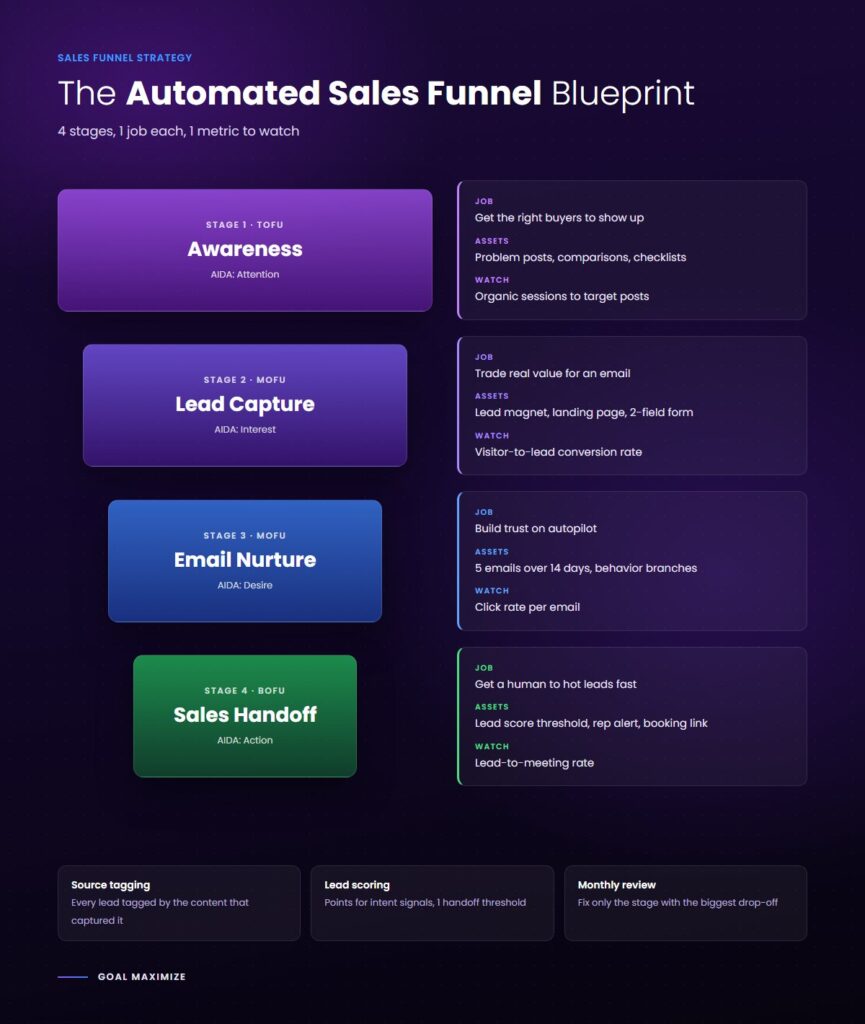
We left benchmarks out on purpose. Conversion rates vary so much by industry and deal size that a generic number mostly causes panic or false comfort. Compare each stage against your own last 90 days instead. For the business-level numbers above all this, like customer acquisition cost and lifetime value, see our guide to the digital marketing KPIs every business owner should track.
“Build Once” Doesn’t Mean “Forget Forever”
The title of this post stretches the truth a little, and we’ll own that. You build the structure once. You don’t rebuild it every quarter. But a funnel left alone for a year slowly drifts: offers get stale, links break, and one day email 4 describes a plan you no longer sell.
Here’s the routine we run for clients:
- Monthly: check each stage’s metric and read 5 recent lead records from first visit to last email
- Quarterly: rewrite the weakest email and test 1 new lead magnet headline
- Twice a year: refresh your top 3 awareness posts with new information
That’s a few hours a month for a system that works every day. It beats launching a new campaign from scratch every quarter.
Build a Sales Funnel: Your 9-Step Checklist
- Write down your ideal customer and the 3 problems they search for most
- Publish or update 3 awareness posts, 1 for each problem
- Create 1 lead magnet tied to those posts
- Build 1 landing page and 1 inline form that asks for name and email only
- Tag every lead by the content that captured it
- Write and schedule the 5-email nurture sequence
- Set up lead scoring with 1 handoff threshold
- Agree on the definition of “sales-ready” with your sales team
- Track 1 metric per stage for 90 days, then fix the weakest one
Frequently Asked Questions
What are the main sales funnel stages?
Most models use 3 to 5 stages. The common version is awareness, interest, decision and action. Marketers often group these into top of funnel (TOFU), middle of funnel (MOFU) and bottom of funnel (BOFU). In an automated sales funnel, we treat the sales handoff as its own stage because that’s where most leads get lost.
How long does it take to build an automated sales funnel?
In our experience, a simple version with 3 awareness posts, 1 lead magnet, a 5-email sequence and basic lead scoring takes a small team about 4 to 8 weeks. After launch, give it around 90 days of data before making big changes, so you’re fixing real patterns instead of noise.
What tools do I need to build a sales funnel?
You need 4 things: a website or CMS for content, a form or landing page tool, an email platform with automation, and a CRM. Many platforms combine the last 3. Pick tools that connect cleanly to your CRM, because the sales handoff depends on that data flowing through.
What’s the difference between a sales funnel and a marketing funnel?
A marketing funnel usually covers the journey from first awareness to a captured lead. A sales funnel continues all the way to a closed deal. For most small and mid-sized businesses they work best as one connected system, and the handoff is where the two meet.
Want Help Building Your Funnel?
If you’d rather have a team map, write and automate this for you, that’s what our sales and lead generation service does. We’ll look at your current funnel, find the biggest leak and build from there. Tell us about your business and we’ll set up a call to walk through it.

**Shalini Thakur** is an SEO Specialist at Goal Maximize with 9+ years of experience in technical SEO, content strategy, and AI-powered search optimization. Specializes in data-driven SEO strategies, website optimization, content development, and adapting websites to the evolving AI-powered search landscape.