
The “Dead” Channel That Keeps Outperforming Everything
Every few months, someone writes a hot take about email marketing being over. They point to short-form video, AI chatbots, or whatever platform just raised a funding round, and they declare the inbox dead.
And every few months, the actual data tells a completely different story.
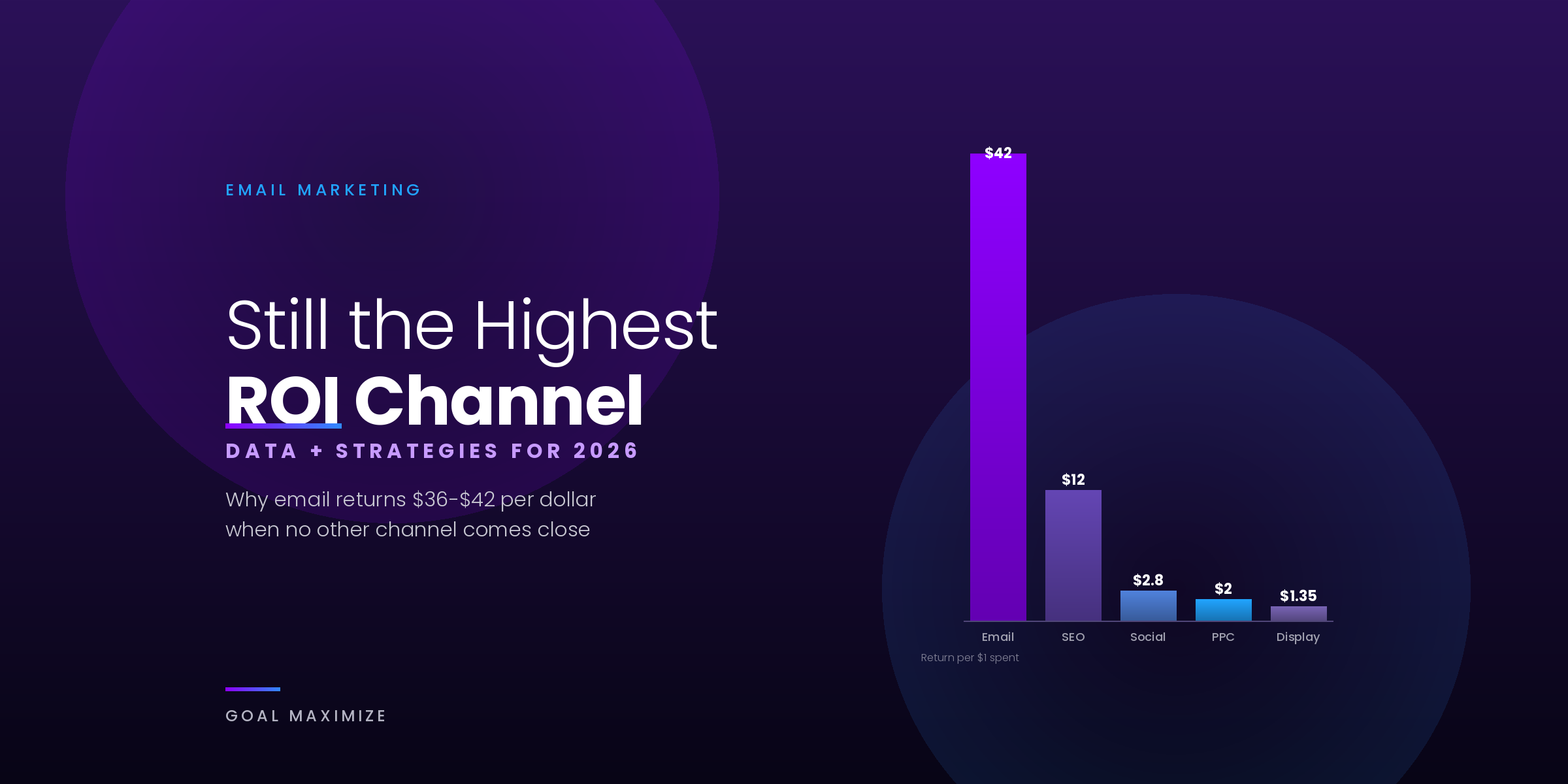
Email marketing pulls between $36 and $42 for every dollar spent in 2026. Paid search brings back about $2. Social ads? Roughly $2.80. Display advertising barely clears $1.35. This isn’t a close race. Email returns 12 to 15 times more per dollar than its nearest paid competitor, and that gap has held steady for 3 straight years.
Nobody gets famous on LinkedIn for talking about their welcome sequence or cart abandonment flow. Email isn’t sexy, and that’s probably why people keep underestimating it. But boring and profitable tend to travel together, and email is living proof.
How the Channels Stack Up (With Actual Numbers)
Opinions are cheap. Data is useful. These numbers come from aggregated 2026 benchmarks published by DigitalApplied, Litmus, and Klaviyo, covering hundreds of thousands of brands and millions of campaigns.
| Channel | Avg. Return per $1 | Approx. ROI % |
|---|---|---|
| Email Marketing | $36 – $42 | 3,600 – 4,200% |
| SEO (Organic Search) | $5 – $12 | 500 – 1,200% |
| Paid Search (PPC) | ~$2 | ~200% |
| Social Media Ads | ~$2.80 | ~280% |
| Display Ads | ~$1.35 | ~135% |
SEO deserves budget. It delivers strong long-term returns. But even a well-oiled organic program maxes out around $12 per dollar. Email triples that on the low end. Retail and ecommerce brands see it climb even higher, with some benchmarks landing at $45 per dollar. The global email marketing industry is projected to grow from $12.33 billion in 2024 to $17.9 billion by 2027. This isn’t a channel in decline. It’s a channel absorbing more investment because the math keeps justifying it.
Now, I’m not saying dump your other channels. They all do different work. SEO puts you in front of people searching for answers. PPC grabs buyers at the moment of intent. Social builds top-of-funnel awareness. But email? Email talks to people who already said “yes, I want to hear from you.” That warmer audience is exactly why the ROI gap is so wide. If you’re trying to figure out where your next marketing dollar does the most work, it helps to understand the real differences in how SEO and PPC deliver returns. But regardless of how you split those two, email probably deserves a bigger slice than it’s getting.
Three Reasons Email Keeps Winning
Cost per send is low. Sure. But cheap alone doesn’t get you a 4,200% return. Something else is going on.
You Own This Channel
Think about what happens with every other digital channel. Instagram throttles your reach whenever it feels like it. Google rolls out a core update and your traffic drops 30% before breakfast. Meta raises CPMs because 10 more advertisers piled into the same auction you’re bidding on.
Your email list? Nobody can touch it. You built it. You own it. When you hit send, your message lands in somebody’s inbox without a platform deciding whether it should show up. That kind of direct access is genuinely rare in digital marketing, and it gets rarer every year as platforms lean harder into pay-to-play distribution.
The Inbox Is a Daily Habit
4.73 billion people use email worldwide right now. 93% of them open it every single day. 58% say it’s the first thing they check in the morning, before social media, before the news, before anything.
Your Instagram Reel might get a 3-second glance during a mindless scroll. An email from a brand someone actually trusts? That gets opened, read, and clicked.
Email Moves Product
Half of consumers say they’ve bought something directly because of a marketing email. Not liked a post. Not saved it for later. Actually purchased. And 80% of marketers say if they had to choose between giving up social media or email, social would go first. That should tell you where the revenue actually lives.
Automation: Tiny Effort, Outsized Returns
If one number could change how you think about email marketing ROI in 2026, it might be this one.
Automated email flows account for just 5.3% of total sends. Welcome series, abandoned carts, post-purchase sequences, win-back campaigns. That’s it. But that tiny 5% generates 41% of total email revenue.
Let that sink in for a second.
Automated emails also bring in 320% more revenue than manual one-off campaign blasts. Abandoned cart sequences alone hit click rates of 6.25%, compared to 1.69% for standard promos. 43% of marketers say more than half their total email revenue now comes from automated flows.
The compounding effect is what makes this so interesting. A paid ad disappears the second you stop funding it. An automated welcome sequence keeps converting new subscribers for months after you set it up. You build it once, tune it occasionally, and the returns keep rolling in at almost zero marginal cost. That’s why the email marketing ROI numbers look so lopsided next to paid channels.
This compounding dynamic isn’t unique to email, by the way. It’s the same reason why brands that invest in content marketing as a growth engine tend to pull ahead of competitors who rely purely on ad spend. Content builds trust over time. Email automation converts that trust into revenue on repeat. The 2 together create a flywheel that just keeps getting stronger.
AI Personalization Is Making the Gap Bigger
2026 is the year AI personalization in email went from “nice experiment” to “table stakes.” And the performance jump is hard to ignore.
Brands running AI-driven personalization report up to 41% more revenue than those still blasting the same message to everyone. AI-optimized subject lines beat human-written ones by 26% on opens. Personalized emails drive 6x more transactions than generic sends. 71% of marketers using dynamic content report at least a 20% engagement lift. And when you stack all the AI layers together (dynamic content, predictive send times, behavioral segmentation), you get 3.2x more revenue per recipient than batch-and-blast.
We’re way past “Hi {first_name}” territory. Real personalization today means product recs based on browsing behavior, send times calibrated to each subscriber’s habits, content blocks that swap based on purchase history, and win-back triggers that fire before someone churns rather than after. All of it runs on subscriber data, which means you need to get the privacy piece right too. More on that below.
Which Metrics Actually Matter Now
Quick note on measurement, because a lot of marketers are still watching the wrong dashboard.
Open rates used to be gospel. Not anymore. Apple’s Mail Privacy Protection auto-loads tracking pixels, which inflates reported open rates by 4 to 8 percentage points. Only 15% of email marketers still use open rates as their primary success metric. The rest have moved on, and you should too.
Watch these instead:
Click-through rate (CTR): Averaging 2.09% across industries this year. Top performers in legal push close to 5%. This requires an actual human to deliberately click something, which makes it the most honest engagement signal you’ve got.
Click-to-open rate (CTOR): Sitting at 6.81% now, up from 5.63% in 2024. This isolates whether your content is good enough to make someone act once they’ve opened.
Revenue per recipient: Especially important for ecommerce. It connects directly to business outcomes instead of vanity engagement numbers.
Unsubscribe rate: Healthy lists stay below 0.5%. The industry average is 0.22%. If yours is climbing, something’s off with your frequency or relevance.
As tracking pixels become less reliable and privacy regulations tighten, the data you collect directly through your own email platform (clicks, conversions, revenue per send) becomes more valuable than anything from third-party cookies. Building your reporting around first-party metrics isn’t just smart measurement. It’s also how you stay on the right side of evolving privacy rules while keeping the data quality high enough to fuel the personalization strategies that actually drive revenue.
5 Ways to Get More Out of Every Send
1. Build the 4 Core Automated Flows Before Anything Else
Welcome sequence. Abandoned cart. Post-purchase follow-up. Re-engagement campaign. If those 4 aren’t live, they come before everything else. Skip the newsletter redesign. Skip the fancy template project. These flows generate outsized revenue with minimal ongoing maintenance. Start with abandoned cart (it converts best for most businesses), then build out from there. Once all 4 are running, add browse abandonment and replenishment reminders for an even bigger lift.
2. Hand Subject Lines and Send Timing to AI
Most email platforms already have these features baked in. AI-generated subject lines lift opens by 26%. Predictive send-time optimization, which figures out when each individual subscriber is most likely to engage, boosts open rates by up to 42%. You can set both up this week and start seeing results in your next few sends.
3. Segment Before You Personalize
Personalization without segmentation is just guessing with a name tag attached. Sort subscribers by purchase behavior, engagement level, and where they sit in the customer lifecycle. Then layer dynamic content on top. Segmented campaigns bring in up to 760% more revenue than non-segmented ones. Even a basic split (new subscribers vs. repeat buyers vs. lapsed customers) makes a real difference in conversion rates.
4. Mobile First, Always
60% of emails get opened on phones. If yours aren’t built for that, people delete them within seconds. Single-column layouts. Subject lines under 40 characters. CTA buttons you can actually tap without zooming in. Test every email on a real phone screen before you hit send.
5. Scrub Your List Every Quarter
A bloated list full of dead contacts kills your deliverability. Your emails end up in spam even for the people who want them. Run a win-back flow first. Then suppress anyone who hasn’t opened or clicked in 6 to 12 months. Drop hard bounces immediately. A smaller, engaged list will outperform a large, neglected one 10 out of 10 times.
And don’t forget: email doesn’t perform in a vacuum. The brands seeing the best email returns are also the ones connecting it to a wider system where social, content, and paid channels all feed into each other. Social brings in new audiences. Content builds credibility and trust. Email turns that trust into transactions. When those 3 channels work as a system instead of separate silos, every one of them gets stronger.
So Is Email Still the Highest ROI Channel?
In 2026? Yes. And it’s not a close call.
$36 to $42 back per dollar. Automated flows generating 41% of revenue on 5% of sends. AI personalization making the gap wider every quarter. No algorithm deciding whether your audience gets to see your message.
The brands that win with email aren’t doing anything exotic. They build their automated flows. They personalize based on real behavioral data. They track metrics that actually connect to revenue. They keep their lists clean. Simple, boring, repeatable work that compounds over months and years. And the upside for getting it right is probably bigger than anything else sitting on your marketing roadmap.
Want help building an email program that actually delivers these kinds of returns? Talk to our email marketing team and we’ll figure out where the biggest wins are in your current setup.

**Shalini Thakur** is an SEO Specialist at Goal Maximize with 9+ years of experience in technical SEO, content strategy, and AI-powered search optimization. Specializes in data-driven SEO strategies, website optimization, content development, and adapting websites to the evolving AI-powered search landscape.