
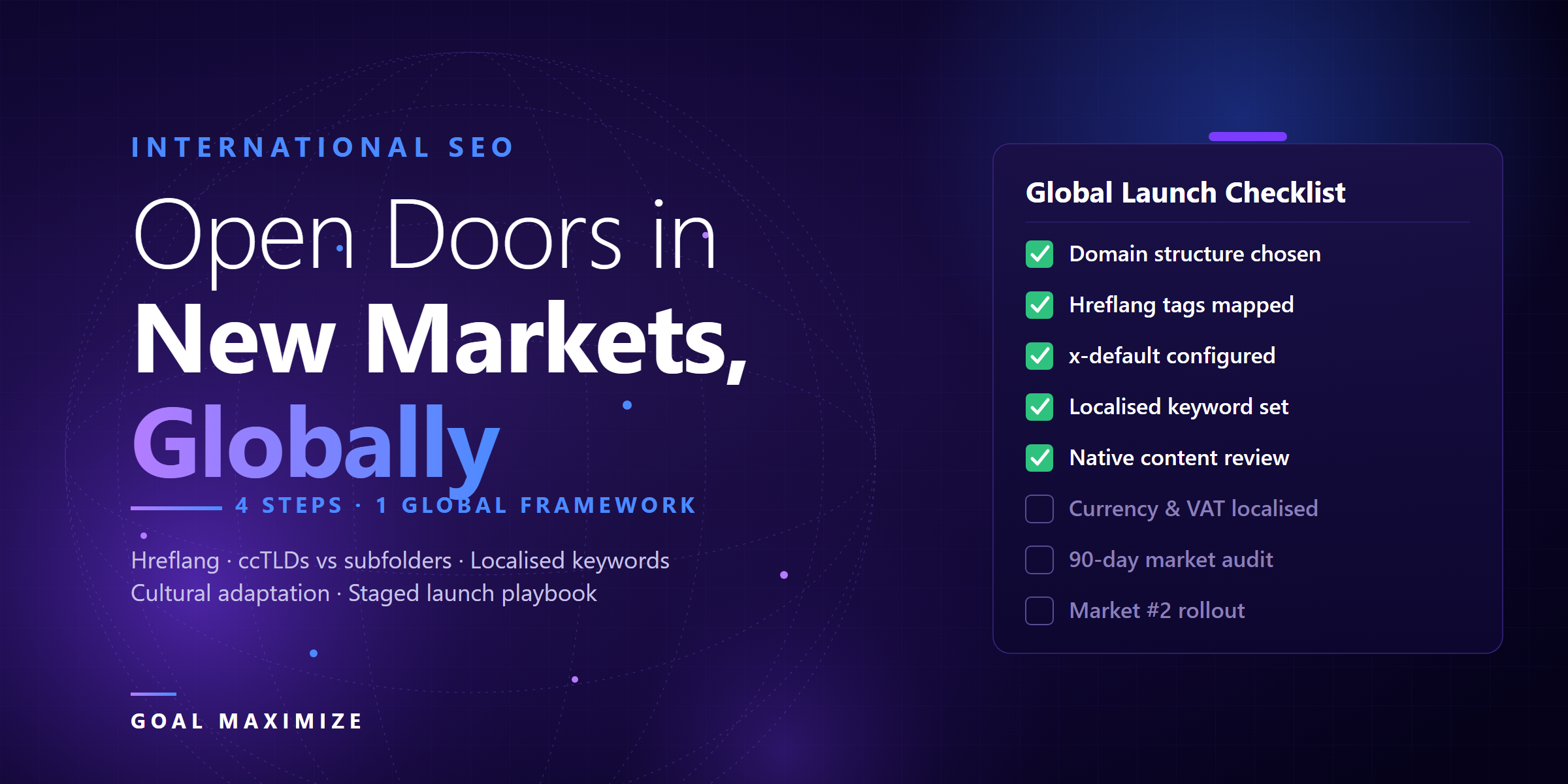
Your product sells in one country. The demand curve says it should sell in five. But when you look at your organic traffic map, everything outside your home market is a rounding error. That gap is what international SEO exists to close, and closing it well is what separates brands that expand from brands that just translate a homepage and hope.
This guide walks through the four decisions that actually move the needle: your domain structure, your hreflang implementation, how you research keywords in a language that is not your own, and how far to push cultural adaptation. If you sell domestically and are still weighing whether to go global, our SEO services page covers the local-market foundation you need first.
What International SEO Actually Is (and Is Not)
International search optimization is the practice of signaling to search engines who your content is for, where they live, and what language they read. It is not the same as translation. A perfectly translated page can still fail if Google serves it to the wrong country, if two language versions compete against each other in search results, or if the currency, examples, and phrasing feel foreign to the reader.
A working global SEO strategy answers three questions at once:
- Targeting: Which country and language versions should exist, and which URL serves each one?
- Signaling: How do search engines know which version to show to which user?
- Relevance: Does the content on each version match how real people in that market actually search and buy?
Step 1: Pick the Right Domain Structure
Every international SEO project starts with a URL architecture decision. There are three defensible options, and the right one depends on your resources, not on which one “ranks best” in the abstract.
Country-Code Top-Level Domains (ccTLDs)
Example: brand.de, brand.fr, brand.co.uk. ccTLDs send the strongest possible geographic signal to Google and build the most trust with local users, who instinctively prefer a national extension. The trade-off is severe: every ccTLD is a separate site that needs its own authority, its own backlinks, and its own technical maintenance. Choose this route when you have real revenue in each market and a team to support it, not for a speculative launch.
Subfolders on a Single Domain
Example: brand.com/de/, brand.com/fr/. Subfolders inherit the authority of your main domain, which is why most B2B SaaS companies and mid-market brands choose them. They are the fastest way to rank in a new market because you are not starting from a domain-authority score of zero. The trade-off is that geographic targeting is weaker and must be set explicitly (in Search Console and through hreflang).
Subdomains
Example: de.brand.com, fr.brand.com. Subdomains sit in an awkward middle: Google treats them as partially separate from the root, so you do not inherit full domain authority, but they are cheaper and simpler than managing ccTLDs. They make sense when you have technical reasons to keep markets on separate infrastructure (different CMS, different hosting region, different team).
For most companies expanding into two to five new markets in the next 18 months, subfolders are the right answer. Revisit the decision when a single market crosses the threshold where a ccTLD’s local trust outweighs the cost of building a second site.
Step 2: Implement Hreflang Tags Without Breaking Anything
Hreflang tags are the single most misunderstood element of multilingual SEO. Done right, they tell Google “this page and that page are the same content in different languages, so show each user the version that matches their locale.” Done wrong, they cause the wrong page to rank, wipe out international traffic, and can take months to unwind.
Four rules keep hreflang from turning into a maintenance nightmare:
- Every version must reference every other version, including itself. If you have English, German, and French pages, each of the three needs three hreflang entries. Missing self-references are the most common cause of ignored tags.
- Use the correct language-region codes. ISO 639-1 for language, ISO 3166-1 Alpha 2 for region.
en-GBanden-USare valid;en-UKis not. When you serve a language without regional distinction, use just the language code (de, notde-DE). - Include an x-default. This tells Google which version to show users who do not match any of your targeted locales. Usually this is your English or global landing page.
- Pick one delivery method and stick with it. Hreflang can live in the HTML head, in the HTTP header, or in the XML sitemap. Sitemaps scale best for large sites; HTML tags are easier to audit for smaller ones. Do not mix them on the same URLs.
Audit hreflang monthly during the first six months of any launch. Screaming Frog, Ahrefs, and Sitebulb all flag mismatched or missing tags in seconds. If your site has crawl or indexation problems on top of hreflang errors, our post on why Google cannot find your website covers the technical fixes to run first.
Step 3: Do Keyword Research in the Target Language, Not English
The fastest way to waste a translation budget is to translate your English keyword list and target the results. Search behavior does not translate. In German, users searching for “software” often type the full English word, but the modifiers around it (“kostenlos,” “fuer kleine unternehmen”) are native. In French, the terms for “digital marketing” split into at least three phrases depending on whether the reader is French, Quebecois, or Belgian.
Real localized keyword research looks like this:
- Start with your English seed list, then run it through Google Keyword Planner set to the target country and the target language separately. Compare the volumes.
- Use a native speaker (not a machine translation) to generate 20 to 30 phrasings of each core query, including the informal, colloquial variants a customer would actually type.
- Look at the SERPs for those queries. If the top results are all local blogs and forums, the intent is informational. If they are ecommerce category pages, the intent is commercial. Match your content to what already ranks.
- Check for query cannibalization across markets. If your Spain and Mexico pages both target “marketing digital,” hreflang alone will not save you if the content is close to identical.
Layer this research into the content-planning process the same way you would domestically. If you are new to intent-based content structures, our guide on building an SEO content funnel shows how to map keywords to TOFU, MOFU, and BOFU stages before you scale internationally.
Step 4: Adapt the Content, Not Just the Words
Machine translation gets you 80 percent of the meaning and 40 percent of the trust. What closes the last 20 percent is cultural adaptation: local currency, local units of measurement, local case studies, local phone numbers, and imagery that reflects the reader’s world rather than yours. Small signals compound. A landing page that quotes prices in euros with VAT included converts noticeably better in Germany than the same page showing dollars with a footnote about tax.
The checklist we run on every localized page:
- Prices, taxes, and shipping shown in local conventions.
- Testimonials from customers in the target region, in their own language.
- Date, address, and phone-number formats that match local expectations.
- Compliance and legal copy (GDPR, CCPA, LGPD) tuned to the market.
- A contact method the reader can trust: local number, local support hours, or at minimum a clearly stated response window.
How to Sequence a Launch
The mistake we see most often is a company translating 200 pages into four languages in one sprint, launching all at once, and then trying to measure what worked. Do the opposite. Pick one market, launch a focused set of 15 to 25 pages (the money pages plus the top-performing blog content), and measure for 90 days before adding the next language. This staged approach gives you a clean baseline to catch hreflang errors, keyword mismatches, and cultural friction before they multiply across four markets.
If you want the full context on how international expansion fits into a larger organic-growth roadmap, work through The SEO Growth Playbook Every Business Needs Before 2027; international SEO is one lever inside a much wider strategy, and treating it as a standalone project is what causes launches to stall.
Where Goal Maximize Comes In
We have run international SEO programs for brands expanding from North America into Europe, from India into the Gulf, and from the UK into Southeast Asia. Every launch looks different, but the failure modes are the same: rushed hreflang, translated (not localized) keywords, and content that reads like it was written for someone else. Our job is to catch those problems before they cost you a year of momentum.
Ready to Open the Doors?
International SEO is the difference between a brand that markets to the world and a brand the world can actually find. If you are ready to build a content and organic strategy that works across borders, we can help you sequence it, build it, and measure it.

**Shalini Thakur** is an SEO Specialist at Goal Maximize with 9+ years of experience in technical SEO, content strategy, and AI-powered search optimization. Specializes in data-driven SEO strategies, website optimization, content development, and adapting websites to the evolving AI-powered search landscape.