
SEO is one of those things everyone thinks they are doing until they open Search Console and see a wall of red. Crawled, not indexed. Discovered, not indexed. Submitted URLs that Google has looked at once and decided were not worth keeping. We have seen this on sites with 3 years of content behind them, on e-commerce stores with 400 product pages, on B2B sites where someone has clearly been trying hard. The problem is rarely what people think it is.
Most SEO advice is written like a course curriculum. Start with keyword research. Move to on-page. Build links. Publish content. The steps are real, but the framing is wrong, because it implies these are sequential phases with clean handoffs. They are not. Technical problems suppress content quality signals. Thin content limits what links can do for you. Analytics gaps mean you cannot tell what is working. Every part of this affects every other part, and the businesses that keep grinding without results are usually stuck in one layer without realising it is undermining everything else.
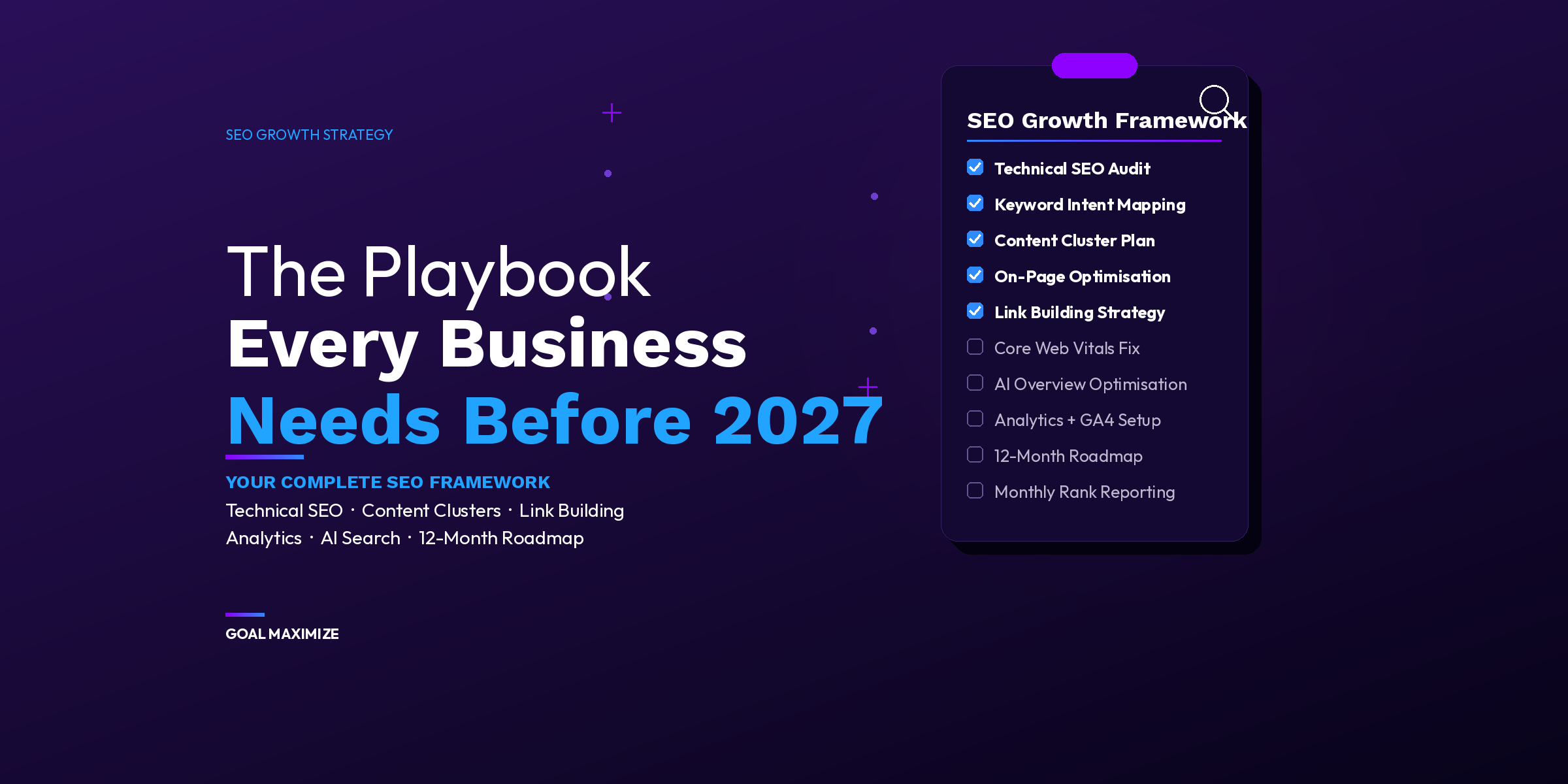
This is the full SEO growth strategy we use with clients: the order of operations, the specific things we look for at each stage, and the honest answer to why some sites move fast and others spend two years going nowhere. No padding. If you already know something, skip it. If something here surprises you, that is probably the section worth sitting with.
Organic Search Is Still Running the Numbers
The “SEO is dead” take appears every time Google makes a big change. Penguin, Hummingbird, the core updates, AI Overviews: each one generates a wave of content predicting the end of organic search. And every time, the traffic data stays stubbornly the same.
BrightEdge’s channel share research puts organic search above 53% of all trackable web traffic across industries. Paid search is around 15%. Social combined, despite the budgets that go into it, sits in single digits for most B2B categories. These numbers shift slightly year to year, but the structure does not. Organic is still the primary way people find businesses they have not specifically gone looking for.
What has changed is the floor. The tactics that worked in 2018 or even 2021, publishing thin posts targeting low-difficulty keywords and getting a few links from generic directories, do not get you anywhere now. Google’s ability to identify content with no real value behind it has improved considerably. The sites still winning at SEO in 2026 are not doing anything exotic. They are doing the fundamentals at a level the average competitor is not willing to sustain.
The other thing worth saying upfront: organic search builds equity. A page that ranks well today keeps generating traffic next month and next year, with no cost per click. Paid search stops the day the budget does. That compounding return is the actual reason to invest in SEO over the long run, and it is also the reason results take time. You are building something durable, not flipping a switch. If you want a direct comparison of how the economics play out between organic and paid at different stages of a business, our breakdown of SEO vs. PPC ROI runs through the numbers in detail.
The Real Reason Your Pages Are Not Getting Indexed
Before we get into tactics, let us talk about the problem most SEO guides skip over entirely: indexing. Specifically, why a large portion of the content on most business websites never makes it into Google’s index in the first place.
There are 2 statuses in Google Search Console that tell very different stories. “Discovered, currently not indexed” means Google knows the page exists because it found the URL somewhere (your sitemap, a link from another page, a crawl reference), but it has not actually visited it yet. That usually comes down to crawl budget. Either the site’s internal architecture is burying those pages, or Google has decided the domain is not worth crawling deeply enough to get to them.
“Crawled, currently not indexed” is a different and more serious diagnosis. It means Google visited the page, read it, and decided it was not good enough to include in the index. There is no technical fix for this. Requesting indexing again from GSC does not help. The page gets re-read and the same decision gets made. The actual fix is improving what is on the page to the point where it is genuinely more useful than what is already ranking for the same topic.
We have worked through this with enough sites to say confidently: the most common root causes are thin content (fewer than 600-700 useful words on a topic that requires real depth), no meaningful internal links pointing to the page from the rest of the site, and near-duplicate coverage of a topic that 300 other pages have already handled better. Any 1 of those is enough to keep a page out of the index. All 3 together means the page basically does not exist from Google’s perspective, no matter how long it has been published.
The lesson here is not to publish fewer pages. It is to stop publishing before the pages you already have are pulling their weight. A site with 40 well-indexed, well-linked pages will outperform a site with 200 pages where 160 of them are stuck in GSC purgatory.
Technical SEO: Getting Google in the Door
People often want to skip technical SEO because it is not creative and it does not feel strategic. But if Googlebot cannot crawl and render your pages correctly, nothing else you do has its full effect. Great content on a broken foundation still underperforms.
Crawlability and Canonical Issues
Start with your XML sitemap. Pull it directly in a browser and check that it reflects your current URL structure, not a cached version from 6 months ago with pages that no longer exist. Submit it in Google Search Console and confirm Google has fetched it recently. Cross-reference against the Coverage report: any pages listed in your sitemap but marked as “Excluded” need an explanation.
Canonical tags are where a surprising amount of crawl budget quietly disappears. If your site serves the same content on multiple URLs (www vs. non-www, HTTP vs. HTTPS, trailing slashes vs. no trailing slashes), Google treats them as separate pages and splits its attention between them. Pick 1 canonical URL for each piece of content, set the canonical tag correctly, and redirect all variants with 301s. Then use the URL Inspection tool in GSC on your most important pages to verify what Google actually sees as the canonical, because sometimes plugins override what you think you have set.
Paginated content is another common crawl sink. Blog archives, product category pages, filtered e-commerce results: these generate dozens of URLs that Google will index if you let it, wasting crawl budget on pages no one searches for directly. The current approach is noindex on paginated pages beyond page 1, with all valuable content internally linked from the main, indexable version of the page.
Page Speed and Core Web Vitals
Core Web Vitals are a confirmed ranking signal. The 3 that Google tracks are Largest Contentful Paint (how fast the main content appears), Interaction to Next Paint (how quickly the page responds when someone clicks or types), and Cumulative Layout Shift (whether things jump around as the page loads). Failing all 3 on mobile puts you at a disadvantage on a competitive SERP even if your content is good.
For WordPress sites specifically, which is most of the web, the biggest performance wins come from a few specific changes: serve images in WebP format rather than original JPEG or PNG, implement a caching plugin, use a CDN for static assets, and defer render-blocking scripts from third parties (ad pixels, chat widgets, analytics tags). Each of these alone moves the needle. All together, they are usually the difference between failing and passing Core Web Vitals. The business case for speed goes beyond rankings though: slower pages convert worse, and the revenue impact is more significant than most people expect. Our post on how page speed affects business revenue has the actual numbers behind this, including what a 1-second delay in LCP does to conversion rates on a typical service or e-commerce page.
Mobile-First and Structured Data
Google indexes the mobile version of your site, not the desktop version. That has been true since 2019. In practice, it means: if your mobile site is loading slowly, hiding content behind tabs or accordions that Googlebot cannot access, or serving a substantially stripped-down version of what desktop users see, your rankings are being evaluated on the weaker version. Check your mobile rendering using the URL Inspection tool’s screenshot view. What you see is what Google sees.
Structured data (schema markup) does not directly lift rankings, but it increases rich result eligibility, which improves CTR. Article and FAQ schema apply to editorial content like this guide. LocalBusiness and Service schema apply to service pages. Use Google’s Rich Results Test to confirm your markup is valid before deploying. A schema error silently removes rich result eligibility, and it does not throw an obvious error anywhere on the page.
On-Page SEO: Intent First, Keywords Second
Most on-page SEO mistakes are not about keywords. They are about intent. A business targets a keyword, publishes a page, watches it fail to rank, and assumes the keyword is too competitive. Often the real problem is simpler: the page type does not match what Google understands searchers to want.
Intent breaks into 4 categories. Informational (someone wants to understand something), navigational (they want a specific page or site), commercial (they are evaluating options), and transactional (they are ready to act). Before writing a single word of a new page, search the target keyword yourself. Look at the top 5 results. Are they blog posts, comparison pages, tool pages, or product listings? Whatever the majority of top-ranking results are, that is what you need to build. A service page trying to rank for an informational keyword will get outranked by editorial content every time, regardless of how well-optimised the page is otherwise.
When you have the intent right, the on-page work is fairly direct: primary keyword in the title tag near the front, under 60 characters so it does not get cut. Meta description written to earn the click, not to summarise the page. One H1 per page. H2s that cover the major sections using natural phrasing, not keyword variations stacked on each other. Internal links placed inside section body paragraphs, pointing to genuinely related content, with anchor text that describes the destination rather than targeting a keyword for that destination page. Our guide to keyword research and optimization covers intent mapping in detail, including how to read your existing GSC query data to find intent signals you may have missed.
Internal Linking Done Properly
Internal linking does 3 things: it distributes page authority to pages that need it, it tells Google what content is topically related, and it keeps users on your site longer. Pages with no internal links pointing to them are crawled infrequently and rank poorly regardless of their content quality.
The practical rule: aim for roughly 1 contextual internal link per 400-500 words of body content. Links should live inside H2 section paragraphs, not in the introduction (intro links carry less crawl weight) and not in a “related posts” block at the bottom. Anchor text should be descriptive. “Read our keyword research guide” is better than “click here” and better than stuffing the destination page’s target keyword into every anchor.
Content Strategy: Why Most Publishing Schedules Do Not Work
Lots of businesses hit a wall around 12 to 18 months into a content program. They have been publishing consistently. The traffic chart is basically flat. And because they do not know what is wrong, they default to publishing more, faster. This makes things worse, not better.
The issue is usually not volume. It is architecture. Publishing 2 posts a week on loosely related topics does not build topical authority. It builds a large collection of unconnected pages, each weak in isolation, that Google has no strong reason to treat as the authoritative source on anything in particular.
The structure that actually works is the pillar and cluster model. A pillar page covers a broad topic in full depth: it is the comprehensive reference document for that subject. Each cluster post goes deep on a specific subtopic within it. The cluster posts link back to the pillar; the pillar links out to each cluster post. Google reads that interlocked network of content as a signal that the site genuinely understands the topic from multiple angles, not just one piece of it.
This page is the pillar for our SEO cluster. The cluster posts sit below it, each covering a dimension of this topic that a pillar cannot fully explore: local SEO, keyword research, technical auditing, AI search behaviour, enterprise-level considerations. Each post has a defined job. None of them exist just to add a number to the publishing calendar.
The other thing most content strategies skip is the refresh cycle. A post from 2023 about digital marketing channels or Google’s algorithm is partially obsolete. Google’s quality raters evaluate whether content is current. A page that was accurate when published but has not been touched since will drift in rankings over time, especially in fast-moving categories. Build a quarterly review into your content plan from the start. SEO content is not a “publish and forget” exercise. The case for treating content as a long-term compounding asset rather than a short campaign burst is one we lay out in detail in our post on why content marketing wins for long-term growth.
What E-E-A-T Actually Means for Business Content
Google’s quality rater guidelines use E-E-A-T: Experience, Expertise, Authoritativeness, and Trustworthiness. A lot of content advice treats this like a checklist (add author bios, cite sources, use credentials). Those details matter, but they are symptoms of E-E-A-T, not the thing itself.
The thing itself is: does this content reflect someone who has genuinely worked in this area, or does it reflect someone who read what other people wrote and rephrased it? Google’s systems are getting better at that distinction. Content that takes a real position based on observed outcomes reads differently from content that hedges everything and defines terms as if you had never heard them before. The first signals expertise. The second signals surface-level coverage.
In practice, E-E-A-T for business content means: use real numbers from your own work (even anonymised), take positions rather than presenting “both sides” of every question, attribute data to actual sources rather than vague references, and update content when the facts change rather than leaving stale paragraphs in place. Author credentials on the page also matter more than most businesses prioritise. A bio that mentions 8 years working in enterprise SEO at named companies reads differently than “content team” in the author field. Google’s quality raters look for this. So do users who arrive from search and decide in the first 10 seconds whether to trust what they are reading.
What erodes E-E-A-T is content written to a template, with generic advice that applies equally to every business in every situation. Google has learned to identify that pattern, and it shows in rankings over the medium term even when a page initially does well. Our post on why Google rewards real expertise over mass content publishing gets specific about what this looks like in practice, and what to look for when auditing your own existing content against this standard.
Link Building: The Gap Between What People Preach and What Actually Works
Backlinks still matter enormously. A link from a trusted, topically relevant site is still one of the strongest signals in Google’s ranking system. The problem is that the link building advice circulating in most SEO guides is either outdated, oversimplified, or describing tactics that work on paper but are much harder to execute than described.
The first thing to understand is the risk side. Link farms, paid link placements, and mass guest posting on sites that exist purely to exchange links are not just ineffective; they create liability. Google’s spam detection has gotten specific enough that a profile full of low-quality, topically irrelevant links can actually hold a site’s rankings back compared to a cleaner profile with fewer but better links. This has been true for several years and is more true now than it was.
What Actually Moves the Needle
Digital PR is the best link acquisition approach available right now, and the most difficult to execute consistently. It means creating something with a genuine finding: original research, a dataset that nobody has compiled before, a well-argued position piece from someone with real credibility in the field. When this lands, the links come from publications with actual editorial standards, which is exactly the type of link that moves domain authority in a way Google respects. The barrier is that you have to actually produce something worth citing, which is harder than most companies want to invest in.
Content-led outreach is more repeatable. Find sites in your category that link to content similar to yours but not to yours specifically. Identify gaps in their existing coverage. Pitch a piece that fills that gap, written at their audience’s standard. The success rate per outreach attempt is low, but the links you do earn are editorial and durable. Over 12 months, consistent outreach builds a link profile you cannot replicate with shortcuts.
Unlinked brand mentions are the most overlooked source of links most businesses have sitting unused. Set up Google Alerts for your brand name and your key team members. When a site mentions you without linking, send a short email asking if they would add one. Conversion rates on these requests are significantly higher than cold outreach because the site has already chosen to reference you. You are not asking them to vouch for something unfamiliar.
On anchor text: keep it varied. Branded anchors, partial-match anchors, generic anchors. A profile that is dominated by exact-match keyword anchors is a flag in Google’s spam systems. Let the context of the linking page drive the anchor text rather than trying to optimise every link for a target phrase.
Measurement: Stop Reporting Impressions and Start Reporting Revenue
A surprising number of SEO programs run for months without anyone really knowing whether they are working. Impressions are up. Rankings moved on a few secondary keywords. Traffic is roughly flat. Is that good? Is that bad? Without the right measurement setup, you genuinely cannot tell, and that ambiguity is what allows mediocre SEO work to continue unchecked.
The 3 Tools You Actually Need
Google Search Console is the primary source of truth for organic performance. Use the Performance report to track clicks, impressions, CTR, and average position by query and by page. The pattern to prioritise: pages sitting at average position 8 to 20 are within realistic reach of the top 5 with focused optimisation work. These are your best opportunities. Pages with deep impressions but very low CTR have a title or meta description problem, not a rankings problem. Fix the click rate before anything else on those pages.
Google Analytics 4 tells you what happens after the click. Set up GA4 events for every action that represents a real business outcome: form submissions, phone number clicks, product additions, checkout completions. Organic session volume is a starting metric. Organic-attributed conversions are the number that should be in every report to a client or leadership team. If you cannot connect traffic to revenue, you cannot defend the budget.
A rank tracker (Semrush, Ahrefs, Wincher, or similar) gives you weekly position history that Search Console does not surface cleanly. This is how you tell whether a content update is having an effect, whether a Google algorithm update shifted your rankings specifically, and which keywords are trending toward page 1 versus drifting back. Monthly rank snapshots are not enough. Weekly data gives you early signals to act on before a trend fully develops.
Reporting That Actually Gets Read
Organic sessions, organic-attributed conversions, keyword positions for your primary targets, new referring domains acquired per month, and Core Web Vitals status for key pages. Impression counts and keyword counts are vanity metrics. Total backlinks without quality filtering is a vanity metric. Report on things that connect to outcomes, and frame SEO performance in the same language as every other channel in your marketing stack. The moment SEO reporting lives in a separate document from paid, email, and social, it becomes harder to justify at budget review time.
What AI Search Actually Means for Your Rankings in 2027
AI Overviews from Google generate a lot of concern about whether traditional SEO is worth continuing. The concern is understandable, but the conclusion being drawn is wrong. The content that appears inside AI Overviews comes from pages that rank well organically. You cannot get into an AI Overview by optimising specifically for AI Overviews. You get there by meeting the same quality and authority thresholds Google has always used, plus a few structural preferences that the generative layer has added.
Those structural preferences are: answer the primary question directly in the first 2 to 3 paragraphs without burying it under preamble, use H2 headings that function as clear, scannable questions and answers rather than vague category labels, include specific data points with attributable sources, and have an E-E-A-T profile that signals the author has direct experience with the subject. Pages that get pulled into AI Overviews are almost always pages that were already doing these things for ordinary organic reasons.
The more interesting development heading into 2027 is entity SEO. Google’s systems increasingly understand the web through entities: organisations, people, places, concepts, and the relationships between them. When Google has your brand established as a recognised entity in its Knowledge Graph, through consistent NAP data, proper Organisation schema markup, and presence in authoritative reference sources, it starts associating your content with related topics that you did not explicitly target. That is a compounding advantage that link metrics alone do not capture.
For local businesses, the Google Maps pack (the 3 map results that appear above organic listings) runs on a somewhat separate set of signals: proximity, Google Business Profile completeness and activity, review velocity, and citation consistency. Local pack rankings typically move faster than organic rankings, which makes them a good short-term priority while the longer organic work builds. The full picture of what is changing in AI search, and specifically how to position content for the shift in user behaviour it is driving, is covered in our post on AI SEO trends for 2026.
12-Month SEO Roadmap
SEO has phases, and running them out of order produces wasted effort. Here is the sequence that works:
| Phase | Months | What You Are Doing | What to Look For |
|---|---|---|---|
| Foundation | Months 1-2 | Full technical audit, crawl fixes, canonical cleanup, GSC and GA4 setup, sitemap submission | Clean coverage report, indexing errors resolved, measurement tracking confirmed |
| On-Page | Months 2-4 | Intent mapping for priority pages, title and meta rewrites, internal link repair and expansion | CTR improvements on high-impression pages, more URLs moving to “Indexed” status in GSC |
| Content | Months 3-8 | Pillar and cluster production, refresh of ranking-but-drifting pages, content gap analysis | New pages indexing within 4-6 weeks of publish, cluster posts lifting pillar rankings |
| Authority | Months 4-12 | Digital PR, content-led outreach, unlinked mention reclamation | New referring domains added monthly, domain authority trending upward |
| Iteration | Months 6-12 | Rank review, content updates based on GSC query data, cluster expansion into adjacent topics | Top-10 positions on primary keywords, organic traffic attributing to conversions |
The phases overlap by design. You do not complete technical SEO and then start content. You run them in parallel, prioritising based on what is most blocking progress. Technical issues come first because a well-written page on a broken crawl foundation still gets ignored. After that, the content and authority work can run together.
One question we get at this stage: should you do this in-house or bring in an agency? The honest answer depends on what is available inside your team. In-house works well when there is a dedicated person with genuine SEO knowledge and the authority to make changes to the site without going through 3 approval cycles. An agency makes more sense when you need a combination of technical, content, and link building expertise that one person realistically cannot cover, or when speed matters more than building internal capacity. Either way, knowing what good work looks like before hiring anyone matters. Our post covering 10 questions to ask before signing with a digital marketing agency lays out what to look for in transparency, reporting, and how to distinguish agencies that deliver results from agencies that deliver activity.
Where to Go From Here
The site we mentioned at the top of this guide went from 47 indexed pages to over 200 in 9 months. Not by publishing more content, but by fixing the technical issues that were suppressing crawl, rewriting the pages that were crawled but not indexed, and building internal links that actually pointed to those pages from contextually relevant content. The volume of content was not the problem. The infrastructure around it was.
That pattern repeats itself across almost every site we have audited. The work is already there. The system to support it usually is not.
If you want to see exactly where your site stands, our free SEO audit covers technical health, index coverage, on-page performance, and competitive positioning across your top 10 organic competitors. No slide deck. Just a clear picture of what is holding you back and what to fix first.
For the wider picture of how SEO fits alongside paid, content, email, and social in a full marketing stack, our complete guide to digital marketing services covers channel strategy and budget allocation across all of them. And if you want to see exactly what our team does on the organic side specifically, the SEO services page has the full breakdown.
Free Audit
Find Out Why Your Pages Are Not Ranking
We audit technical health, index coverage, on-page performance, and your top competitors. No fluff, no sales deck. Just a clear picture of what is holding you back and what to do next.
Frequently Asked Questions
How long does SEO take to produce real results?
Technical fixes and on-page changes can show measurable impact within 4-8 weeks, especially on pages that are already indexed but ranking poorly. Meaningful organic traffic growth, the kind that shows up in lead or revenue numbers, typically takes 6-12 months. Sites with existing domain authority tend to move faster. New domains with no link profile take longer. The most common reason timelines extend is not that SEO is slow; it is that foundational issues (indexing problems, thin content, weak internal linking) are not addressed before content production begins, so the content you publish sits on a broken base.
What is the difference between “Crawled, not indexed” and “Discovered, not indexed” in GSC?
“Discovered, not indexed” means Google has found the URL but has not visited it yet. This is usually a crawl budget issue or a site architecture problem that buries certain pages. “Crawled, not indexed” means Google has visited and read the page but decided not to include it in the index. The second status is more serious and is almost always a content quality or relevance issue. Requesting indexing from GSC does not fix it. Improving what is on the page, adding substantive internal links pointing to it, and making it clearly more useful than competing pages are the things that shift this status.
Does AI Overviews mean I should change how I write content?
Partially. The structural characteristics that make content more likely to appear in AI Overviews (direct answer early, clear H2 structure, attributed data, strong E-E-A-T) are things good SEO content should already be doing. The main adjustment is around structure: frontloading the answer rather than warming up to it through several paragraphs of context-setting. If your content currently buries the core answer 400 words in, restructure so the direct answer appears in the first 2-3 paragraphs with the supporting detail following. This improves both traditional ranking performance and AI Overview inclusion.
How many blog posts do I need before SEO starts working?
There is no threshold. The question is not volume; it is whether the pages you have are well-indexed, well-linked, and genuinely useful to someone searching for the topic they cover. 15 strong pages that are properly indexed and internally linked will outperform 80 thin pages scattered across unrelated topics. Start by getting the pages you have performing correctly before adding more. When you do add more, each new page should have a specific place in a content cluster rather than existing in isolation.
Is it better to target high-volume keywords or low-competition ones?
Neither in isolation. The better question is: which keywords have search intent that matches what my site can realistically deliver, and which have a gap in the current top results that my content fills better than what is there? A 50,000-search-per-month keyword is irrelevant if your domain has no authority and every top result is a major brand. A 500-search keyword is valuable if you can rank in the top 3 and the searcher is exactly the type of person you want to reach. Keyword difficulty is one input. Intent alignment and content quality relative to current rankings are the inputs that determine whether a target is actually worth pursuing.
Should I hire an SEO agency or build in-house?
In-house works when you have someone with real SEO expertise who can make changes to the site without bureaucratic delay. Agencies make sense when you need the combination of technical, content, and link building skills that a single person cannot credibly cover. The main risk with agencies is paying for activity (reports, audits, meetings) rather than results. Before hiring, understand what deliverables you are paying for, how you will measure success, and what happens to the work if you end the relationship. These are not unfair questions to ask upfront.

**Shalini Thakur** is an SEO Specialist at Goal Maximize with 9+ years of experience in technical SEO, content strategy, and AI-powered search optimization. Specializes in data-driven SEO strategies, website optimization, content development, and adapting websites to the evolving AI-powered search landscape.