
Programmatic SEO gets sold as the shortcut every founder wants. Point a script at a spreadsheet, generate 500 landing pages, watch organic traffic climb. It sometimes works. It also produces some of the most obvious spam Google has ever penalized. The difference between a Nomad List that quietly compounds and a template farm that gets deindexed in a single core update comes down to how the pages are built, what data feeds them, and whether anyone would ever bookmark one.
We have run programmatic pilots for clients sitting on real inventory data such as locations, prices, and product specs. We have also talked founders out of it more than once when the underlying dataset was thin. This post is the honest version of when to reach for programmatic SEO, how to build it right, and where it goes wrong.
What programmatic SEO actually is
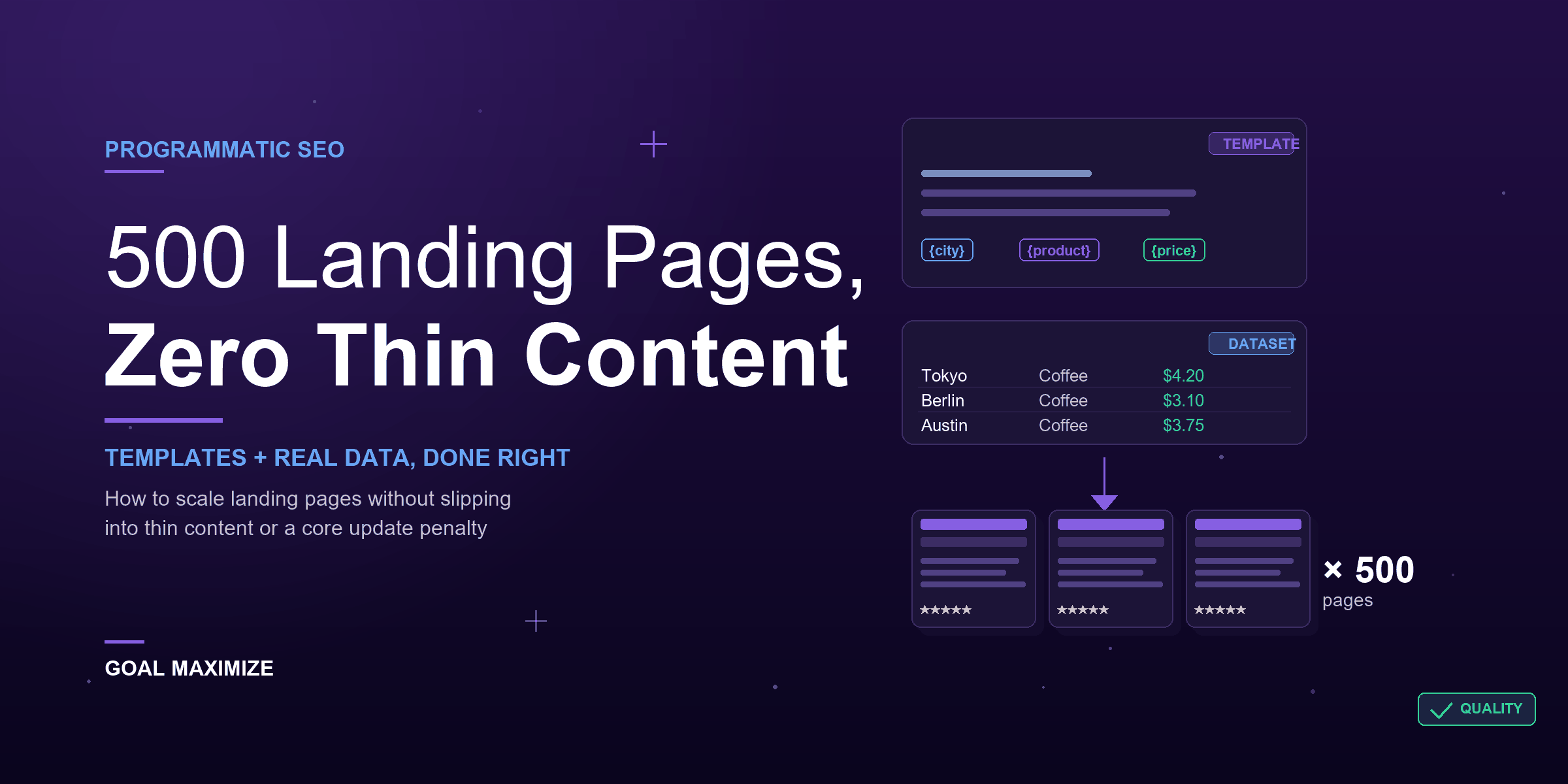
Programmatic SEO is the practice of generating a large number of landing pages from a single template plus a structured dataset. Instead of writing 500 articles by hand, you write one template with variables such as city, product, use case, or price band, and let the data populate the rest.
The technique is not new. Yelp, TripAdvisor, and Zillow have used it for over a decade. What changed in the last 3 years is the accessibility. Airtable plus Webflow plus a 30 dollar CMS plugin now lets a solo founder ship what used to require an engineering team.
That accessibility is also the reason programmatic SEO earned a bad reputation. The tooling made it easy to publish thin, duplicative pages that answered no real search intent. Google noticed. The Helpful Content Update in 2022, the March 2024 core update, and every update since have all penalized sites where scale outran substance.
Done well, programmatic SEO captures a class of search demand that manual content cannot economically reach. Long tail queries with strong intent and low volume per query, but massive volume in aggregate.
The examples worth studying
Three sites explain the range of what programmatic SEO can do when the data is real.
Zapier built landing pages for every possible app pairing in its integration directory. Search Slack to Notion integration and Zapier ranks because it has a page that literally answers that query with a working integration. The data, meaning which apps connect to which, is real, unique to Zapier, and useful to the searcher.
Nomad List generates city pages for remote workers, populated with cost of living, internet speed, weather, and safety data pulled from multiple sources and updated continuously. The template is the same. The data behind each page is genuinely different and genuinely researched.
Wise, the money transfer service, publishes currency conversion pages that rank for USD to EUR and thousands of similar queries. The page ships with a live rate, historical charts, fees, and a comparison to bank margins. Again, the data is proprietary and dynamic.
The pattern across all 3 is simple. The dataset itself is the product. The template is a way to publish it at scale, not a way to fake depth that does not exist.
Where the data comes from
The single biggest predictor of whether a programmatic SEO project will work is the dataset. Not the template. Not the writing. The data.
Good sources look like this. Your own database (product catalog, user reviews, transaction data, integration list). Public APIs (weather, currency, government data, sports scores). Licensed datasets (business listings, patent filings, real estate). Scraped and cleaned public information where the terms allow it and you have added meaningful processing on top.
Bad sources look like this. A single spreadsheet you built in an afternoon by asking a language model for 50 cities and their average rent. That is not data. That is a plausible looking list, and Google can tell the difference because so can any reader who spot checks 2 rows.
The test for a dataset is one question. Could a competitor recreate this in an hour with the same tools? If yes, you do not have a data moat and programmatic SEO will not save the pages from being commodity content. If no, and if the data actually answers what someone searched for, you have the raw material for pages worth ranking.
Aim for at least 3 unique data points per page that a searcher could not easily assemble themselves. Below that threshold you drift into thin content territory fast.
For a broader view of how organic search economics stack up against paid, our SEO vs PPC breakdown walks through why the compounding math on organic favors this kind of investment when the dataset holds up.
Template design that does not read like a template
Once the data is real, the template has one job. Present it in a way that answers the specific query without feeling formulaic.
The failure mode is the mad libs template. The best X in Y is important because X helps you Z. Two paragraphs of filler, a table of the data, another paragraph of filler. Every page reads identical. Google clusters them into a duplicate content bucket and ranks none of them.
The working pattern uses conditional logic. If population is above 1 million, show the neighborhood breakdown block. If the currency pair includes USD, show the Federal Reserve rate context. If the integration involves a project management tool, show the workflow example instead of the data sync example.
You are still using a template. You are just letting the shape of the page respond to what the data says. A visitor who lands on the Tokyo page and the Boise page should see meaningfully different pages, not the same page with 2 words swapped.
Titles and meta descriptions should also pull from the data, not just concatenate variables. USD to EUR exchange rate today beats Convert USD to EUR ExampleSite every time. And schema markup should be per page and populated from the actual data, not a boilerplate Article block copied across all 500 URLs.
Quality safeguards that keep 500 pages out of thin content territory
Before you ship, run these checks. They are the difference between programmatic SEO that compounds and programmatic SEO that gets buried.
Minimum content threshold. Pages with fewer than 300 words of substantive content (data does count, filler does not) rarely rank in 2026. Set a floor and drop pages that cannot clear it. It is better to launch 180 strong pages than 500 mediocre ones.
Uniqueness score. Run every generated page through a similarity checker against every other generated page. Anything above 70 percent similarity is a signal you are shipping near duplicates. Rework the template until the score drops.
Manual spot check. Review a random 5 percent sample of the generated pages by hand. If any of them make you wince, the whole batch has the same problem. Fix the template and regenerate.
Indexation staging. Do not submit all 500 URLs at once. Ship 20, watch how Google indexes and ranks them for 3 weeks, then scale. If the first 20 struggle, the next 480 will struggle harder and you will have poisoned the site crawl budget in the process.
Ongoing freshness. A currency page with a rate from 6 months ago is a dead page. Build the update pipeline before you build the template. If the data cannot stay current, the pages cannot stay ranked.
This is also why we always recommend pairing programmatic pages with a strong editorial layer. Our post on why Google rewards real expertise over mass publishing covers the flip side, and the 2 approaches work best together, not as substitutes.
When NOT to use programmatic SEO
Programmatic SEO is the wrong tool in more cases than the sales pitch suggests.
Skip it when the underlying dataset is small or static. If you have 30 rows and no plan to grow them, write 30 real articles instead. The overhead of building a template pipeline for a small corpus is never worth it.
Skip it when the query intent needs judgment, not data. Best CRM for a 12 person consulting firm is not answered by concatenating firmographic data. It is answered by someone who has actually implemented 3 CRMs and can weigh the tradeoffs. That is a manual article, and the content marketing case for depth over volume applies directly.
Skip it when you do not have technical resources to maintain the pipeline. Programmatic SEO is infrastructure. It needs monitoring, error handling, and someone to fix the template when a data source changes format. If nobody on the team owns it, it will rot.
Skip it in regulated niches such as medical, legal, and financial advice unless you can pair every page with a qualified reviewer. Google YMYL guidelines make thin programmatic content in those verticals a fast route to invisibility.
And skip it when what you actually need is 10 pieces of genuinely useful content. Most sites we audit do not have a programmatic SEO opportunity. They have a content strategy problem that another 500 URLs will not solve.
Closing thoughts
Programmatic SEO is a legitimate technique with a specific set of preconditions. You need a real dataset, a template that respects the data, quality safeguards that catch the failure modes early, and the discipline to say no when the fit is not there. Most of the horror stories come from teams that had none of those and shipped anyway.
If you are sitting on structured data that could power a scaled content play, and you want a second opinion on whether the opportunity is real before you invest in the build, this is exactly the kind of engagement we take on.
For the full framework this post fits into, start with our SEO Growth Playbook. When you are ready to talk specifics about your dataset and market, our SEO services team can pressure test the plan before you write a single template.
