To choose a mobile app development company, check 5 things before you sign: proof of past work, the people who will build your app, how they price and run the project, who owns the code and what happens after launch. Most vendor lists skip the last two. Below are 12 questions to ask, red flags to watch for, contract terms that protect you and a way to test a vendor first. If you are still deciding whether to build, read our mobile app development guide.
Short answer: shortlist 3 vendors, ask all of them the same 12 questions, verify the portfolio by speaking to past clients, insist on a written IP assignment and source code access, and run a paid discovery sprint with your top pick before signing the full contract. Last reviewed: 15 November 2026.
Before you start: what to define internally
A vague brief produces quotes that cannot be compared. Write down 6 things first:
- The goal: the one outcome the app must deliver and how you will measure it.
- Must-have features: a ranked list, with everything else marked “later”. Our guide to the mobile app requirements document shows how to write it.
- Platforms: iOS, Android or both, and why.
- Budget range: a ceiling you can state, informed by our app cost guide.
- Decision-maker: 1 person who can approve each stage.
- Deadline: a real date, such as a campaign or funding milestone, or “none”.
12 questions to ask before you sign
Ask every vendor the same questions in the same order. The same logic works for any agency, as in our guide to choosing a digital marketing agency. The good answers and red flags below are our own judgment from the buyer’s side, not an industry standard.
Portfolio and references
Q1. Can you show 3 shipped apps similar to mine?
- Good answer: Live store links, a clear account of what the vendor built and which parts the client’s own team built.
- Red flag: Only mockups, screenshots with no store link, or “everything is under NDA”.
Q2. Can I speak to 2 past clients?
- Good answer: Contact details, including 1 project that hit problems and how the vendor handled it.
- Red flag: Written testimonials only, or references who are friends of the founder.
Verify the portfolio yourself in 15 minutes:
- Download each app and use it on your own phone.
- Open the store listing and check the developer name and the update history.
- Ask the client what went wrong and how long fixes took.
- Treat review sites as a start. Clutch says every review goes through an identity and work-history check, and it labels reviews it cannot confirm as “Not Verified” (Clutch help centre, read 15 November 2026). The FTC’s consumer reviews rule, in force since 21 October 2024, bans fake reviews and review suppression (FTC guidance).
Team and who actually builds it
Q3. Who will work on my project, and are they employees or subcontractors?
- Good answer: Named people with roles, seniority and the share of time each will spend on your project.
- Red flag: Senior people in the pitch and unnamed juniors on the build, or subcontractors disclosed late.
Q4. What happens if a key person leaves mid-project?
- Good answer: Code reviews, written documentation and a named backup who already knows the codebase.
- Red flag: “That will not happen”, or all knowledge sitting with 1 developer.
Process and communication
Q5. How will we work together week to week?
- Good answer: Sprints of about 2 weeks, a working build demoed at the end of each, a tracker you can open and a named project manager. A good vendor can map this to the 8 stages in our app development process guide.
- Red flag: No demo until the end, no tracker access or “we will update you when it is ready”.
Q6. How do you test before release?
- Good answer: QA starts during development, covers real iPhones and Android phones and ends in a written test report, as in our app testing and QA service.
- Red flag: Developers test their own work, or QA is an optional extra.
Pricing model (fixed vs time and materials)
| Model | Best when | Main risk | Protect yourself by |
|---|---|---|---|
| Fixed price | Scope is written down and unlikely to change, such as an MVP | Every change becomes a paid change request, and a tight price can tempt a vendor to cut corners | Signing a detailed scope and acceptance criteria |
| Time and materials | Scope will evolve as you learn from users | No natural ceiling on spend | Agreeing a monthly cap and weekly hours reports |
Q7. Which pricing model do you recommend for my project, and why?
- Good answer: A reason tied to how clear your scope is, often a phased mix: a fixed-price discovery, then time and materials with a cap.
- Red flag: A fixed price with no written scope, or hourly work with no estimate at all.
Q8. What exactly is in the estimate, and what is excluded?
- Good answer: An itemised estimate by stage and role, with exclusions listed: third-party fees, design revisions, hosting and store accounts.
- Red flag: A single lump sum, or a price far below the others. Our cost guide shows how hours by role drive the total, so a very low quote usually means missing QA or project management.
IP and code ownership
Q9. Who owns the code, designs and accounts, and when does ownership transfer?
- Good answer: A written assignment of all custom IP to you, source code in a repository you control and accounts in your company’s name.
- Red flag: The vendor keeps the repository, offers only a “licence to use” or publishes under its own developer account.
This matters legally. Under US law, a commissioned work counts as “work made for hire” only if it falls into 1 of 9 listed categories and both sides sign a written agreement saying so (17 U.S.C. 101). Custom software does not obviously fit those categories, and a copyright transfer needs a signed writing (17 U.S.C. 204), so a clear assignment clause is the safer route. This is general information, not legal advice, and the vendor’s country may change the rules.
Accounts matter too. Apple shows the enrolled legal entity as the App Store seller, and organisations need a D-U-N-S Number (Apple enrollment page, read 15 November 2026). If the vendor publishes your app under its account, the vendor is the seller of record.
Security and compliance
Q10. How do you protect user data and meet privacy rules?
- Good answer: Encryption in transit, role-based access, regular dependency updates, a security test before launch for sensitive data and experience with rules in your market, such as GDPR or HIPAA.
- Red flag: “We will add security later”, real customer data used in testing or no experience in your regulated industry.
Ask about store requirements too. Google says every Play app must complete a Data safety form and link a privacy policy, even if it collects no user data (Google Play Help, read 15 November 2026).
Post-launch support and SLA
Q11. What support is included after launch, and what does the SLA say?
- Good answer: A free bug-fix warranty period stated in days, severity levels with written response and fix times and a price for ongoing support, including new iOS and Android releases.
- Red flag: “We are always available” with no written response times. Budget 15% to 20% of the build cost per year for upkeep, an agency rule of thumb from our cost guide, not measured data.
Q12. If we part ways, what do we receive and how fast?
- Good answer: A handover pack with source code, documentation, build scripts and credentials within a set number of days, at no extra fee.
- Red flag: Handover as an undefined paid extra, or a proprietary framework that only the vendor can maintain.
Red flags in proposals
A good proposal contains the written scope, deliverables by stage, named team, milestone timeline, itemised price, payment schedule, exclusions and the IP and support terms. Watch for these warning signs:
- No written scope, so every price is open to argument later.
- No line for QA or project management.
- A price much lower than the other 2 quotes, with no explanation.
- Most of the fee due upfront rather than at approved milestones.
- Guaranteed results, such as downloads or rankings, that no vendor controls.
- A vague IP clause, or none at all.
Contract terms that protect you (IP, source code, exit clause)
Put these in the contract, not in an email. Have a lawyer review the final text, because this table is a checklist, not legal advice.
| Term | What to require | Why it matters |
|---|---|---|
| IP assignment | All custom code, designs and documentation assigned to you in a signed writing | Without it you may only hold a licence |
| Source code access | Repository access from week 1, not only at the end | You can see progress and are never locked out |
| Accounts | Apple, Google, cloud and analytics accounts in your company’s name | You stay the seller of record and keep control |
| Milestone payments | Payments tied to approved deliverables with written acceptance criteria, and a written change-request process | You pay for finished work |
| Warranty | Free fixes for defects for a stated number of days | Early bugs are the vendor’s cost |
| Exit clause | Notice period, payment for work done and a full handover within a set number of days | You can leave without losing the project |
How to test a vendor with a paid discovery sprint
Before signing a large build contract, hire your top pick for a paid discovery sprint. Stages 1 to 3 of our app development process work well here: discovery, requirements, and wireframes. We suggest 2 to 4 weeks and a fixed fee that stays well below 10% of the build budget. That 10% is our rule of thumb.
- Deliverables: a scope document, clickable wireframes, a technical plan, and a phased estimate.
- What you learn: how fast they reply, how sharp their questions are, and how they handle disagreement.
- Your protection: the contract says you own the deliverables and may take them to another vendor.
Scorecard to compare 3 vendors
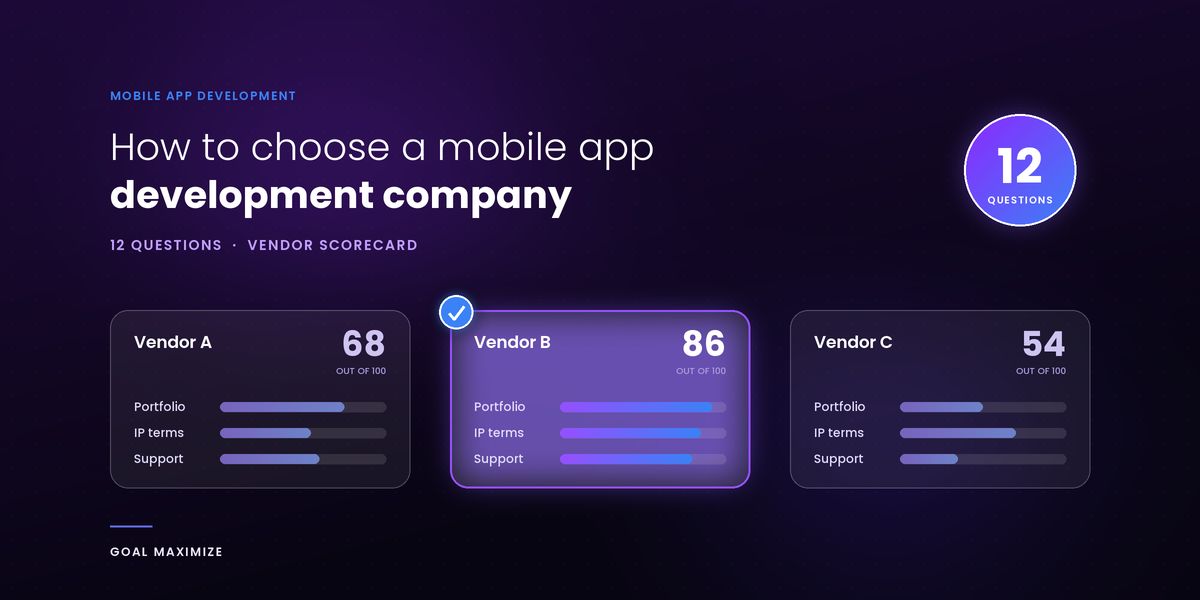
Score each vendor from 1 (poor) to 5 (excellent) per row. Multiply each score by its weight, add the results, and divide by 5 for a total out of 100. The weights are our suggestion. For example, scores of 4, 3, 5, 4, 2, 3, 4 give 72.
| Criteria | Weight | Vendor A | Vendor B | Vendor C |
|---|---|---|---|---|
| Relevant portfolio and verified references | 20 | |||
| Team quality and stability | 15 | |||
| Process and communication | 15 | |||
| Estimate clarity and price | 15 | |||
| IP and contract terms | 15 | |||
| Security and compliance | 10 | |||
| Post-launch support and SLA | 10 | |||
| Total (out of 100) | 100 |
Copy this table into a spreadsheet to score your shortlist. If 2 vendors score within a few points, use the discovery sprint as the tie-breaker.
FAQs
How do I choose an app development company?
Shortlist 3 vendors and ask each the same 12 questions. Verify portfolio claims by downloading the apps and calling past clients, and check that the contract assigns the code to you in writing. Then run a paid discovery sprint with your top pick before signing.
How much should I pay an app development company?
It depends on scope, not on the vendor’s logo. In our illustrative model for a US-based team, a simple app costs $30,000 to $50,000, a medium app $105,000 to $165,000 and a complex app $265,000 to $430,000 or more. Those are planning figures, not quotes. See the full breakdown in our app cost guide, then compare itemised proposals rather than totals.
Should I hire a freelancer or an agency?
In our view, a freelancer suits a small, well-defined build that you can manage yourself. An agency suits a larger app because design, development, QA and project management come as one team, and the project survives if one person leaves. The trade-off is price. The IP, source code and exit terms in this guide apply to both.
What contract terms matter most?
Four matter most: a signed assignment of all IP to you, source code and store accounts in your name, milestone payments tied to written acceptance criteria and an exit clause that guarantees a full handover. Have a lawyer review the final contract.
Next step: write your brief, shortlist 3 vendors and send each the same 12 questions. If you would like us on that shortlist, see our mobile app development services or contact the team and ask us all 12.

Shalini Thakur is the Marketing Head at Goal Maximize with 10+ years of experience in SEO, content strategy, and AI-powered search optimization. Areas of focus include data-driven marketing strategies, technical SEO, content development, and keeping websites visible as search shifts to AI-generated answers.