
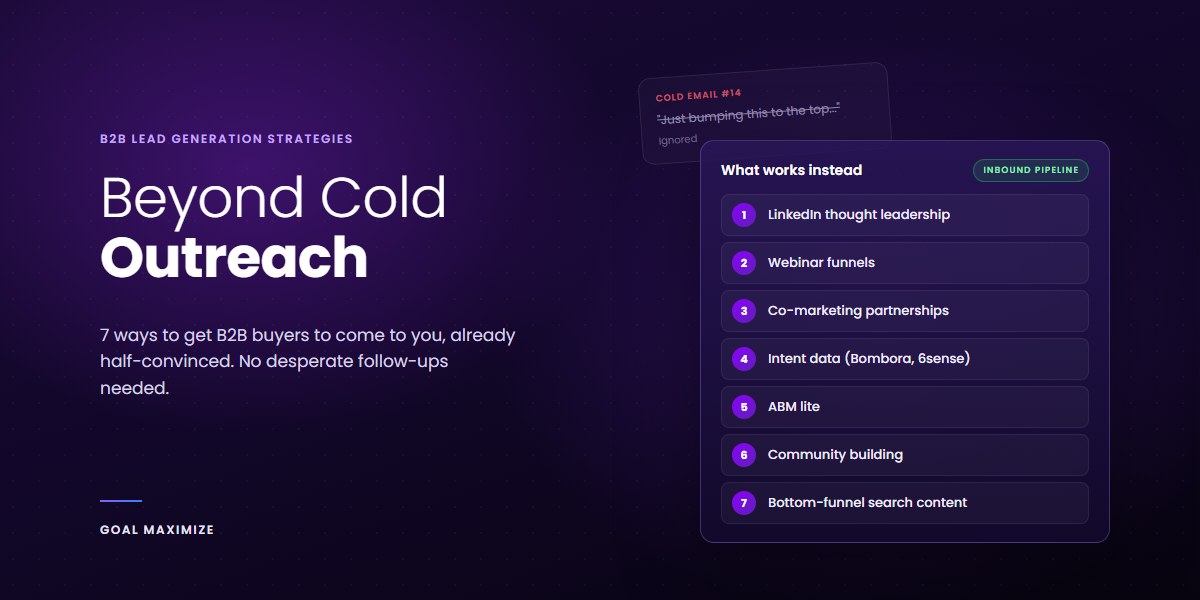
Most B2B inboxes look the same on a Monday morning. 14 cold emails, 6 LinkedIn connection requests that turn into a pitch within the hour, and at least one “just bumping this to the top of your inbox.” Buyers have learned to ignore all of it, and they’re right to.
Cold outreach isn’t dead. It just works best when the person on the other end already knows who you are. The B2B lead generation strategies below are about building that recognition first, so that when you do reach out, it feels like a follow-up and not an interruption.
This post is part of our lead generation playbook, which maps out the full system. Here we zoom in on 7 tactics that bring B2B buyers to you.
Why Chasing Buyers Stopped Working
B2B buyers do most of their homework before they ever talk to you. In the 6sense 2025 B2B Buyer Experience Report, buyers started 79% of their conversations with sellers. By that point they were about 61% of the way through their buying process, and the winning vendor was already on their “Day One” shortlist 95% of the time.
Read that last number again. In most deals, the shortlist is decided before your sales team is invited in. If your company wasn’t visible during that quiet research phase, a well-written cold email won’t fix it.
So the job of B2B demand generation has changed. It’s less about finding people who are ready to buy today, and more about being the obvious name when they are.
1. LinkedIn Thought Leadership That People Actually Read
Posting company news on your LinkedIn page is not thought leadership. Thought leadership is a person with a real opinion, sharing what they’ve learned from doing the work.
It pays off. According to the 2024 Edelman and LinkedIn B2B Thought Leadership Impact Report, 73% of B2B buyers say a company’s thought leadership is a more trustworthy way to judge its capabilities than its marketing materials and product sheets. 90% say they’re more likely to respond to outreach from companies that consistently publish high-quality thought leadership.
That second number is the key one. Thought leadership doesn’t replace outreach. It makes outreach work.
How to do it without it taking over your week:
- Pick one or two people to post, usually a founder and a senior practitioner. Personal profiles usually get more reach than company pages.
- Post 2 to 3 times a week about specific problems your buyers face. “3 reasons your CRM data is lying to you” beats “Excited to announce our new feature.”
- Share numbers from real projects, lessons from deals you lost, and opinions your competitors won’t say out loud.
- Spend 15 minutes a day commenting thoughtfully on posts by people in your target accounts.
Our social media marketing team often ghostwrites from recorded interviews, which keeps the voice real while saving the executive’s time.
[EXAMPLE TO CONFIRM – delete before publishing] Add one anonymised result from a client, for example: “A [industry] founder posted 3 times a week for [X] months and booked [Y] sales calls from LinkedIn.” Use a real figure or remove this line.
2. Webinar Funnels That Do the Selling for You
A good webinar does something an eBook can’t. It puts your expertise in front of a buyer for 45 minutes, live, and lets them ask questions. People who sit through that are far warmer than people who downloaded a PDF and never opened it.
- Before: a short registration page with one clear promise, plus 3 reminder emails. Our list of 12 landing page fixes applies to registration pages too.
- During: teach, don’t pitch. Save 5 minutes at the end for one specific offer, like a free audit or a working session.
- After: send the recording within 24 hours, then split follow-up by behaviour. Attendees who asked a question get a personal email. No-shows get the replay and a shorter sequence.
That post-webinar sequence is where most of the pipeline comes from, and it’s a perfect job for an automated sales funnel.
[EXAMPLE TO CONFIRM – delete before publishing] Add one real webinar result, for example: “One webinar with [X] registrants and [Y] attendees led to [Z] booked calls within 30 days.” Use a real figure or remove this line.
3. Co-Marketing With Companies Your Buyers Already Trust
Somewhere out there is a company that sells to exactly the same people you do, but doesn’t compete with you. A payroll software firm and an HR consultancy. A cybersecurity vendor and a managed IT provider. Those companies have already earned the trust you’re trying to build.
Co-marketing lets you borrow some of it. Common formats include:
- A joint webinar where each partner invites its own list
- A co-authored report or benchmark study
- Guest spots on each other’s newsletters or podcasts
The rule that makes it work: both sides must bring a similar-sized audience and agree in writing on how leads get shared. Unclear lead ownership kills more partnerships than poor results do.
4. Intent Data: Knowing Who’s Researching Right Now
Remember that silent research phase? Intent data platforms try to make it visible. Tools like Bombora and 6sense track which companies are reading a lot about topics related to what you sell, then flag them as “surging” or in-market.
Bombora builds its signals from a cooperative of B2B publisher websites that share content consumption data. 6sense combines third-party intent with signals from your own website and CRM to predict which buying stage an account has reached. Both report at the company level, not the individual level.
Here’s where teams go wrong. They see a spike and fire off the same cold email they were already sending. The better move is to use the signal to change the message:
- If an account is researching “SOC 2 compliance,” send content about SOC 2, not your general brochure.
- Raise ad spend on surging accounts and cut it on cold ones.
- Give sales a short weekly list of 10 to 20 accounts to prioritise, with the topics each one is reading about.
Intent data is the most expensive option on this list, so it’s usually worth it once you have a defined target account list and a sales team with spare capacity. It also comes with privacy rules you need to respect, which we cover in our guide to data privacy for digital marketers.
5. ABM Lite for Teams Without an Enterprise Budget
Full account-based marketing can mean custom microsites, direct mail and a dedicated team for each account. That’s out of reach for most mid-sized companies. ABM lite keeps the core idea, focusing on a short list of accounts that fit, and drops the expensive parts.
A simple version looks like this:
- Pick 25 to 50 accounts that match your best existing customers by industry, size and problem.
- Map 3 to 5 people in each account: the decision-maker, the day-to-day user and whoever controls budget.
- Run LinkedIn ads targeted only to those companies, using a matched audience list.
- Build one page per industry, not per account, with examples and case studies they’ll recognise.
- Coordinate sales and marketing weekly so outreach lands after accounts have seen your content.
It’s slower than spraying 5,000 contacts, but every account on the list is a good fit, so the sales calls start warmer. Paid ads make up a large part of this approach, so our PPC advertising team usually runs the LinkedIn targeting side.
[EXAMPLE TO CONFIRM – delete before publishing] Add one anonymised ABM result, for example: “We ran ABM lite for [X] target accounts and [Y] agreed to a first meeting within [Z] weeks.” Use a real figure or remove this line.
6. Community Building: The Long Game That Compounds
A community is a place where your buyers talk to each other, and you happen to host it. It could be a Slack group for operations leaders, a monthly roundtable for CFOs in your city, or a private LinkedIn group for people who use a certain tool.
This is the slowest strategy on the list. It’s also the hardest for a competitor to copy, because you can’t buy trust that took 2 years to build. What keeps a community alive:
- A narrow focus. “Marketing leaders” is too broad. “Marketing leaders at SaaS companies under 200 staff” gives people a reason to join.
- A regular rhythm, like a monthly call or a weekly discussion thread, so people know when to show up.
- A strict no-pitch rule. The moment members feel sold to, they leave.
Leads come from the community indirectly. Members ask for recommendations, see your team answering hard questions, and reach out when they’re ready.
7. Search Content That Answers Buying Questions
Your buyers Google things like “best ERP for manufacturing,” “X vs Y pricing” and “how long does implementation take” during the first 60% or so of the journey, the part they spend alone. If your content answers those questions honestly, you’re in the room when the shortlist gets made.
Focus on bottom-of-funnel topics first: comparisons, pricing explainers, implementation guides and case studies. These pages get less traffic than broad “what is” articles, but the readers are much closer to a decision. Our guide to building an SEO content funnel that sells walks through how to plan these pages, and how to add a lead magnet that people will actually download once readers arrive.
Which B2B Lead Generation Strategies Should You Start With?
Don’t try all 7 at once. Pick 2 that fit your budget and the time you can give them, and run them properly for at least one quarter.
| Strategy | Cost | Time to first leads | Best for |
|---|---|---|---|
| LinkedIn thought leadership | Low | 1 to 3 months | Founder-led and service businesses |
| Webinar funnels | Low to medium | 1 to 2 months | Complex or technical offers |
| Co-marketing | Low | 1 to 3 months | Companies with an obvious partner |
| Intent data | High | Weeks | Teams with a set account list |
| ABM lite | Medium | 2 to 4 months | High-value deals |
| Community building | Low to medium | 6 months or more | Niche markets |
| Bottom-funnel search content | Medium | 3 to 6 months | Any company with buyers who research online |
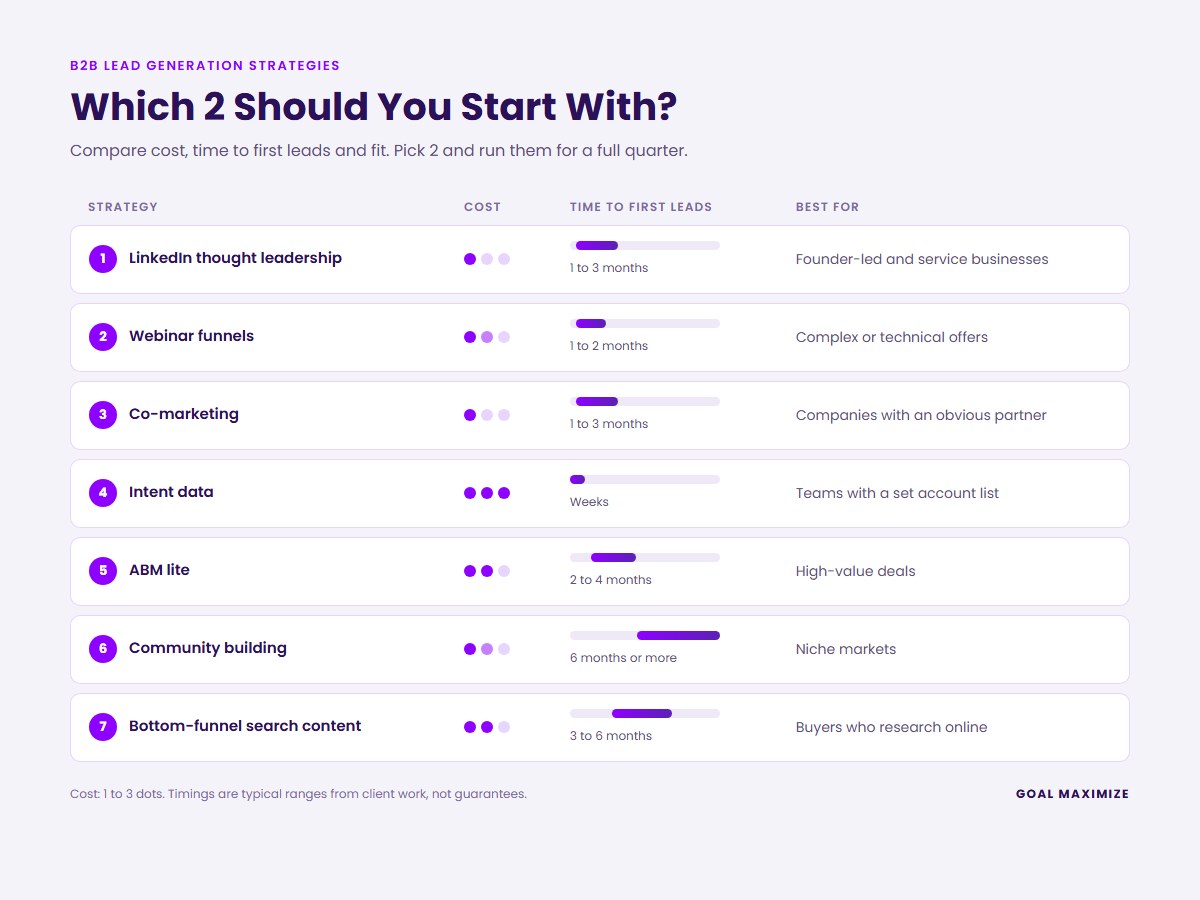
A pairing we see work well for smaller teams is LinkedIn thought leadership plus a webinar funnel. The posts build an audience, and the webinar turns that audience into conversations. Teams with bigger budgets often pair intent data with ABM lite, since one tells you who to target and the other tells you how.
Whatever you pick, decide how you’ll measure it before you start. Track meetings booked and pipeline created, not likes or registrations. Our post on digital marketing KPIs lists the numbers that matter.
Doing It Yourself vs Getting an Execution Partner
None of these strategies are secrets, and if you have a named owner and a few spare hours every week, running one or two in-house is realistic. The hard part is keeping them going for 6 months while also running your business. That’s usually where in-house efforts stall. The founder posts for 3 weeks, the second webinar never happens, and the intent data dashboard goes unchecked.
That’s the gap our B2B lead generation services fill. We handle the execution: ghostwriting LinkedIn content, building webinar funnels and follow-up sequences, setting up ABM lite campaigns, and reporting on pipeline instead of vanity metrics.
If you’re comparing partners, use our checklist on how to choose a digital marketing agency. Ask every agency, including us, those 10 questions before you sign.
B2B Lead Generation FAQs
What is the most effective B2B lead generation strategy?
There isn’t one winner for every company. For most mid-sized B2B firms, a mix of LinkedIn thought leadership and bottom-funnel search content gives the best return over time, because the content keeps working long after you publish it.
Is cold outreach still worth doing in B2B?
Yes, as long as it isn’t your only channel. Outreach works much better when the prospect has already seen your content, attended your webinar or been flagged by intent data. Use it as a follow-up, not a first impression.
How long does it take to generate B2B leads with these tactics?
Intent data can produce conversations within weeks, and webinars within 1 to 2 months. LinkedIn thought leadership typically brings first leads in 1 to 3 months, while search content usually takes 3 to 6 months to build momentum. Community building takes the longest but tends to produce the most loyal customers.
What is the difference between lead generation and demand generation?
Lead generation captures contact details from people who show interest, so sales can follow up. Demand generation builds awareness and trust so more of the right buyers want to talk to you in the first place. Most of the tactics in this post do both.
Which B2B lead generation strategy suits a small budget?
Start with LinkedIn thought leadership and bottom-funnel search content. Both rely more on time and expertise than on ad spend. Add a webinar once you have an audience to invite, and leave intent data until you have a defined account list and the budget to act on it.
Stop Chasing. Start Being Found.
The best B2B marketing strategies have one thing in common. They make the buyer come to you, already half-convinced, so reaching out never has to feel desperate. Pick 2 tactics from this list, give them a full quarter, and measure the meetings they create.
If you’d like a second opinion on which 2 fit your business, talk to our B2B lead generation team. Tell us about your pipeline and we’ll look at what you’re doing now and suggest where to start.

**Shalini Thakur** is an SEO Specialist at Goal Maximize with 9+ years of experience in technical SEO, content strategy, and AI-powered search optimization. Specializes in data-driven SEO strategies, website optimization, content development, and adapting websites to the evolving AI-powered search landscape.