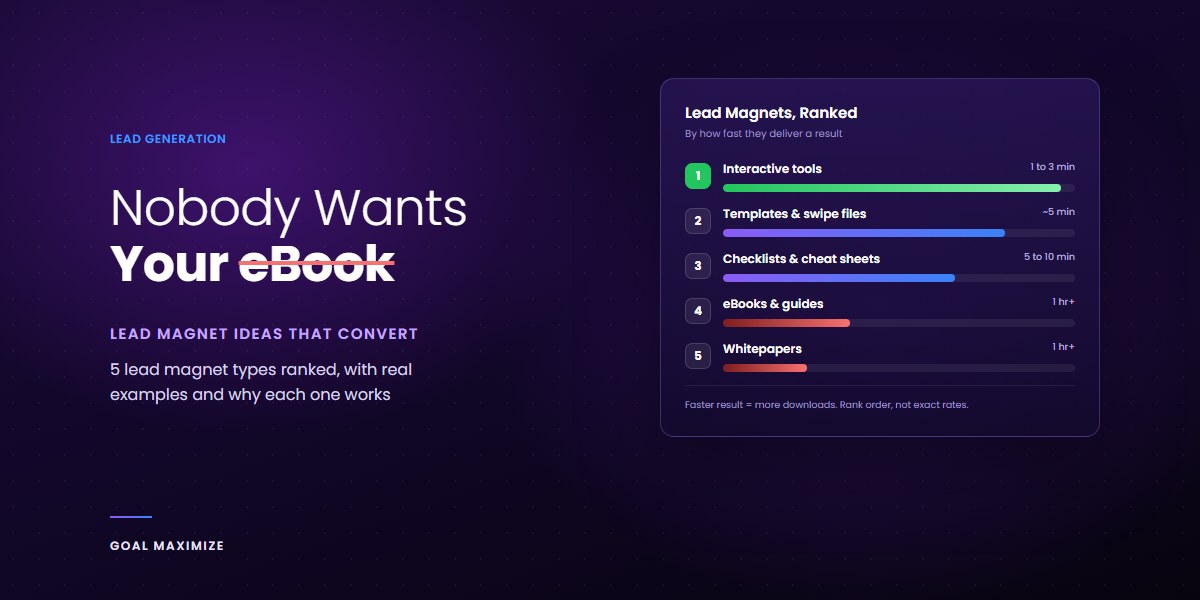
Somewhere on your website there’s probably a 40-page eBook with a nice cover. Someone spent weeks writing it, the designer made it look sharp, and it gets about 6 downloads a month.
Your audience still wants help. What they don’t want is homework. A visitor who lands on your page has a problem right now, and an eBook asks them to set aside an afternoon to read about it. The lead magnet ideas that actually get downloaded do the opposite. They solve 1 small, specific problem in a few minutes.
Below we rank 5 types of lead magnets, from the ones that convert best to the ones that convert worst, with real lead magnet examples and the reason each one works. This post is part of our lead generation playbook, which covers the full system for filling your pipeline.
Why Most eBooks Fail as Lead Magnets
An email address is a price. People pay it when the return is quick and obvious. Before you build anything, run your idea through 3 questions:
- Is it specific? 1 problem, 1 type of reader. “The Complete Guide to Marketing” fails. “A 12-Point Audit for Your Google Business Profile” passes.
- Is it fast? Can someone get value from it in under 10 minutes?
- Does it give a result? A score, a finished document, a decision. Information alone is easy to find for free.
Most eBooks fail all 3. They’re broad, slow to read, and they hand over information the reader could get from a search. That’s the whole reason the format sits near the bottom of our list.
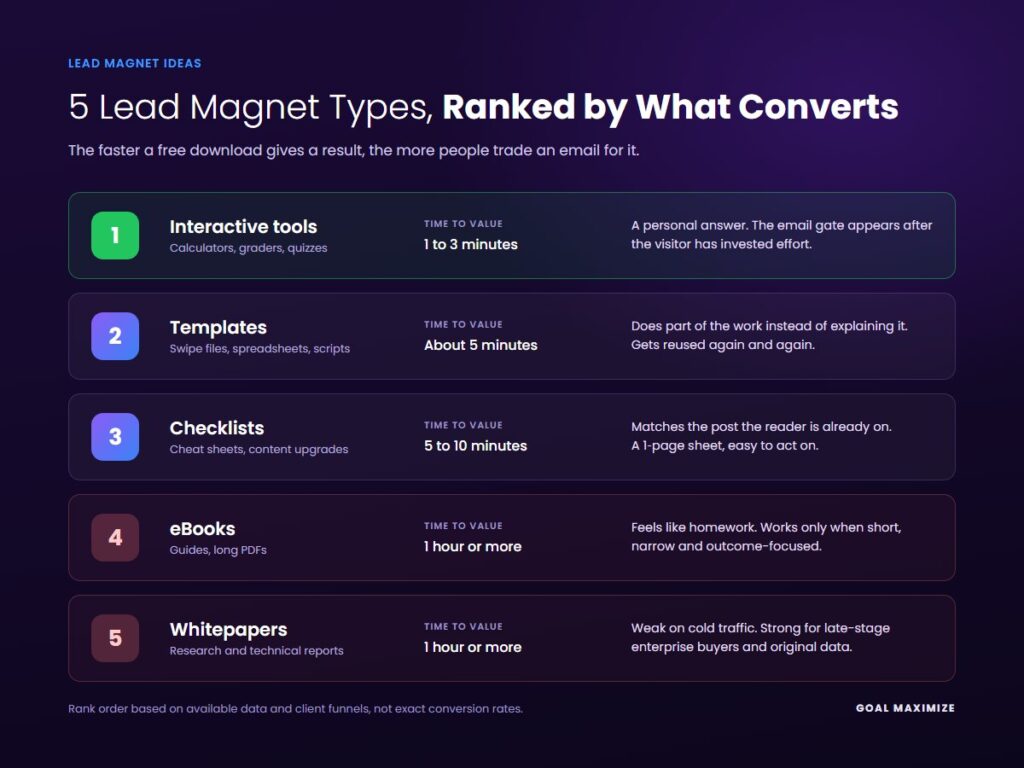
A quick note on the ranking. No public study tests all 5 formats head-to-head on the same audience. The order below combines the data that does exist with what we’ve seen running lead capture for clients. Treat it as a strong starting point, not a law.
Lead Magnet Ideas Ranked: The Short Version
| Rank | Lead magnet type | Time to value | Best funnel stage |
|---|---|---|---|
| 1 | Interactive tools (calculators, graders, quizzes) | 1 to 3 minutes | Top and middle |
| 2 | Templates and swipe files | About 5 minutes | Middle |
| 3 | Checklists and cheat sheets | 5 to 10 minutes | Top |
| 4 | eBooks and guides | 1 hour or more | Top, if short and narrow |
| 5 | Whitepapers and research reports | 1 hour or more | Bottom, mostly enterprise B2B |
1. Interactive Tools: The Best Lead Magnets for Most Businesses
Calculators, graders, assessments and quizzes are the most high-converting lead magnets we build. They win because they give each visitor an answer about their situation. A PDF says “here’s how websites lose leads.” A grader says “your site loses leads here, here and here.”
There’s a second reason. By the time the email gate appears, the visitor has already typed in their numbers and wants to see the result. Asking for an email at that moment feels fair.
The numbers back this up, with some caveats. Quiz platform Interact’s Quiz Conversion Rate Report puts the average start-to-lead rate at 40.1%, with 65% of people who start a quiz finishing it. That’s vendor data, and it measures people who start the quiz, not every site visitor. Older research points the same way: in a Demand Metric survey, 70% of marketers using interactive content said it converted moderately or very well, against 36% for passive content.
Real examples:
- HubSpot Website Grader. You enter a URL and get a score for performance, SEO, mobile and security. It has fed HubSpot’s funnel for years because every report reveals problems HubSpot sells fixes for.
- ROI and savings calculators. A solar installer showing “your estimated savings over 20 years,” or a SaaS tool showing hours saved per month.
- Readiness quizzes. “Is your business ready for paid ads?” with a score and 3 next steps.
You don’t need developers. Tools like Outgrow and Interact build these without code. Show a partial result for free and ask for the email to send the full report.
2. Templates and Swipe Files
A template doesn’t teach someone how to do the work. It does a chunk of the work for them. That difference is why templates get downloaded far more than guides on the same topic.
They also get reused. A good proposal template gets opened every time the reader sends a proposal, and your logo sits in the footer each time.
Real examples: HubSpot’s free template library (marketing plans, email templates, sales scripts) is gated behind a short form and covers almost every routine marketing task. Smaller ideas that work well: a cold email swipe file, a content calendar spreadsheet, a project quote template for contractors.
1 rule: deliver it in the format people work in. A Google Sheet they can copy, a Canva link or a Word file. A PDF of a template is just a picture of a template.
3. Checklists and Cheat Sheets
Checklists are quick to make, quick to use and easy to say yes to. They work best as a “content upgrade”: a downloadable version of the blog post the reader is already halfway through. Brian Dean of Backlinko made this tactic popular, and it still works because the offer matches exactly what the reader came for.
Examples: a post on landing page fixes that doubled conversions offering a 1-page audit checklist, or an ecommerce pre-launch checklist turned into a printable sign-off sheet.
The common mistake is pasting the article’s subheadings into a PDF and calling it a checklist. Give it something the post doesn’t have: tick boxes, a priority order, or a score at the end.
4. eBooks: When They Still Work
eBooks aren’t dead. They’re overused and usually too long. They still work in 3 situations:
- The buyer is making a big, considered purchase and wants to research properly.
- The eBook is short (10 to 15 pages) and the title promises 1 outcome.
- Your brand already has enough trust that people want your full point of view.
If you already have an eBook nobody downloads, don’t delete it. Break it apart. Chapter 2 becomes a checklist, chapter 4 becomes a template, and the rest becomes a 5-day email course. Same work, 3 lead magnets that people actually want.
5. Whitepapers: Save Them for Late-Stage B2B
Whitepapers convert worst on cold traffic, but they have a real job. Enterprise buyers often need a document they can forward to finance, IT or legal to justify a purchase. For that reader, a dense whitepaper is exactly right.
The exception is original research. A benchmark report built on your own data gets downloads and gets cited by other sites, which makes it one of the link building strategies worth your time. If you have data nobody else has, publish the headline findings openly and gate the full report.
How to Get Your Lead Magnet Downloaded, Not Just Built
A great lead magnet on a weak page still fails. 4 things decide how many people download it.
Keep the form short
For a top-of-funnel offer, ask for an email and nothing else. Every extra field costs you downloads. Save the company size and phone number questions for later in the relationship.
Put it where the traffic already is
The best place for a free download is inside blog posts that already rank, matched to the topic of each post. That’s why content marketing beats traditional advertising for long-term growth: every useful post becomes a steady entry point for leads. Our guide to building an SEO content funnel shows how to map offers to each stage.
Follow up within minutes
Send the download by email straight away, then follow with 3 to 5 emails that move the reader toward a call or a trial. Email is still the highest-ROI channel for this stage, and an automated sales funnel runs that sequence without anyone touching it.
Measure the right numbers
Downloads are a vanity metric on their own. Track the landing page conversion rate and how many of those leads become customers. If 1 offer gets half the downloads of another but twice the sales calls, it’s the better offer. Our conversion rate optimization guide covers how to test pages and offers properly.
Lead Magnet FAQs
What is the best lead magnet for B2B?
For most B2B companies, an assessment or ROI calculator. It qualifies the lead while capturing it, because the answers tell your sales team how big the problem is.
Should every lead magnet be gated?
No. Gate what is worth paying for with an email, like a personal result, a finished template or a full report. Keep general advice open so it can rank and build trust.
How many lead magnets should a business have?
Start with 1 strong offer for your main service. Once it converts, add content upgrades for your 5 to 10 highest-traffic blog posts.
Pick 1 and Ship It This Month
You don’t need 5 lead magnets. You need 1 that solves a real problem fast. If you sell a service, build a calculator or assessment. If you publish a lot of content, start with checklists for your top posts. If you have an unloved eBook, break it apart this week.
If you’d rather have the tool, landing page and follow-up emails built for you, our lead generation services team does exactly that. Tell us about your funnel and we’ll suggest the offer most likely to work for your audience.

**Shalini Thakur** is an SEO Specialist at Goal Maximize with 9+ years of experience in technical SEO, content strategy, and AI-powered search optimization. Specializes in data-driven SEO strategies, website optimization, content development, and adapting websites to the evolving AI-powered search landscape.