
You are publishing blog posts. You are getting traffic. Maybe even decent traffic. But when you check your pipeline, it is crickets. No demo requests. No contact form submissions. No revenue attached to any of it.
That is not a traffic problem. That is a funnel problem.
Most businesses treat SEO content like a megaphone: blast information into the void and hope someone converts. But the businesses that actually close deals through organic search do something different. They build an SEO content funnel, a deliberate system that meets people at every stage of their buying journey and moves them toward a decision.
Here is how to build one that works.
Why Most SEO Content Fails to Generate Revenue
The mistake is straightforward. You write content for keywords without thinking about where the reader is in their decision-making process.
Someone searching “what is content marketing” is not ready to buy. Someone searching “content marketing agency pricing” absolutely is. But if every blog post you publish targets that first person (awareness-stage, top-of-funnel queries), you will attract a crowd that has zero intention of purchasing anything today.
This is the disconnect we see with businesses that invest heavily in content but cannot tie a single dollar of revenue to it. Their blog is busy. Their pipeline is empty.
Content marketing works. The data consistently favors it over paid campaigns for long-term growth and compounding returns. But only when each piece has a defined job inside a larger system. A blog post without a funnel role is just noise. A blog post with one is a sales asset. If you are still weighing whether content deserves your budget, the case for content marketing over traditional advertising lays out the numbers.
What an SEO Content Funnel Actually Looks Like
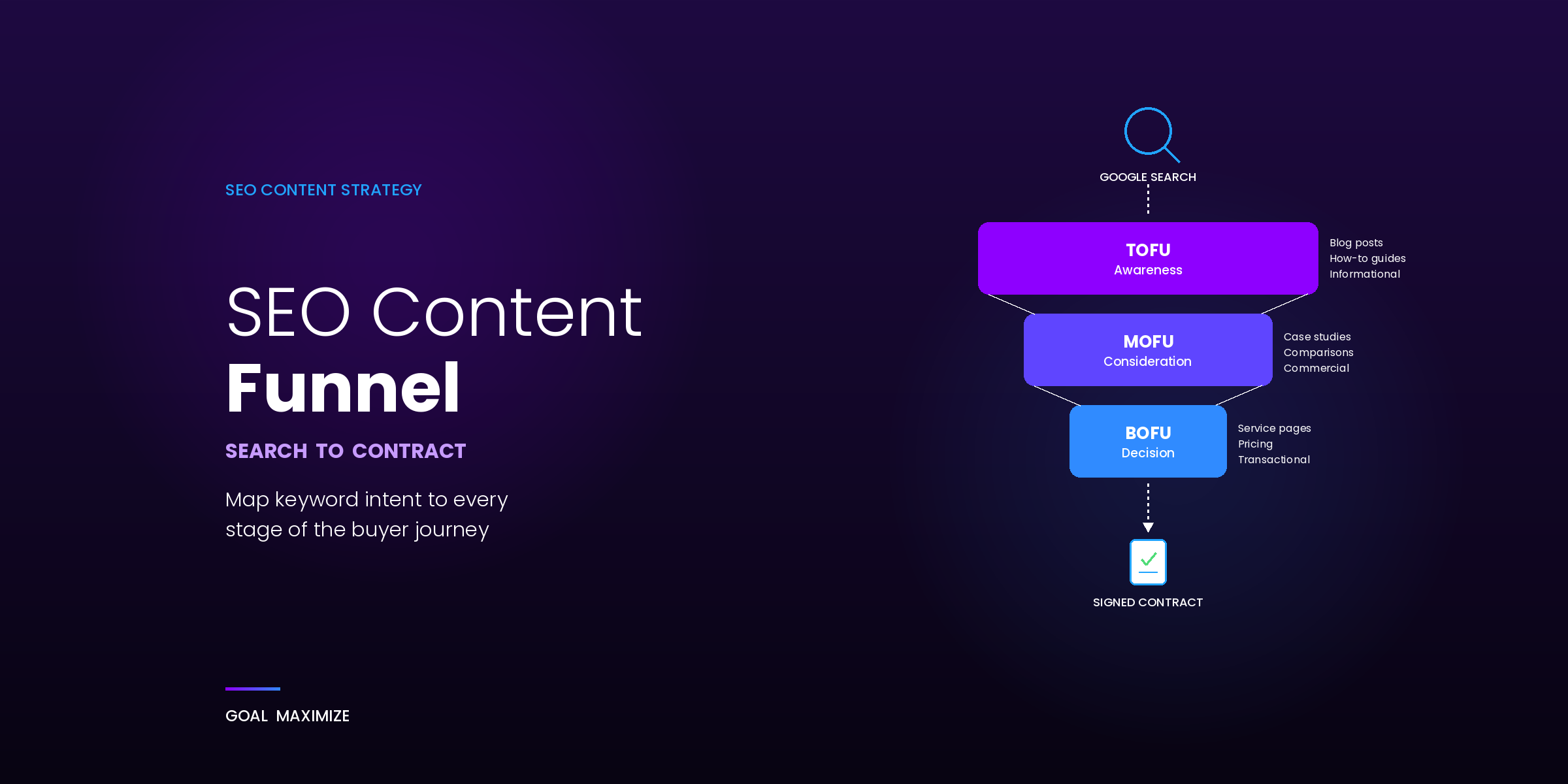
An SEO content funnel maps your content to 3 stages of the buyer’s journey. You have probably heard these called TOFU, MOFU, and BOFU.
Top of Funnel (TOFU) is the Awareness stage. The reader has a question or a pain point. They do not know you exist. They are typing broad, informational queries into Google.
Middle of Funnel (MOFU) is the Consideration stage. The reader understands their problem and is actively evaluating solutions. They are comparing options, reading case studies, and looking for proof that someone can actually solve it.
Bottom of Funnel (BOFU) is the Decision stage. The reader is ready to buy. They are searching for pricing, specific service pages, provider comparisons, or “best [your service] for [their industry]” queries.
The magic is not in any single piece. It is in how they connect. Each stage pulls the reader deeper toward a conversion.
Search Intent to Funnel Stage Mapping
Here is how search intent maps to each funnel stage, including the content types and goals that belong at each level:
| Funnel Stage | Search Intent | Example Queries | Content Types | Goal |
|---|---|---|---|---|
| TOFU (Awareness) | Informational | “what is SEO,” “how does PPC work,” “content marketing basics” | Blog posts, guides, educational videos, infographics | Attract and educate new audiences |
| MOFU (Consideration) | Investigational / Commercial | “SEO vs PPC for ecommerce,” “best CMS for business websites” | Comparison guides, case studies, whitepapers, webinars | Build trust and establish authority |
| BOFU (Decision) | Transactional | “SEO agency pricing,” “hire digital marketing company,” “content marketing services near me” | Service pages, pricing pages, testimonials, consultation offers | Convert and close the deal |
Getting your keyword research right is the foundation here. Bad keyword choices produce content that ranks for the wrong audience at the wrong stage. You end up with traffic that will never convert, and no amount of CTA optimization will fix that.
TOFU Content: Capture Attention, Not Leads
Here is where most businesses get impatient. TOFU content does not convert directly. Its job is to get your brand in front of people who will need you later.
Think “how does X work” and “what is Y” and “beginner’s guide to Z” queries. These are the questions your ideal clients are asking 6 to 12 months before they are ready to sign a contract.
The best TOFU content answers real questions your target audience is actively searching, ranks for high-volume informational keywords, and establishes your expertise on a topic before the reader even considers hiring someone. It creates a natural entry point into your site.
But here is the part most people miss. TOFU content needs a next step. Every awareness-stage piece should include a contextual internal link or a soft CTA that nudges the reader toward a MOFU piece. If someone reads your guide on how SEO works, the natural next step is a comparison of SEO approaches or a checklist they can apply to their own site.
Write your TOFU pieces so they are genuinely useful on their own, but always leave the reader wanting more depth. And make sure every page is properly optimized. Not with keyword stuffing, but with intent-matched on-page SEO that signals relevance to both Google and the human reading it.
MOFU Content: Where Deals Are Actually Won
Middle-of-funnel is where deals are won. Not at the bottom. Not at the top. Right here, during the consideration stage.
By the time someone reaches MOFU, they know they have a problem and they are evaluating solutions. Your content at this stage needs to demonstrate that you understand their specific situation, show proof that your approach works, and differentiate you from every other option they are looking at.
Effective MOFU content types include comparison guides (“WordPress vs Headless CMS” or “SEO vs PPC”), case studies with real numbers and outcomes, industry-specific guides that prove you understand their world, and detailed how-to content that shows your depth beyond surface-level advice.
The reader at this stage is not looking for theory. They want specifics. They want to see that you have done this before for someone like them.
Here is a practical example. If you are a web design agency, a MOFU piece might walk through the exact design principles that turn website visitors into paying customers. That kind of content does double duty: it educates the reader and proves your team knows what it is doing. That is the MOFU sweet spot.
BOFU Content: Closing Without the Hard Sell
Bottom-of-funnel content is where most service businesses underinvest. They have 30 blog posts answering beginner questions and exactly 1 service page with a contact form. That is not a funnel. That is a dead end.
Your BOFU content should include service pages that speak directly to the buyer’s needs (not just a feature list), pricing context that covers ranges, cost factors, and what is included, testimonials and social proof placed at decision points, and consultation or audit offers with low friction to get started.
The search queries at this stage are high-intent and high-value: “hire SEO agency,” “content marketing services pricing,” “digital marketing company for SaaS.” These pages need to rank, but they also need to convert once someone lands on them.
One of the most common mistakes? Treating service pages as afterthoughts. Your BOFU pages deserve as much strategic attention as your blog content. Arguably more, because a single conversion at this stage is worth dozens of TOFU pageviews.
This entire approach fits into a broader SEO strategy. If you want the full picture of how content, technical optimization, and authority-building work together, the SEO Growth Playbook lays out the complete framework.
Connecting the Stages: CTAs, Links, and Email Capture
A funnel with disconnected pieces is not a funnel. It is a pile of content. Here is how you connect the stages into a system.
Internal linking: Every TOFU piece should link to at least 1 relevant MOFU piece. Every MOFU piece should link to your BOFU service page. This is not just good for SEO. It literally guides the reader through your sales process.
Progressive CTAs: Match your calls to action to the stage. TOFU gets “download the checklist” or “read the full guide.” MOFU gets “see the case study” or “compare your options.” BOFU gets “book a consultation” or “get a custom proposal.” A single generic CTA across all your content is leaving conversions on the table.
Email capture: Add lead magnets at the TOFU and MOFU stages. When someone downloads your guide or checklist, you have a direct line to move them through the funnel on your schedule, not Google’s.
Retargeting: Anyone who reads your MOFU content is a warm lead. Set up retargeting to serve them BOFU content or case studies in their social feeds. You paid nothing for the initial visit. The retargeting click is incredibly efficient.
Measuring Your Content Funnel’s Performance
You need different KPIs at each stage. Tracking pageviews on BOFU content or conversion rate on TOFU content will give you misleading signals.
TOFU metrics: organic traffic, keyword rankings, time on page, bounce rate, percentage of new users.
MOFU metrics: return visits, pages per session, email signups, content downloads, scroll depth.
BOFU metrics: conversion rate, form submissions, consultation bookings, cost per acquisition, revenue attributed to organic search.
Track these per stage and you will spot exactly where your funnel leaks. Maybe you are pulling in plenty of awareness traffic but nobody moves to consideration content. Or maybe your MOFU pieces are strong but your service pages are not closing. Knowing where the drop happens tells you where to invest next. For a deeper look at which numbers actually matter across your entire marketing operation, here is a full breakdown of the KPIs every business owner should track.
Build a Funnel That Turns Traffic Into Revenue
The businesses that generate real pipeline from SEO are not guessing. They are mapping content to intent, connecting every piece with purpose, and measuring results at each stage. They treat their blog as a sales system, not a publishing calendar.
If your content is bringing in traffic but your pipeline is still empty, the problem is not your writing. It is your architecture. An SEO content funnel fixes that by giving every page a role and every reader a path forward.
Ready to stop publishing into the void? Our content marketing team builds SEO content funnels that turn organic search into signed contracts. Let’s build yours.

**Shalini Thakur** is an SEO Specialist at Goal Maximize with 9+ years of experience in technical SEO, content strategy, and AI-powered search optimization. Specializes in data-driven SEO strategies, website optimization, content development, and adapting websites to the evolving AI-powered search landscape.